My Blog List

Showing posts with label mullein. Show all posts

Tuesday, April 27, 2021

SPRING IN THE SUNKEN GARDEN

 The area between the house and the pool was a blank canvas and perfect to create a sunken garden. The inspiration was partly inspired by the many sunken gardens I have visited in England, my grandfather's garden where I spent my teenage years and the sunken courtyard at the Lady Bird Johnson Wildflower Center. Many of the rocks dug up during the building of the house were saved in order to create a foundation wall around the sunken area. The floor is Arizona sandstone over decomposed granite. I'm sure the builder was happy not to have to cart those rocks away. Nature has done much of the planting and I am happy for that although it does create considerable work keeping it under control. But, both David and I delight in all the blooms that appear-as if from nowhere. The scene changes from week to week and from year to year. Spring is the most floriferous time.
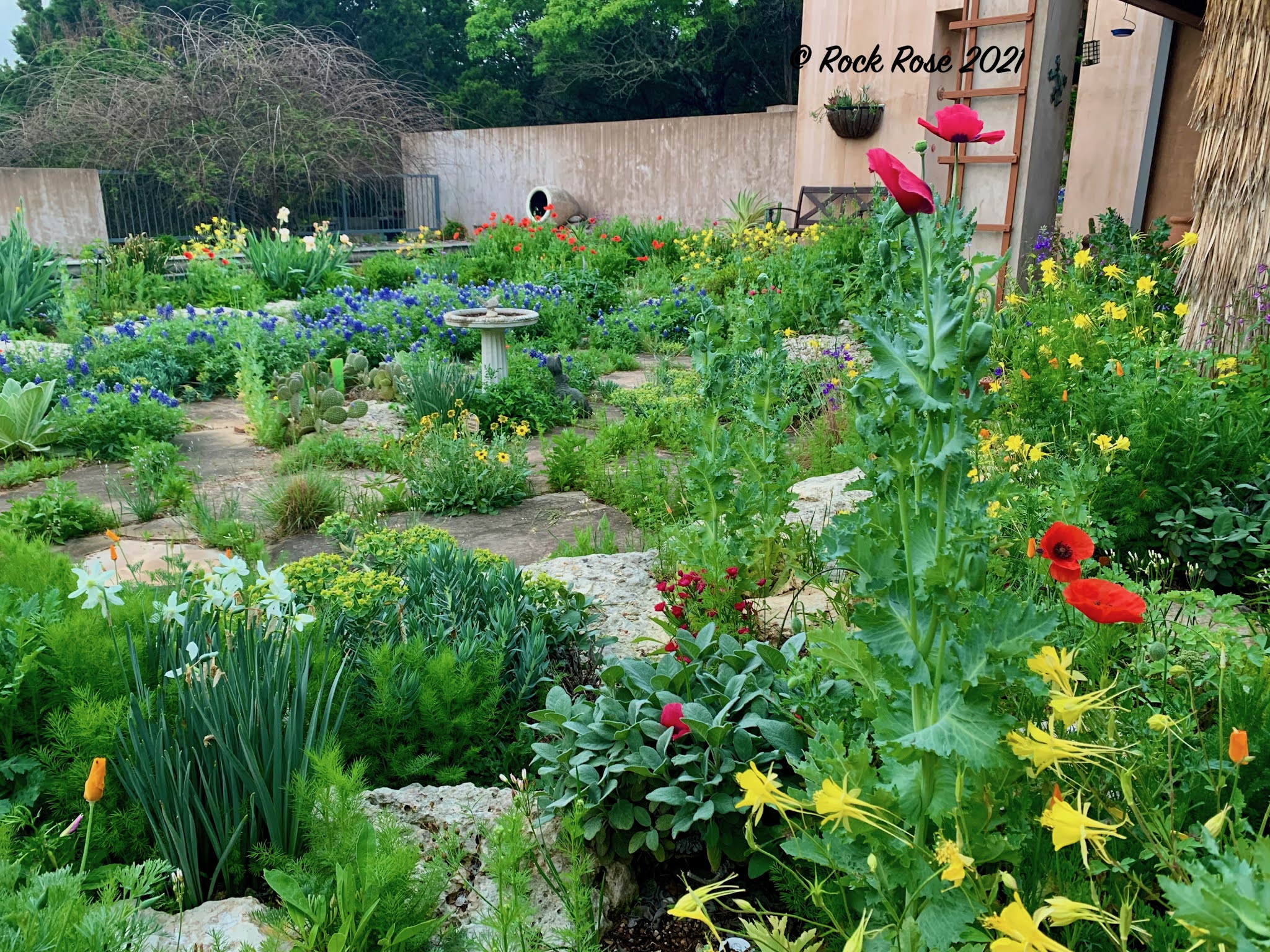
The only step down is along the front and even here it requires some agility as a Gulf Coast penstemon, Penstemon tennuis, has seeded right in the middle of the two stones. How could I possibly pull it when it was so happy there. I love this penstemon but it is prone to root aphids, placed there by ants who farm its honeydew. They are not easy to control and will kill the plant.

A few plants have been with me since the beginning and one is the chocolate daisy, Berlandiera lyrata

Compact in the early weeks it does eventually become rather rangy. It has only seeded in one other place and I suspect this is because I usually cut it back part way through the season and the new seed heads may not have time to mature. 

Mullein, may be considered a weed by many but I love its beautiful form over the winter before sending up a tall flower spike with yellow flowers. It is also a favorite of the bees. Many may seed but only a few will be chosen. This was a lucky one on the lower level.


In early spring bluebonnets can really take over and I'm afraid this year I have let rather too many and some of the plants growing beneath have suffered. A single bluebonnet plant can spread to cover 3' and is better suited to a meadow setting.


Hinckley's yellow columbine. Here there and everywhere as usual.


 It is always interesting to watch how plants grow and move. A large cluster of bee balm was gradually evicted by this yellow iris, so that now there are only a few plants left. Time for the iris to be divided and passed along nd maybe the bee balm will move back in.


 I always let the corn poppies grow wherever they wish. Easy to pull out and something will always take their place later.
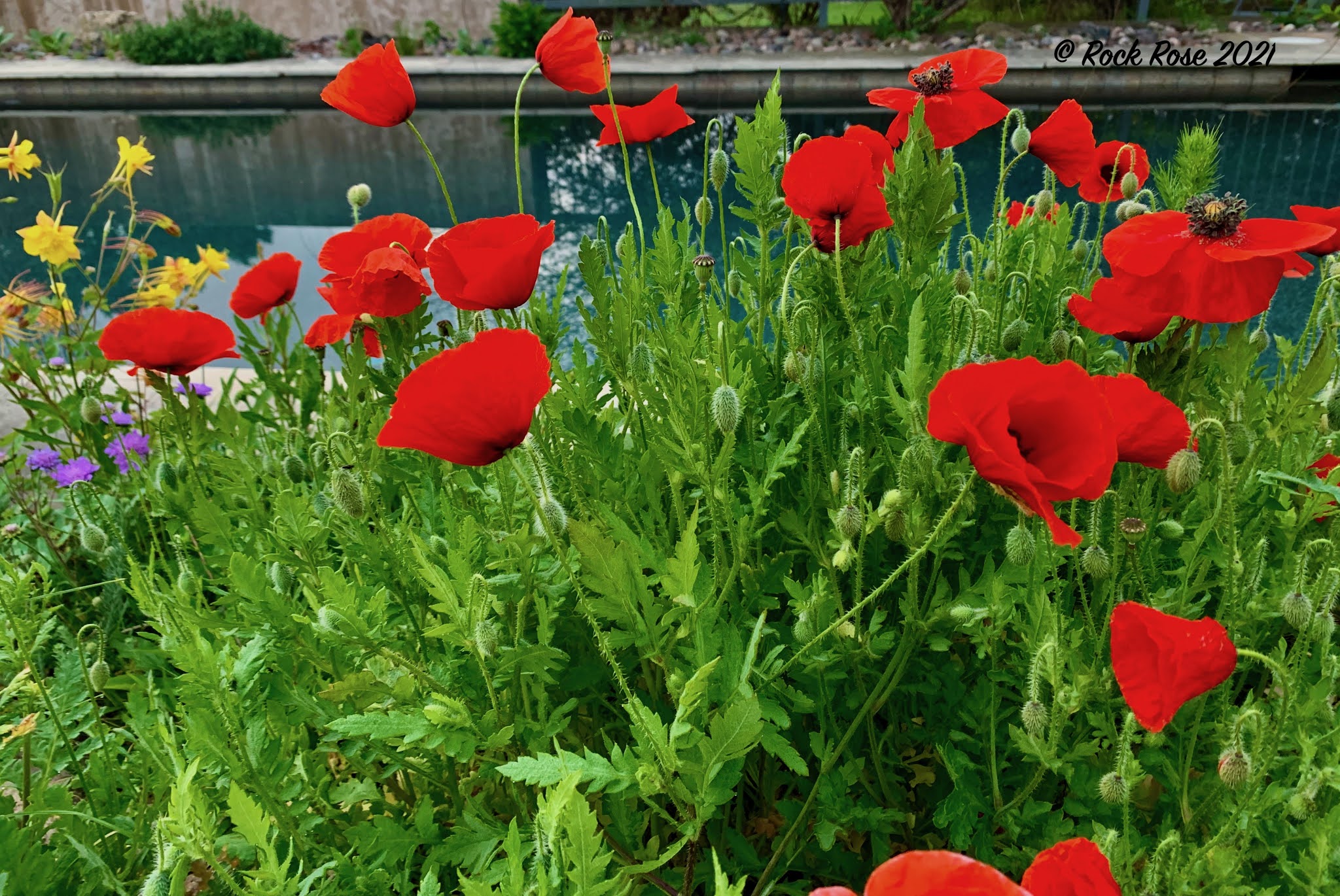
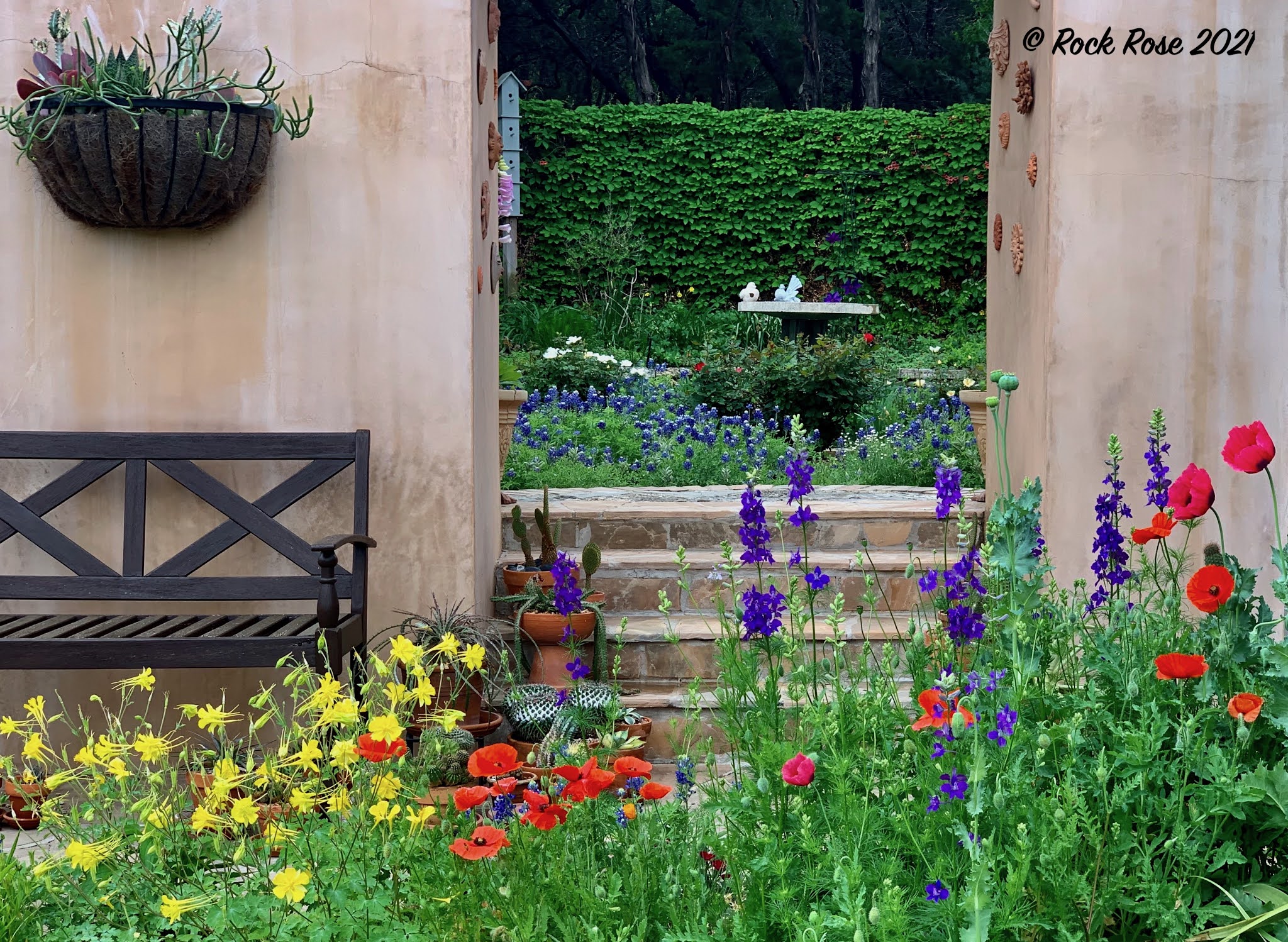
One of my favorite views is standing in the sunken garden and looking up to the Sun and Moon Archway. A mix of columbine, larkspur and poppies.
 

The gopher plant, Euphorbia rigida, has flowered and gone to seed. Some of the longer leaves have been removed to leave a small cluster of seed heads for seed saving. Nigella hides the leaves of the faded daffodils above the  mealy blue sage and larkspur.
 

Late April and the wine cups begin to bloom and spread, and spread and spread! Frequent trims will keep them in order. 

There will be a few plants missing this year and they will be missed. Two beautiful Pride of Barbados were lost to the freeze. The seed had appeared from nowhere and we had several years of their summer blooms. There is however, a very small one growing between two of the ledgestones and possibly in a more favorable place. 


It's time to get out there and remove some of the more boisterous residents in the sunken garden.

Friday, May 15, 2020

FRIDAY FLOWERS

I never expected my sunken garden and its surrounds to be a wildflower meadow but it seems that is exactly what I have. Does that disappoint me? Not really although I would love the wildflower meadow to be outside the main garden. But I love the profusion of blooms that greets me every morning when I step outside the door. Each new flower aiming beat the heat and fulfill its destiny-seeds.


And those seeds, wherever they fall, will create next year's garden. The coneflowers, Echinacea purpurea, are beginning to bloom alongside the gaura, Gaura lindheimeri. I have two varieties one pink and one white which seed around the garden and once they start blooming they bloom all summer long. And hidden among them I see the new leaves of the Mexican Bird of Paradise. It will be many weeks before that plant begins to bloom.


I didn't pull out as many of the mulleins as I said I would but they will not be long in the garden as they will soon enter into their rather messy phase. How I wish we could get the perennial kind that I see in English gardens. This one is my favorite although it is taking up more than its share of the sunken area.


Blue flax, Linum lewisii, with it long arching branches.


And scarlet flax, Linum rubrum, native to North Africa but naturalized in the USA. Always there is a plan to have more but always just a few develop.


Seen here with coreopsis and California poppies.


I grew this achillea from seed 2 years ago. It was supposed to be a much darker color. Sometimes the seeds will surprise you.


And also this foxglove, Digitalis purpurea,  which has taken it three years to flower.


On a rather humid morning the chocolate flowers, Berlandiera lyrata, filled the air with its delicious fragrance. They can't help but draw attention to themselves.


Bee balm, Monarda 'Peter's Purple' enjoys far too much success in this garden to the point of crowding out other plants, including the iris it has surrounded.


And under the shade of the Yucca rostrata the shrimp plant, Justicia brandegeeana has been blooming for several months.


 And a surprise shrimp plant which suddenly appeared has been identified as the native Montell bractspike, Yeatesia platystegia,


And finally Brazilian verbena, Verbena bonariensis with prickly pear.


 I rely heavily on the sunken garden to seed itself so never know what will be growing there from year to year. Unfortunately last year I lost all but one pink skullcap and all the purple skullcap which had been a staple in this garden for nearly 15 years but gardeners learn to move on and like Wilkins Micawber I rely on the fact that "Something will turn up" and it usually does.
Have a great weekend.

Thursday, May 7, 2020

MAY IN THE SUNKEN GARDEN.

I am often surprised by the continuation of flowering in the sunken garden into May and June. As I remove the spent blooms from early flowering annuals such as Nigella, bluebonnets, poppies and last years blanket flowers there is a whole new cast of characters waiting in the wings, some perennial some annual.


The red in the foreground is the native Rock Penstemon, Penstemon baccharifolius, which I cut back early this spring. It's another red flower I have come to love and a favorite of there humming bird. It absolutely demands dry calcarious soils which is just what it gets in the sunken garden. No amendments necessary. 


Another pretty red annual is the scarlet flax, Linum grandiflorum, seen here with coreopsis and gulf coast penstemon. 


Last year there was a lamb's ear plant about 6 feet away from here which withered during the summer. This one seeded here and grew over the winter and I hope some of its seeds will find a happy place to grow.


There are sprinklings of this coreopsis in just about every garden I have. The original was from a packet of seeds planted nearly 20 years ago. It does get a little tall and floppy so I had to stake it up. 


Keeping the trailing winecup, Callirhoe involucrata, under control is not easy. It will run across the paving as well as climb as much as 4' among taller plants.


Square-bud primrose, Calylophus berlandieri, with a few seed heads of Nigella and one of two stragglers.


There are several dwarf day lilies including these two which do well along the edges of the rocks. 


And scabiosa, which blooms all through summer and even during a mild winter.


And the common mullein, Verbascum thapsus, of which there are 5 in the sunken garden, is just beginning to flower. It is an invasive species having been introduced from Europe.


It gives me great pleasure to walk out there in the morning and see the new blooms of the day. Any yes it is constant work and will they all be there next year-probably because I just love them too much not to allow them to seed.
And who will be up next? The gauras, coneflowers, small flowering coreopsis and the prickly pear cactus. 

Saturday, May 25, 2019

A MUSTER OF MULLEIN

Earlier this year I wrote about how I appreciated having several of our roadside mullein plants, Verbascum, in the garden for their early rosettes of soft grey leaves. Read here. Well here they are all grown up, and standing to attention ready for drill practice.


They would like to be in the sunken garden but can only look over the wall. They are destined to stay in the vegetable garden. Unnoticed as they spent the winter underneath stands of Love-in-a-mist, they seemed to shoot up within days-or was I just not watching. I think they benefitted from drip irrigation along the bed.
One thing about mullein, they want to stay put. I have tried without success to transplant them.


A trio of mullein on our septic field. Slower growing because of less water.


These accidental plantings are welcome. I have to pull some but every year several pop up and get to stay because they are well placed. Many are pulled.

A couple get to stay on pathway, between the septic field and wall, now cleared of bluebonnet skeletons.


But I may have been won over by some of the hybrid mullein displayed at the Chelsea Flower Show this year. Some pretty colors in peach and rose. Now to find the seeds.

Saturday, April 13, 2019

I COULDN'T DO IT WITHOUT HER

It is often said that mother nature is no gardener but today I will sing her praises as I share with you some of the things she gets right. Just look how she planted this mullein , Verbascum thapsus, in my English garden. It's as though she thought the expanses of gravel needed just a little dressing up. How about a few bluebonnets sprinkled here and there and a grass or two. Isn't that better?


And another fine specimen at the bottom of the vegetable garden steps. What is not to love about those beautiful sage-colored velvety leaves.


I will admit that she tries to have me grow more than I actually need and I am choosy. They must meet a certain criteria if they are to stay, like a  nice even rosette of leaves with few blemishes.
Mullein were introduced into he USA in the 1700s and are pretty widespread throughout the country. They also appear on the invasive list although I rarely see more than a few scattered around where I live. In the 80s we hiked with a Navaho guide into the ruins of Betatakin, and she told us that Native Americans used the leaves as baby diapers. In Texas it is known as cowboy toilet paper. As a biennial it reaches the rosette stage during the first year of its cycle and then sends up a tall flower stalk with pretty yellow flowers. Although, some time in Texas it achieves both stages within a year.


There is no better place to see her handiwork than in my sunken garden. Toadflax, Nuttallanthus texanus, is everywhere this year and one special clump has me won over that this is a worthwhile plant to have in the cottage garden, particularly if you can get it to seed en masse.


There are so many plants in this area that have self seeded, poppies, mealy blue sage, Brazos penstemon, columbine, grasses, skullcaps and even the delicious chocolate daisy. I never know from one year to the next what will be where, but rest assured, they will be there.


A visitor to the garden this past weekend commented to David, out of my earshot, that there didn't seem to be very many vegetables in my vegetable garden. I could have put him straight about the change-over season, when winter crops such as kale, cabbage, broccoli and peas reach the end their lives, to be replaced by the summer vegetables. So far I had only planted some tomatoes and peppers. But he did have a point as many of my beds are filled with those same poppies as grow in the sunken garden.


And then there are the cilantros and parsley plants which I allow to go to seed every year and repay me by filling in the beds with new plants each winter.


I rather like the way she planted the pink primrose at the corner of one of the vegetable beds. Most would rip this plant out immediately because it does have a tendency to spread everywhere. I'm that different kind of gardener.


and this blanket flower in the pathway between vegetable beds.


In the front courtyard I will have to take some action against the numbers of liatris that are showing up everywhere. I tried to gather the seed in the fall but much escaped and is now seeding heavily in the gravel. Most of them will be removed but this is one of the lucky ones which, in a previous year, found a permanent home.


But I am truly excited to see many seedlings of this little plant, Colorado Venus' Looking Glass, Triodanis coloradoënsis. Two years ago the flower showed up in a hole in a rock I had brought in from another area of the lot, and is now starting to spread itself around the garden. It is a member of the bluebell family and endemic to the Hill Country fo Central Texas. A delicate little beauty which I am sure to blog about when it starts blooming in a few weeks. A perfect little rock garden plant.


All thanks to Mother Nature.