My Blog List

Showing posts with label Desert garden. Show all posts

Tuesday, September 26, 2023

WAR

 I'm about to head into a full out and out war with the javelina. And to say I have few weapons would be an understatement. Javelinas or peccaries as they are sometimes known are not pigs or wild boar although they may have had a common ancestor, but they have common behaviors. They roam the desert fearing only the shotgun. Their only predators are the mountain lion or coyote who would probably only take the young.

They have a gland on their back which produces a foul smelling musk when they are agitated. They have poor eyesight so they usually roam around in a squadron. They can smell garbage a mile away. So much so that we can never leave a garbage can outside at night. They are powerful and can easily knock over the bins as well as take down any poorly constructed fencing. Their numbers are increasing.

The only thing that works is full enclosure and although our back garden is enclosed it is impossible to do anything at the front except an electric fence across the driveway. No one told me about gardening with javelina.

One of the first things we did when we moved in was to arrange to extend the fencing from the front of the house to meet the side fence. It was a pretty expensive project as we had to keep uniformity with the neighborhood fencing. That meant the cutting of steel piping ( the price of which had risen steeply during Covid) and welding into sections which would be cemented in the ground. Also a gate for access. A worthwhile expense.

Prior to this javelina could just wander down the side and into the back garden. It explained what had happened to all the gaura on the original garden plan. Now at least I could begin to plant some more interesting plants. 

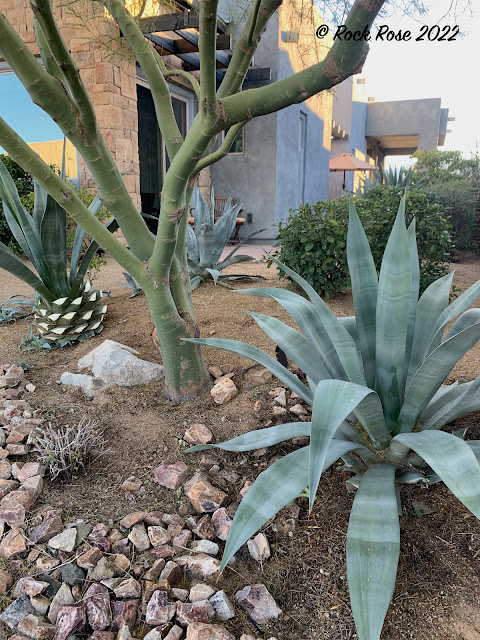
Meanwhile, I began a complete revamp on the front, removing all the large agave and photinia, leaving only the giant hesperaloe.

Before.


I added rocks, cactus, leucophyllum, whale's tongue agave, lantana, damianita, blackfoot daisies, chocolate flowers and skullcaps. I stood back with a smile on my face. It appears I was lucky with my picks as the only thing the javelina went for was the roots of the hesperaloe-ripping the leaves out of the ground. 

After. 

I continued down the side garden leading to the front door, removing some bushes, planting bougainvillia, and creating a dry winding creek. 


I added more barrel cactus and tucked the five balloon cactus, Parodia magnifica,  that had been in a pot in my Texas garden, in the front corner. They had been in the ground for 18 months and nothing had eaten them. They are, after all, spiny. Javelina will browse on bougainvillea leaves and earlier in the week, to do so, they had trodden on one of the balloon cactus. 


I was a little annoyed at their clumsiness but worse was to come. On Monday I went outside and discovered the javelina had eaten them all. Not a scrap was left. In fact They had managed to pull them out, eat them and leave me nothing but some dried up roots on the driveway. Every one was gone. But worse than that they had removed the protective wire basket from the Echinocereus mohavensis f. inermis a garden visitor had brought me. It had settled in nicely to its new home.

 All that was left was one small piece which I will try to bring back to health. As to the balloon cactus. No more of that. I read somewhere that the javelina has glands in its lips which secrete a substance which deadens their mouths so they can eat spines and prickles. 

So what can we do to discourage them. Someone mentioned the usual sprays of garlic and pepper. How about coffee grounds. Coyote urine? Flashing lights? Motion activated water spray. They'd probably like that. 

The only thing is to plant plants that they will not eat. Have I just been lucky or will I go out there one morning and discover they have destroyed my front garden? So, more barrel cactus, lantana, rosemary and agave. But not the octopus agave I am growing from bulbils. I have already been told they eat those. 

Life is tough enough in the desert but as someone said, " They were here first" 

Saturday, April 29, 2023

THE TEXAS OLIVE

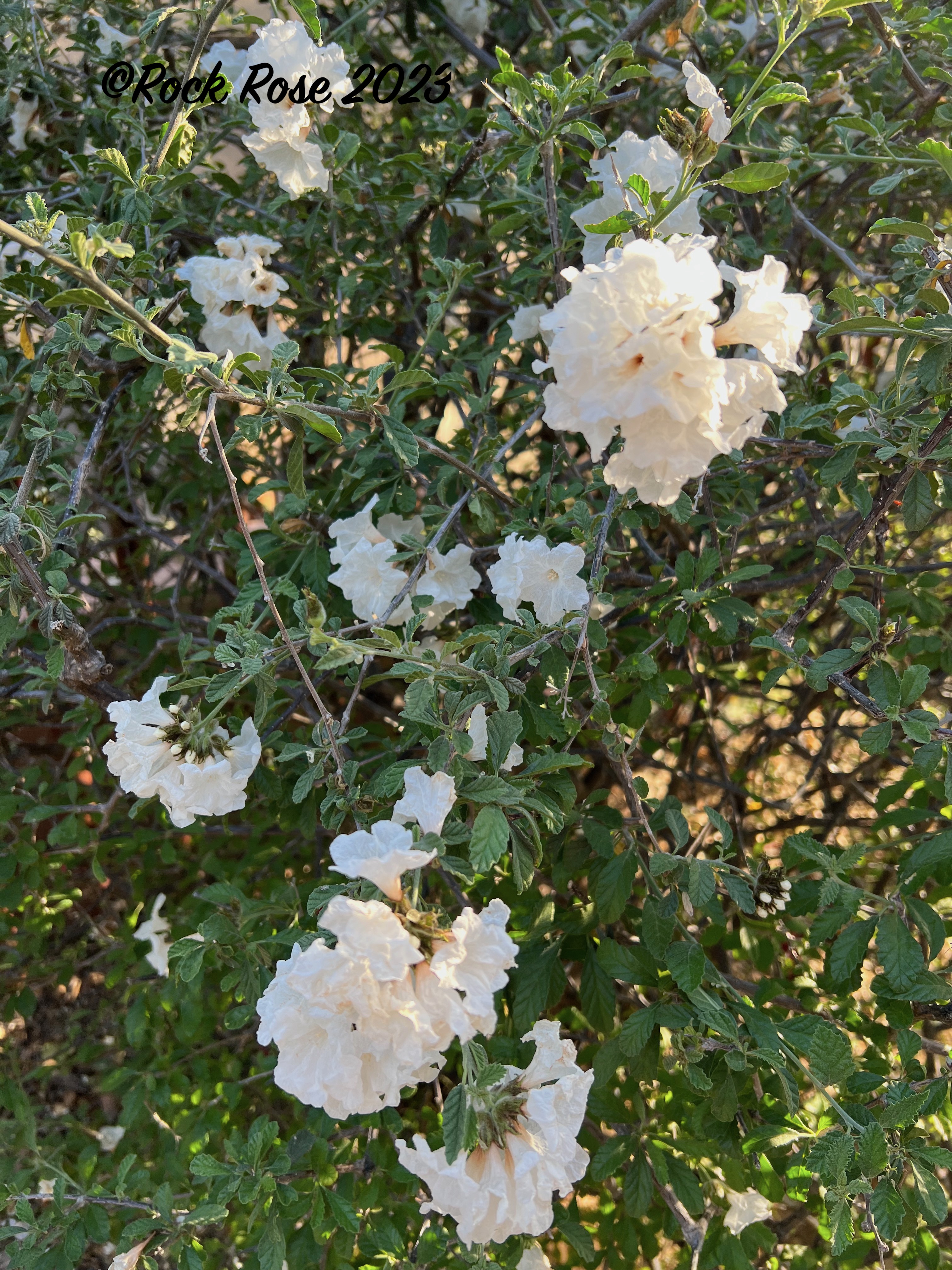
When we first moved into the house I was chatting with the neighbor and asked him if he knew what the large bushes were between our property. He didn't know the name but he did say they were filled with lovely white blooms during the summer. Little did I know that I was looking at Texas Olive trees. The only other Texas olive I had seen was at the Lady Bird Johnson Wildflower Center in Austin where a lone tree grew just outside the auditorium. It was a nicely shaped tree but only ever had a couple of blooms. It succumbed to a hard freeze and was removed. 

My neighbor was right about the flowers. Around April the tree began to bloom with these gorgeous papery white blooms with yellow centers. The plant bloomed constantly through November. 

It isn't hard to see why someone, seeing this tree in bloom, wouldn't immediately fall in love with it, and find a place for one in their garden. We have nine!


Also known as the Anacahuita ( a much better name for this tree growing in the Arizona desert) Cordia boissieri, can be used in the landscape as a tree or as a shrub. Of the nine that the landscaper planted eight were pruned as shrubs and one was left to grow as a tree. Their main purpose was as a screen between the houses. Training as a tree requires careful pruning by hand. As a shrub a power trimmer makes quick work. You can imagine which was chosen by the landscaper. Below are my attempts to train the plants as a tree. You can imagine the pressure that these plants were putting on each other as bushes. 


I am doing a similar pruning to the Texas mountain laurel. Eventually, as they are pruned up I will be able to utilize the filtered shade beneath to add small plants.  
Every time I look at the plantings they did along the edge of the driveway my blood boils. They planted so many different plants giving them no room to breathe. No chance to be themselves. We have already taken out 1 tree and 2 bushes and even now I know there are more that need to be removed. Just to give an example here are 3 trees. The Anachuita, an Anacacho orchid and a photinia all within 4' of each other. 


And on the other side we removed 2 little leaf cordia. It breaks my heart to see them planted this way. This is a well-known landscape company who proudly left their file with information on the plants. I decided I would try to prune the Anacahuita as a tree, taking some pressure off the orchid tree. Brave little soul has bloomed its head off this spring but you can see the horrible growth pattern from constant cutting back. 


 In the end I feel I will only be able to keep the Anacahuita and will have to pull the other two plants. They just don't fit well together. 

despite their beautiful flowering at the hottest time of the year there is a downside to the Anacahuita. It produces a lot of fallen litter, both fruit and leaves which are slow to leave the tree. This is particularly true after a freeze although in the low desert they may behave differently.

It is only now that most of them are free from last years leaves. I find myself going out ever morning and helping them along. The litter isn't all bad because it dries out very quickly and I go around and crunch it up and leave as mulch. The fruit are another thing. They attract the javelina so I find myself collecting them up or cutting them off before they fall. It is a prolific fruiter and every flower seems to produce a fruit. 

Flower buds.

I was told by a local that something can be made of the fruit but it appears to be a long drawn procedure and the result is probably an acquired taste. I will be snip, snip snipping into a bucket all summer.

There is another cordia which was a favorite of the landscaper. The little leaf cordia, Cordia parviflora, I see lots of theses bushes along the roadsides where they are allowed to grow to form an arching bush covered with white flowers. Pruning is not good for them as it results in the branches growing every which way. But the flowers are certainly pretty. It seems my garden is a sea of white with the cords and the bauhinia. 


I am in the process of seeing how well they perform after being cut back to a foot. There is much work to be done. 

Tuesday, January 17, 2023

DAY 2 OF WET AND WILD IN THE DESERT

 I am remembering some stretches of wet and cold days in Austin when David would grumble about getting away. I asked him this morning how he was feeling about day 2 of wet and cold in the desert. He surprised me by not seeming to be bothered at all. The fact is that these days don't come along too often in winter and when they do our thoughts are filled with the increasing chances of having a bumper wildflower season in the desert.

Of course I stood at the front window this morning looking out on a dreary, wintry scene and when I stepped outside to fill the bird feeder I noted the bird bath was full. It really is time I bought myself a rain gauge as well as a rain barrel. This is where I regret not bringing at least one barrel from my old garden. 


 There are cold day things to do in the kitchen. I brought a bag of lemons home from my son's house with a plan to make some lemon marmalade and maybe some limoncello. Last year I made calamondin and sour orange marmalade but I have not been able to get hold of those two fruits this year. Once that is all used we will have lemon marmalade on our toast. Not having ever made lemon marmalade before I dug out my very old Jams and Jellies book from England and found the page for lemon marmalade. 


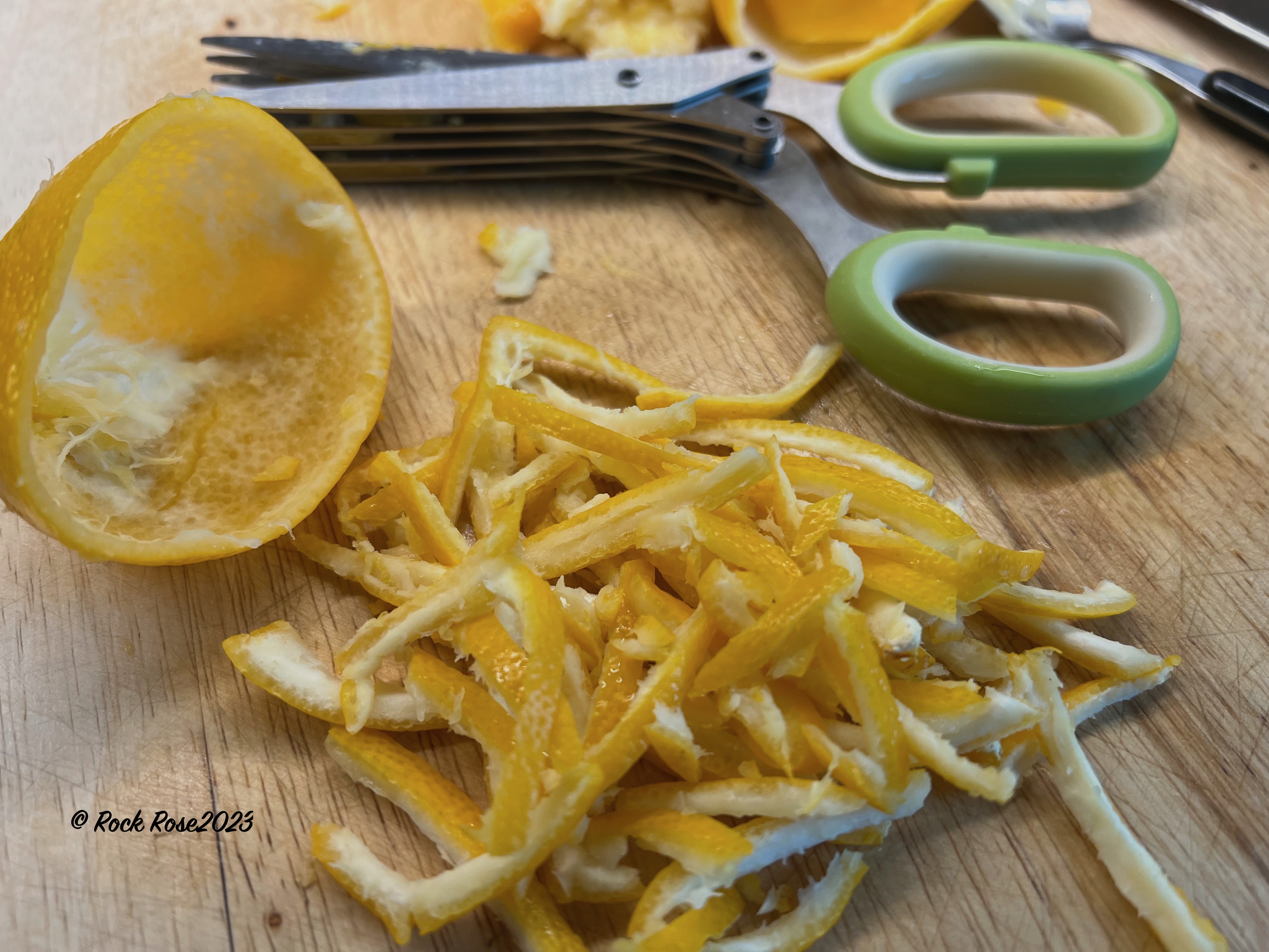
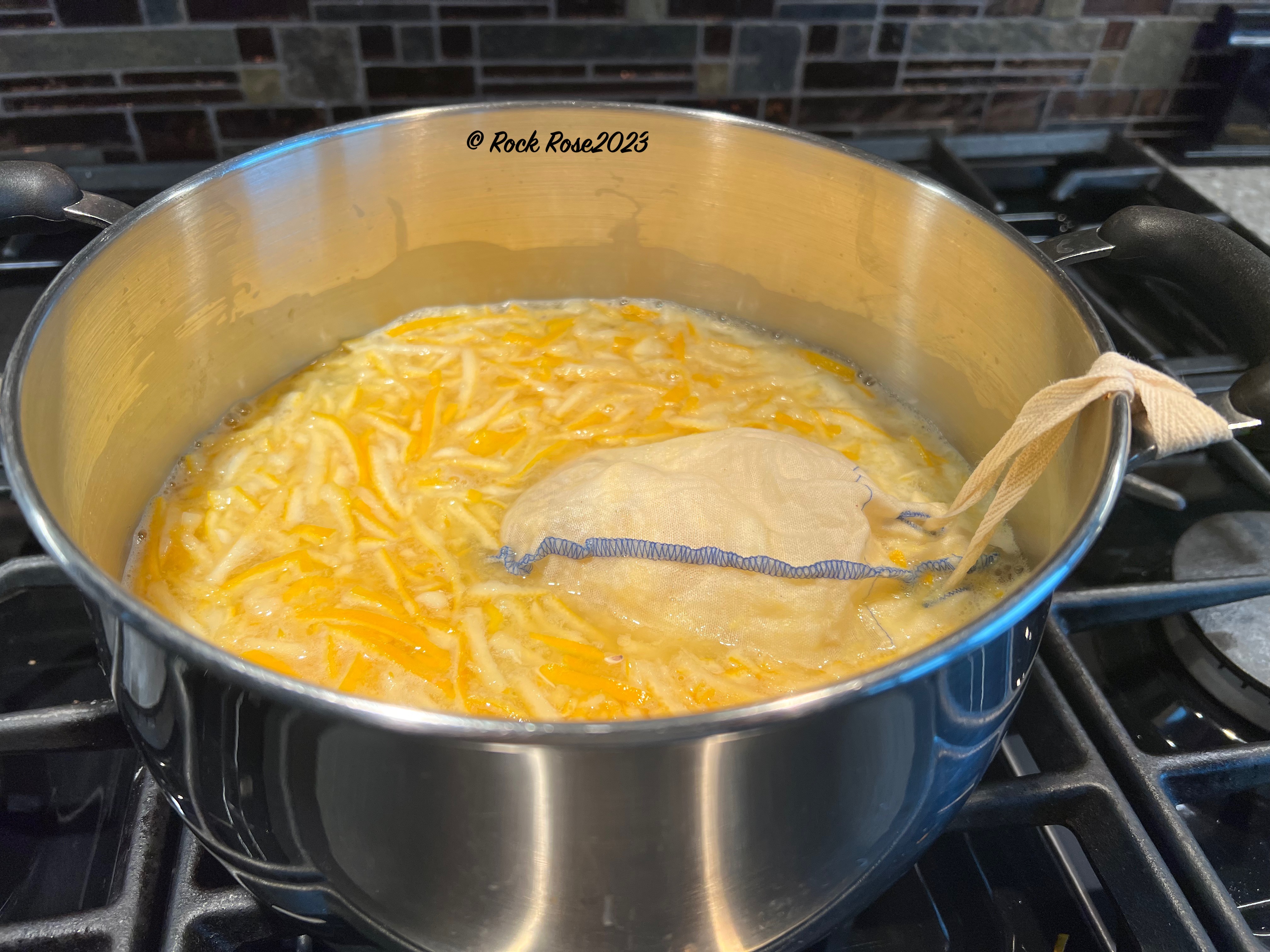
Having been a science major I really like to work with definite quantities. 3lbs lemons, and 6 pints is fine but then to have reduced to 4½lbs of liquid! Or did they mean pints. Confusing. Right from the start I am gambling on getting this right as I am working with cups. I should have looked elsewhere for a recipe. The electric lemon squeezer made light work of getting out the juice and scraping the pith from the peels is very easy with Meyer lemons.  Pips and pith went in to a cotton bag to ensure plenty of pectin. The peel was shredded quickly using these herb scissors. Thanks to my garden friend Barbara Segall for this suggestion. I measured the juice and peels and added water per the recipe and boiled down for 1½hrs until the peels were soft. Left overnight to make the following morning.

I added sugar at one cup for each cup of juice/peels and boiled until the setting point was reached.

 That setting point always seems to be a gamble. There are several methods to use and I find it best to use a combination. A jelly thermometer, the cold plate and the spoon drop. The suggested temperature is 220° but what do you do when your two thermometers read differently? Then you use the cold plate test. And if you can't get a good fix from that then drop some from a spoon and see if it forms a flake. The ultimate test is when a few hours later you dip a spoon into the small test pot and are delighted to find it has set to the perfect consistency and tastes pretty good.


The rain is due to end soon but there is bad news on the horizon. They are forecasting some night time temperatures in the 20s next week. In will come the plants and out come all the blankets again.

Sunday, April 3, 2022

ADDING MORE ROCKS AND NEW PLANTS

It is characteristic of me to be working in more than one place at the same time. A few weeks ago I turned by attention to the front of the house, abandoning some of the others areas I had been working on. The whole front needs a revamp which includes removing plants that have grown too big for the area. A huge A. weberi and two baja ruellia, Ruellia peninsularis. Baja ruellia, is a great plant, but when squeezed up against a wall and in poor soil with no attention but chopping they don't do well. No sooner do I say to David, this one is going and those two as well, than he is out there with his saws and choppers. It's a two day job.

We have garbage pick up twice a week and this is our way of disposal. It's a full bin every week.

There is also a giant hesperalo, Hesperaloe funifera, which David does not like which will remain for the time being. Purely a well established structural plant for now. And one Agave weberi at the back.


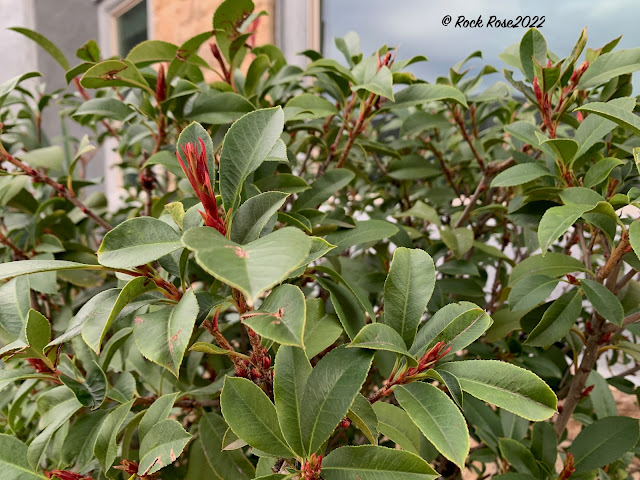
And a photinia, Photinia x fraseri, which will also remain for the time being. They add some height and winter structure, I am still thinking about what to put there. Maybe a desert willow. For all the bad press the photinia received in Austin, it seems to thrive here and no one would disagree with how wonderful the new growth looks in the spring. I read that it can be trained into a small tree so I will take a look at this one and see if that is an option.

It also does well as cut branches in the house. It is now blooming although as someone said the blooms have an unpleasant smell. 

So with a good area now cleaned out I turned my attention to adding more rocks adding 12 more to the front. We have found a good local supply of both larger granite rocks and the Coronado brown rip rap that are used for erosion control. Monsoon season demands this. To bad we no longer have a truck  but we are managing with car loads for now. We will eventually rent a trailer in order to bring in some of the smaller rock to use as a ground cover. I redid all the edge rock adding more around the sides. 

Then planting began. I added the 3 barrel cactus I brought with me and purchased 3 Agave 'blue glow,' one A. parryi, a damianita, Chrysactinia mexicana,  and a chocolate daisy, Berlandiera lyrata. The A. blue glow is a cross between A. attenuata and A. ocahui. It is prized for its blue green floiage with red and yellow margins and its compact size. I will see how well they do in this location, which is west facing. I removed a sad clump of claret cup cactus, Echinocereus triglochidiatus,  that were rotting due to too much moisture. I am trying to rejuvenate the parts that still showed life but am not too hopeful. 

I am on the hunt for a Whales tongue agave, A.ovatifolia, but as yet have not come across any.


 I also found a home for the concrete balls I made for my Austin garden.

A nice specimen of the blue barrel cactus, Ferocactus glaucescens, is starting to bloom. It reminds me of the crown of thorns starfish.

The area at the back is where the clean outs are for our sewer line and for now I have just added a germander, Teucrium fruticans "Azure Blue' 


I see lots of plants growing in gardens that I would love to have but it is a matter of  balance between seasonal bloomers, structural plants and plants to carry the garden through the hottest months of the year. And we shall be gone for a few weeks this summer as we drive up to Madison, Wisconsin to attend he Garden Bloggers Fling. Click here for details.

Will you be there? I hope so.


Monday, January 17, 2022

THE STOCKERS TAKE STOCK

 Moving to a new garden is no piece of cake. Unless maybe it is your first and comes already made. Such was the case when we bought our first house in 1972 in Beaconsfield, Quebec, Canada. It came with lawns, fruit trees, a Russian olive, a weeping willow, lilac, spring bulbs, iris and a rockery. What more could a newbie gardener wish for. I did tinker with it adding a veg. garden and fruit bushes and a post and rail fence.  Fast forward nearly 50 years with 6 more gardens under my belt, none of which came with so much as a blade of grass, to December 2021 when we purchased, what we expect to be our final house, in the Sonoran desert of Oro Valley, Arizona. The much smaller house on a very small lot is already landscaped and to a non-gardener might be considered complete. 


The builder was very generous with the plants which was clearly required by the association to make sure properties were pleasing to the eye. Even to installing lights and drip irrigation. It would appear the original owners added more plants to the plan although many have been lost. Javelina, rabbits, rats, mice and lack of care may be to blame. Or was it just over planting? If they had just waited, but you know how that goes. They left me the plans which are very helpful in identifying a few of the plants I am not familiar with.  


Then, there were additional plans with more plants added. I have no idea how many were in the final installation but it is clear that many are missing like S. greggii and gaura. 

I was incredibly excited to find quite a number of Agave "Blue Glow" and Anacacho orchid trees, Texas mountain laurel and a number of Mexican olive trees. Now I learn the latter are rather messy as their brown leaves hold even through winter and I will need to remove the fruits so we don't encourage rats.


And several Agave Victoriae reginae. I brought Brer rabbit with me and he seems happy in his new home. He was a housewarming gift 22 years ago when we built our last house.


There are more large A. weberi that I need. Already past their prime. We have already begun removing some of the lowers leaves becasue they provide a good hangout for mice and rats.

 And we are not making a pineapple out of this one but slowly removing the leaves with each trash day! It will finally be removed and as yet I don't have plans for what will be there. Maybe a Whales tongue, A. ovatifolia. There are a number of pups which I will likely use to replaced other outgrown agave.


Oh! and there are quite a lot of red tip photinia. That was a no-no in Austin so not quite sure how conditions might differ here. They look healthy. I suspect they are the builders standard plant which grows quickly is evergreen and wows with those red tips.

There are a number of bushes I am not familiar with and frankly most of them will have to come out or at least be cut down to the ground as they are growing into other bushes.They have been miserably hacked by the landscapers to keep them under control-with a blunt pair of sheers. It is sad to see the Texas mountain laurel treated in this way as well as a number of Anacacho orchid trees. Only one has been allowed to take a tree form and then a small one shows promise of making it to adulthood. 

At first glance I remember thinking there wasn't much gardening to be done but a second glance has told me otherwise. I have been scanning local landscapes for which plants will work best here. Once again much will depend on micro climates and visiting wildlife. Although our property is fenced on 3 sides we intend to complete the fencing. It may keep javelinas away but not rabbits. 

This weekend we got to grips with some drainage we needed to understand and the irrigation system. We have had to order a new control box as most of the buttons weren't working. What was that David was thinking about not having to do such things! We also removed the Mediterranean fan palm(what a brute) and I planted an Agave desmettiana I brought with me. It feels good to get my hands in the dirt although I'm not sure I would call it that. It's basically just gritty sand. 

Maybe I will get to a nursery this week.