My Blog List

Showing posts with label Englemann's daisy. Show all posts

Sunday, June 13, 2021

WHO WOULD WIN

I often ask myself when I am out in the garden, "Who would win if I just let the garden take care of itself." Would it become a mono-culture or would every year bring a different winner. I think maybe the latter and I say this because I often say, "It's been a really great year for such and such a plant" I think mother nature gives every plant a chance.

This year the cone flowers, Echinacea purpurea, would take the prize.

They were busy preparing for this year last year when they set hundreds of seeds-which, of course, I allowed to remain.  And I am not really sorry because I think they just look marvelous. I wish they would last a little longer although I suppose the idea is to let something else take center stage. They have even muscloed their way into the English garden. Of course as often happens they are right by the stepping stone instead of in the more open spaces.

And who among this group would take over. Mulleins, gopher plants, blanket flowers or wine cups. Each one of them would vie for top dog position in the garden.

Naturally the weather plays a big part on what will bloom successfully in each season. We had a relatively dry winter  and then all hell let lose with one of the deepest freezes, in fact the deepest freeze I have experienced while living in Texas. It wiped out a number of plants, in particular the larger ones. Maybe some of them were ready to go. I had a gorgeous Pride of Barbados that had volunteered in the small strip between sunken garden and pool. Over a period of 5 years, despite dying back to the ground every winter, its girth increased with every year. 


It was really too big for the space but that deep freeze did something I couldn't bring myself to do and that was remove it. But the good news is it left behind some offspring. One a little further along and one in the middle of the sunken garden. Maybe they will be too young to flower this year but I am excited that in the future they will. And in a prior year one grew between two rocks on the other side of the sunken garden. Maybe it was sheltered between those rocks and that was why it survived or maybe the covering of ice and snow helped insulate it. It does seem to be the smaller plants that survived.


Let's look at Monarda 'Peter's Purple' Is there a more successful spreader than this plant? It isn't that it seeds but that it sends its underground runners out in all directions to make new plants. One year it managed to successfully invade the yellow iris. How charming, I thought, when the iris finish here comes the bee balm. That is until the iris failed to bloom the following year, completely crowded out by bee balm. Then the bee balm decided to move out and this year the iris bloomed with a mighty vigor chasing the bee balm in its relentless spread.The bee balm is so adored by all manner of flying insects and hummingbirds too that I don;t have much of a problem letting it go on its merry way. 

My beautiful Philippine violets, Barleria cristata,  took a big hit. The two along the edge of the pathway(volunteers) in the Sunken garden are slowly making their way back but the big one has split itself into four plants leaving a gaping hole in the center. It is a perfect place to add a pot and it so happens that last winter an arm broke off the plumeria, which I potted up and is growing. 

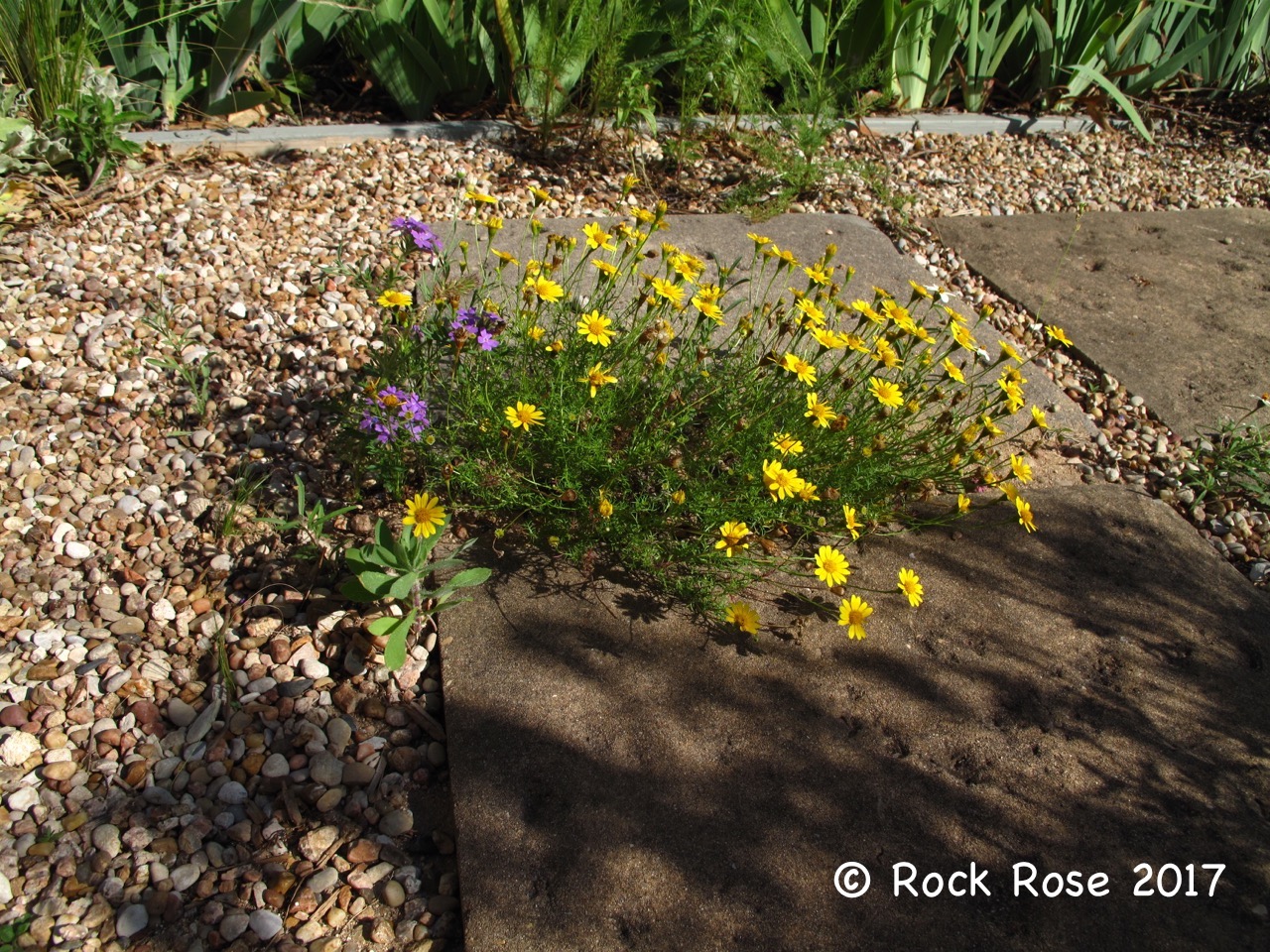
 One plant that is not permitted in the back gardens is the Engelmann daisy, Engelmannia peristenia. I can remember when I bought 3 small 4" plants at the Wildflower Center sale. "Oh! you'll have plenty of those" someone said. Now I have more than even I could have imagined and I constantly pull them out-not an easy propositions as they send down a big successful taproot. That is why they do so well in dry gardens . But they are beautiful when in bloom in the early morning. By afternoon their yellow petals have curve under. They do give the garden a somewhat wild appearance.

 And that was before the American beautyberry, Callicarpa americana, and the liatris, Liatris spicata.  started to move in. I think the latter might be the most freely seeding plant in Texas. At least in my garden. It does add gorgeous color in the later months of the year. 

But of course I am not going to let any one of these plants the chance to take over. I leave that to the next gardener who lives here.


Tuesday, April 23, 2019

WHO IS ON THE STAGE THIS WEEK

The most dominant flowers of the last 4 weeks have been the bluebonnets, columbines and Indian paintbrush. They are now busy setting seed for next year while a whole new range of plants take over, primarily the yellows. Our roadsides are quite stunning with their yellow composites mixed in with blanket flowers.

My garden is not so shabby either.

Square bud primrose, Calylophus barlandieri, nestled in among rocks and gravel.


Engelmann's daisy, Engelmannia peristenia. I remember when I bought this at the Wildflower Center sale some years ago someone said they would be everywhere, and they are.


But so far, only in the from Courtyard garden where I pull those that are in the wrong places. I am hoping to get them to move outside the walls at the front. The question is always, will I be around at seed collection time.


Four nerve daisy, Tetraneuris scaposa,


Damianita, Chrysactinia mexicana.


Threadleaf coreopsis, Coreopsis verticillata, swaying around on two foot high thin stems.


And California poppy, Eschscholzia californica, a vigorous self seeder.


These are all native to Texas but there are a few more yellows enjoying the stage. The native Coreopsis tinctoria is a few weeks away from flowering but other tall and short coreopsis are flowering.


And the silver leaf gazania, Gazania tomentosa, perfectly at home in a bed of gravel.


And in the English Garden the many petaled, fragrant  Rosa 'Molineux' named by David Austin for the football stadium of his favorite soccer team, Wolverhampton Wanderers.


And finally the large yellow named bearded iris which is a favorite because blooms after my other iris have finished blooming.


Will the yellow flowers please take a bow.

Tuesday, May 2, 2017

CELEBRATE NATIONAL WILDFLOWER WEEK, May 1-7

Do you have wildflowers growing in your garden? I do. Let's see what is blooming out there this week as we celebrate National Wildflower Week.

I'll begin with Colorado Venus' looking-glass, Triodanis coloradoƫnsis. (A)What a lovely name.


And where did it come from because I have never seen it before? It came inside a hole in a rock I brought into the garden when I redid the dry creek along the garage wall.


The plant is annual so I shall watch carefully for the seed pods ripening. I would like to have more next year.
A final blooming of the lace cactus, Echinocereus reichenbachii.(P) Even after the blooms die it remains a tidy addition in the rock-scape.


And the blousy Engelmann's daisy, Engelmannia peristenia, (P) opening with new flowers every day from a winter rosette of leaves.


The pathways in the vegetable garden are crowded with blanket flowers, Giallardia pulchella. (A) Goldfinches feast on their seeds but always leave plenty to bloom next year.


And Mexican bush sage, Salvia leucantha,(P) blooming months ahead of schedule this year. Will it bloom again in the fall as the hummingbirds begin their long winter flight to SouthAmerica?


The trailing wine cup, Callirhoƫ involucrata, (P) spilling over the dry-stone wall. Always everyone's favorite when they visit the Wildflower Center.


The flowers on the Texas prickly pear may only last for a day but they may leave behind some nice fruits. These fruits, call tuna, ripen to a burgundy red and can be used to make jelly.


Wooly stemodia, Stemodia lanata, (P) makes a good ground cover and is deer resistant.


It has tiny blue flowers.


Our native Lantana, Lantana horrida (P) is also deer resistant and blooms through the hottest months of the year with little water.


Purple skullcap,  Scutellaria wrightii,(P)  can be pruned into a tidy clump and blooms all summer.


Echinacea, Echinacea purpurea, (P) a summer bloomer and another favorite of the birds when it goes to seed.


The Blackfoot daisy, Melapodium leucanthum, (P) another deer proof summer bloomer.


The columbines are among the earliest of spring flowering plants. here the Hinckley's yellow columbine, Aquilegia hinkleyana, (P).


and the more delicate smaller flowered Aquilegia canadensis,(P)


Damianita, Chrysactinia mexicana,(A)is both drought and deer tolerant but does best when given occasional waterings.


All these plants are blooming in my west Austin, rocky landscape, with minimum watering.

If you would like to learn more about wildflowers for you area you can get information on the Ladybird Johnson Wildflower Center website. There are all kinds of programs going on this week in Celebration of National Wildflower week.

Saturday, May 14, 2016

I HAVE THE COTTAGE GARDEN GENE

It's not surprising that I have this gene. After all, I spent the formative years of my life growing up in England, the land of cottage gardens. You only had to drive into a rural area to see multicolored, informal groups of plantings both in gardens and along the hedgerows. Who knows how far back the cottage garden dates but their numbers increased dramatically during prosperous Elizabethan times.  Once-fashionable garden designs have come and gone but the cottage style of gardening has remained. It seems I have brought it to Texas.


It isn't an easy gene to carry with you to Texas. In the words of Penelope Hobhouse, 'Well, I just think that if I were a plant, I wouldn’t want to live in Texas.' Not true. There are plenty of plants that like living here in Texas and even though their flowering may be short they are happy enough to return for another year. The problem is more to do with their success during a long growing season. They don't come in quietly in the spring, flourishing through the summer and fading into the fall. They just keep growing.


This year many plants didn't even go dormant and the penalty is that they now have a very long growing season to look forward to and they will keep on growing and growing unless they are cut back.

Engelmannia peristenia with Verbena bonariensis

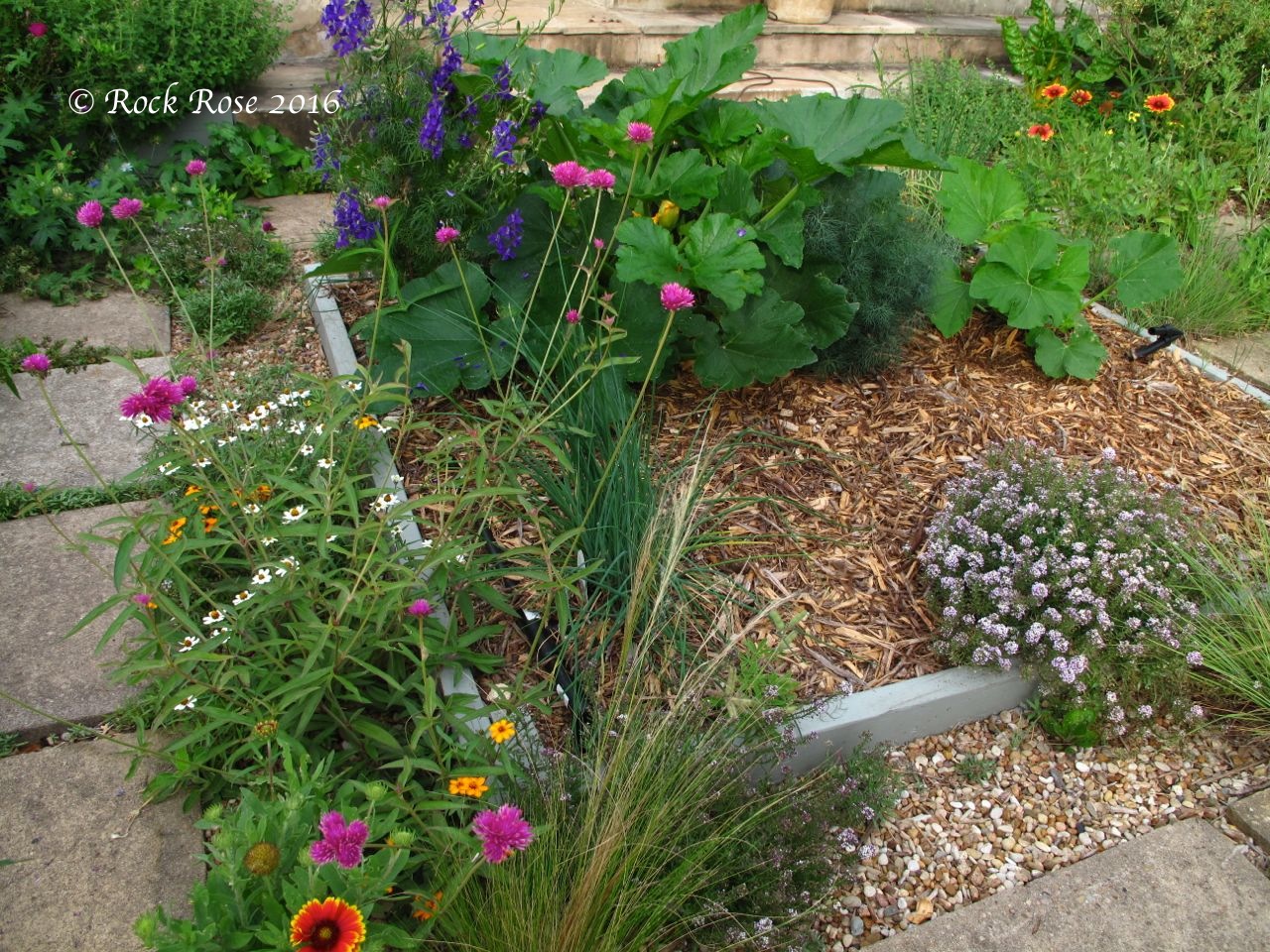
So what are the features of a cottage garden. The first is that they are usually enclosed by walls or hedges. The garden is not meant for the person passing by. Plants are crowded together so there is little soil showing. The plants generally come from neighbors and friends, cuttings and seed. The plants are a veritable jumble with flowers growing alongside the vegetables.


Plants put themselves where they want to be.


And even the most weedy plants are welcome.

Pink primroses among the Dicliptera.

And when the annual  plants fade the cottage gardener goes out and collects their seed to save for next year so she can spread the flowers everywhere.


It's in the genes.

Monday, May 2, 2016

MY GARDEN CELEBRATES NATIONAL WILDFLOWER WEEK MAY 2-8

The week of May 2nd is National Wildflower Week and I am delighted to share some tiny Texas treasures with my readers as well as some of my more boisterous blooms.
I have always had a weakness for the more delicate of our wildflowers so I was happy to see that for the first time the violet wood sorrel,  Oxalis violacea, has appeared in my garden. I'm sure readers are saying they have this plant growing everywhere but for me it is a joy to see this one plant has found a home in my garden. I would be happy to see it growing as a carpet.


It is growing beneath the unnamed clematis which I purchased from the Wildflower Center. It is of the group of clematis that share the name leather flower, possibly Clematis viorna.


 My entry courtyard is full of yellow blooms, Engelmann's daisy, Engelmannia peristenia,  being one flower of the more boisterous.


 I always try to gather up seeds before they fall but  some always escape. They will grow out of rock crevices and in the gravel.


My gravel garden is a perfect place for Zexmenia, Wedelia texana. Another plant whose seeds need controlling.


 The square but primrose, Calylophus berlandieri, is one flower I would be happy to see seed out but it never does.


The purple skull cap,  Scutellaria wrightii, and Blackfoot daisy, Melampodium leucanthum, mass together along the edge of the dry creek.


This same skullcap can be trimmed to form a low mounding plant.


Scutellaria wrightii in the sunken garden
 I just have a few standing wine cups, possibly Callirhoe leiocarpa or C. pedata. The flowers are on a tall leafless stem.


They are quite distinct from the trailing wine cup, Callirhoe involucrata, with its heavy foliage.
 

Another member of the mallow family, rock rose Pavonia lasiopetala,


 I am always on the lookout for plants that form tidy mounds. A chance seedling of gray vervain,Verbena canescens, pruned to form a mound.

 You have to get close up to appreciate its tiny flowers. It seeded in a few places and I have moved the seedlings into other areas.


I took a walk in my meadow today and discovered several delicate blooms. The first the Colorado Venus' Looking-Glass, Triodanis coloradoensis.


and Prairie brazoria, Warnockia scutellarioides.


Now that the bluebonnets and Indian paintbrush have set seed it is the time for the yellow flowers to carpet the meadow.


Antelope horn, Asclepias asperula, in the meadow.


HAPPY NATIONAL WILDLFOWER  WEEK TO ALL MY READERS.