Sometimes, after I turn out the light at night, I think about what I might do in the garden the next day. It isn't a real plan but a suggestion to tackle some of the many things that need my attention. The fact is if I made a list it is unlikely that I will do many of the things on that list. This morning was a good example.
My pretty little Mexican trailing purslane, Portulaca Mexicana, in a planter high up on the wall, was being visited by ants. I know immediately that spells trouble. Is it root aphids, stem aphids or scale? It had to be one of those. Closer examination revealed this-scale. I brought the leaves inside to take a good photo of them.
Scale needs to be dealt with immediately otherwise it will just overwhelm the plant and bring about its death. Early intervention is the answer. I have already battled scale on one of my cactus this year. It took a lot of effort but I think it is now scale free. Scale also likes prickly pear and citrus.
Some time later I was filling up a watering can at the barrel when I notice ants crawling up the side of the water tank garden. This time it is aphids.
There I was the other day just thinking how carefree the water garden was and now this. The mud baby, Echinodorus cordifolius, was infested with green aphids. I ran my fingers up and down the stems removing most of them and then dunked the flower heads in the water to remove the rest. I'm not sure what to do here other than hand removal because I don't want to spray with oil. I can't remove the plant because it is growing among the papyrus. I will have to go out with an artist's paint brush to remove the remaining aphids in the cracks and do this regularly until I am sure there are no more. They do make an untidy mess on the water and lily pads with their molting skins. And then there was this......
I searched for this on the internet thinking it was some kind of mealy bug but the only photograph I came up with said it was a ladybird larvae, Hyperaspis. I have never seen one look like this but apparently they secrete this waxy substance along their sides as a protective device. I'm glad I left well alone because he can get busy eating the leftovers.
Next it was the Manfreda sileri. When ants build up around the base of plants I am always concerned for root aphids. These aphids cannot be seen above the ground but settle onto the roots and suck the plant dry. They are particularly prevalent under dry conditions and favor certain plants like blackfoot daisies, skullcaps and Gulf coast penstemon to name a few. If you see a plant start to fail and there is no visible reason then consider root aphids. They do their work silently below the ground but little do they know that ants give the game away above the ground.
Now it was time to get round to doing the garden chore I had planned; removing the A. parryi pup from underneath mother. Almost buried underneath the mother plant I knew I needed to remove it this summer so that it would have the chance to settle in before winter. I have been leaving it until it was old enough to have its own root clump which it did. The damp soil made extraction easier.
Now, I could cut off the old leaves and the second pup, growing a little further away, would have more room to grow.
The pup was planted along the edge of the dry creek with plenty of room. Next on the list is to try to remove the Whale's tongue agave pup. That will be more of a challenge.
Showing posts with label portulaca. Show all posts
Wednesday, July 23, 2014
Saturday, June 15, 2013
GARDEN BLOGGERS' BLOOM DAY JUNE 2013
Bloom day again! Thanks Carol at Maydreams for hosting the day.
I have to give my Spanish bayonet yucca, Yucca aloifolia, an opportunity to star in June's bloom day. Not quite in full bloom yet but by next month blooming will be over and it has waited 12 years for the chance. Maybe this will be an annual event from now on. The difficulty will be cutting back the stalk after it has finished. It must be 10' up.
Recent rains have been kind to my Texas garden. here is what is blooming today.
Hope your garden is having a wonderful June Bloom day.
I have to give my Spanish bayonet yucca, Yucca aloifolia, an opportunity to star in June's bloom day. Not quite in full bloom yet but by next month blooming will be over and it has waited 12 years for the chance. Maybe this will be an annual event from now on. The difficulty will be cutting back the stalk after it has finished. It must be 10' up.
Recent rains have been kind to my Texas garden. here is what is blooming today.
![]() |
| Colorado water lily |
![]() |
| Texas mud baby, Echinodorius cordifloius |
![]() |
| Anisacanthus |
![]() |
| Trailing purslane |
![]() |
| Peter's purple bee balm, Monarda fistulosa. |
![]() |
| Dittany of Crete,Oreganum dictamus. |
![]() |
| Dwarf papyrus, Cyperus haspens |
![]() |
| Blanket flowers, Gaillardia pulchella. |
![]() |
| Purple cone flower, Echinacea purpurea. |
Monday, September 26, 2011
ANOTHER ROUND OF SUMMER
The garden has been fooled into thinking it is fall. Color began returning to my plants when we began to experience a cooling in evenings and mornings.
Gomphrena never seem to mind the hot days, continuing to bloom through even the most miserably hot of days. I have been pruning them back, especially these new firecrackers. Unlike the globe amaranth they tend to elongate with age and shed the bracts. Cutting the stem back to the last leaf node results in new flowers forming.
Even the alyssum is blooming again and one morning I detected that sweet honey fragrance on the air.
I just wish there weren't so many white ones. I may have to refresh with a packet of Royal Purple seeds.
I still love the globe amaranth saving the seeds from year to year.
Having struggled for years to have success with wall planters I decided to plant agaves and grasses this year. The grasses died, the agave lived and so did the native Portulaca pilosa.
Earlier this week I moved the A. desmettiana from its morning sun location in the front garden where it had spent the summer, back into its pot in the back. Yesterday, with another 103 degree day expected I moved it back into the shade along with the 'sticks of fire' euphorbia.
Should I go into business! I saw them selling bunches of the pink globe amaranth for $9.99 at the grocery store.
Another amaranth or celosia has grown in the corner of this bed. Tucked out of sight behind the potting shed this is probably a good place for it. Two more growing in the path are looking decidedly lanky although starting to produce flower heads.
Gomphrena never seem to mind the hot days, continuing to bloom through even the most miserably hot of days. I have been pruning them back, especially these new firecrackers. Unlike the globe amaranth they tend to elongate with age and shed the bracts. Cutting the stem back to the last leaf node results in new flowers forming.
Even the alyssum is blooming again and one morning I detected that sweet honey fragrance on the air.
I just wish there weren't so many white ones. I may have to refresh with a packet of Royal Purple seeds.
I still love the globe amaranth saving the seeds from year to year.
Having struggled for years to have success with wall planters I decided to plant agaves and grasses this year. The grasses died, the agave lived and so did the native Portulaca pilosa.
Earlier this week I moved the A. desmettiana from its morning sun location in the front garden where it had spent the summer, back into its pot in the back. Yesterday, with another 103 degree day expected I moved it back into the shade along with the 'sticks of fire' euphorbia.
Should I go into business! I saw them selling bunches of the pink globe amaranth for $9.99 at the grocery store.
Another amaranth or celosia has grown in the corner of this bed. Tucked out of sight behind the potting shed this is probably a good place for it. Two more growing in the path are looking decidedly lanky although starting to produce flower heads.
Labels:
A. desmettiana,
alyssum,
amaranth,
portulaca,
sunken garden
Saturday, September 10, 2011
I LIKE SURPRISES
When several Austin gardeners began mentioning the emergence of their Oxblood lilies I looked to see if any of mine were poking through the ground. Sure enough there were one inch shoots. Yesterday they were in full flower. The splash of red against the rocks took me by surprise. Boy do they grow quickly when they get going.
The second surprise came this morning. Rain lilies between the pavers in the vegetable garden. I try so hard to gather the seeds before they fall but never seem to manage to get them all. I think the combination of my watering the plants in this area and a cooling trend got them going.
Similarly, in the front garden I have watered the cactus and succulents without water all summer and it resulted in the flowering of one of my favorite rock garden plants. I know it is some form of purslane but it is not the common one seen in the nurseries. It grows completely flat against the gravel. It isn't hardy but roots very quickly so I manage to save it over the winter.
It rarely opens before mid afternoon. It is very similar to Portulaca pilosa, which I also have, but the leaves are less pointed and the flowers larger.
This morning, as I came out of the potting shed I surprised a road runner. He was in the vegetable garden and was up in the air and flew over the wall. Yes, they fly quite well. We have even had them on the roof.
The second surprise came this morning. Rain lilies between the pavers in the vegetable garden. I try so hard to gather the seeds before they fall but never seem to manage to get them all. I think the combination of my watering the plants in this area and a cooling trend got them going.
Similarly, in the front garden I have watered the cactus and succulents without water all summer and it resulted in the flowering of one of my favorite rock garden plants. I know it is some form of purslane but it is not the common one seen in the nurseries. It grows completely flat against the gravel. It isn't hardy but roots very quickly so I manage to save it over the winter.
It rarely opens before mid afternoon. It is very similar to Portulaca pilosa, which I also have, but the leaves are less pointed and the flowers larger.
This morning, as I came out of the potting shed I surprised a road runner. He was in the vegetable garden and was up in the air and flew over the wall. Yes, they fly quite well. We have even had them on the roof.Sunday, July 18, 2010
WHEN WILL THE NIGHTS GET COOLER?
Not for some time, I'm sure.
For weeks on end the garden has been subjected to temperatures in the 90s and that wouldn't be so bad if it weren't for the fact that night time temperatures do not drop below 75degrees. That makes all the difference in how plants tolerate the heat.
Tomatoes stop producing fruit once the night time temperatures stay above 70. At least most plants. My Celebrity, Peach and Romas have finished production. The cherries do a little better and my yellow pear and juliets are still producing. The Juliet was a seedling growing in the gravel which I found a new home for in the vegetable garden. It is a prolific producer of small fruits with a somewhat sharper taste than the larger fruited tomatoes. When I have an odd assortment of tomatoes, misshapen or requiring some parts to be cut away, even green ones, I have a great recipe.
Saute some onions and garlic until soft. Add the cut up tomatoes and cook for a few minutes. Pour into a casserole and add chopped mozzarella, basil. Season and grate parmesan cheese over the top. Bake 20 minutes until cheese in brown. Great dish to have with fish or meats.
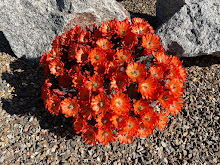
If the tomatoes shun the hot nights then this little plant is quite the opposite. It doesn't even want to open its flowers until later in the day when the sun is beating down with all its ferocity. Afraid that it would not be hardy in our winters I took cuttings in the fall and kept them alive over the winter, replanting them when danger of frost had passed. The plant sulked for the longest time until conditions were to its suiting. The time has come. It is vibrant pink like the portulacas but the leaf is small. Anyone know its name?
I always buy a couple of 4" pots of portulaca, Portulaca grandiflora. That is all you need because they are so easy to root. Just break off a stem and stick it in a pot in a sheltered spot until it roots and then plant. Notice the competing wine cup among the pink portulacas.
The difference between these plants and the first one is , these open their flowers as soon as the sun comes up and the other creeper opens its flowers as the portulaca is closing.
Here is another member of the portulaca family, shaggy portulaca, Portulaca pilosa. It appeared in the gravel and opened its flowers this week. It is native to texas and will cover the ground with a rosy mat of flowers. It seeds easily, hence its appearance in my garden this year. I won't give a mention to that other purslane, the weedy one, which doesn't ever produce a visible flower but manages millions of seeds. Plenty of that over here.
Subscribe to:
Posts (Atom)