My Blog List

Showing posts with label mealy blue sage. Show all posts

Tuesday, April 27, 2021

SPRING IN THE SUNKEN GARDEN

 The area between the house and the pool was a blank canvas and perfect to create a sunken garden. The inspiration was partly inspired by the many sunken gardens I have visited in England, my grandfather's garden where I spent my teenage years and the sunken courtyard at the Lady Bird Johnson Wildflower Center. Many of the rocks dug up during the building of the house were saved in order to create a foundation wall around the sunken area. The floor is Arizona sandstone over decomposed granite. I'm sure the builder was happy not to have to cart those rocks away. Nature has done much of the planting and I am happy for that although it does create considerable work keeping it under control. But, both David and I delight in all the blooms that appear-as if from nowhere. The scene changes from week to week and from year to year. Spring is the most floriferous time.
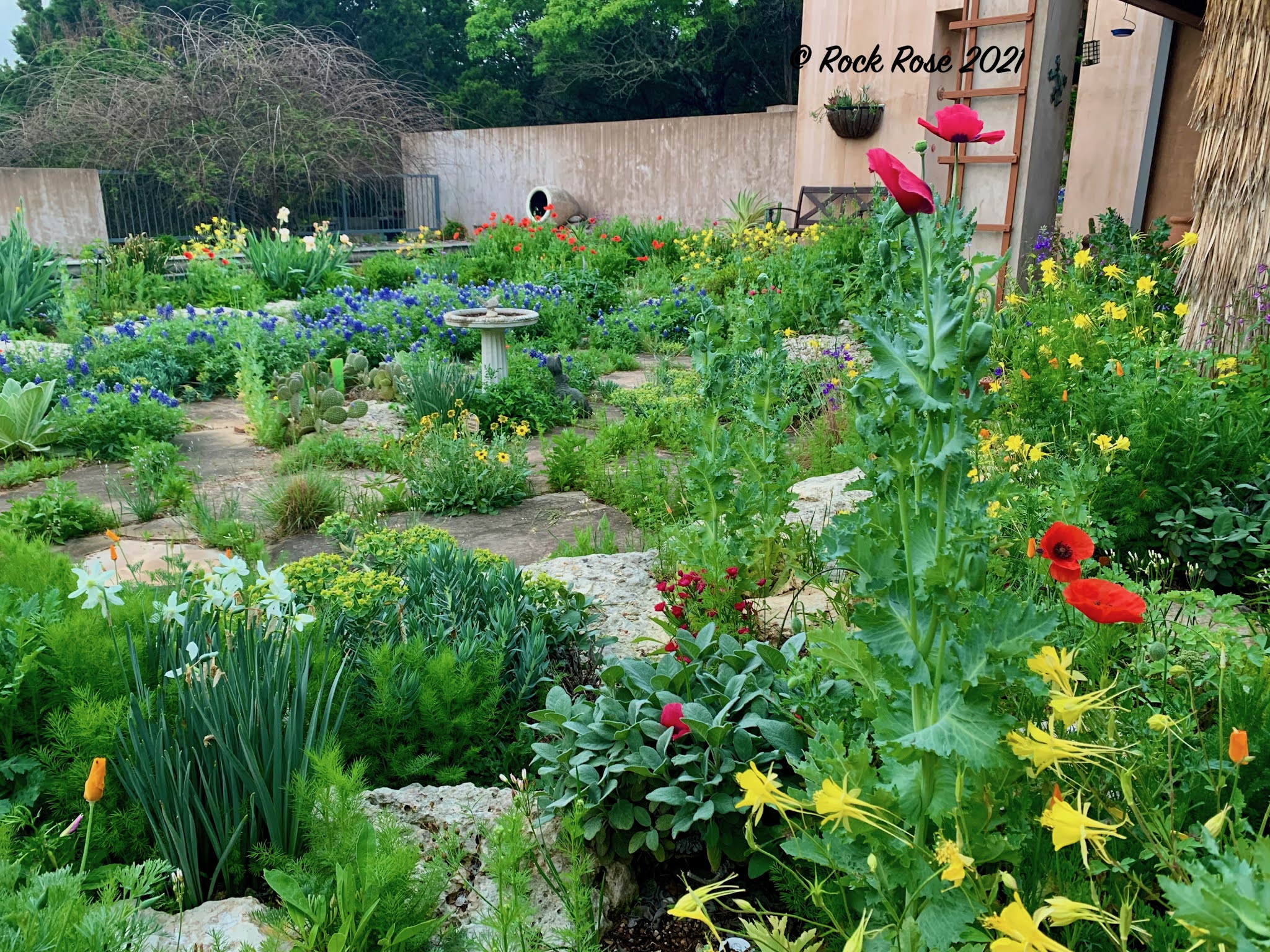
The only step down is along the front and even here it requires some agility as a Gulf Coast penstemon, Penstemon tennuis, has seeded right in the middle of the two stones. How could I possibly pull it when it was so happy there. I love this penstemon but it is prone to root aphids, placed there by ants who farm its honeydew. They are not easy to control and will kill the plant.

A few plants have been with me since the beginning and one is the chocolate daisy, Berlandiera lyrata, 

Compact in the early weeks it does eventually become rather rangy. It has only seeded in one other place and I suspect this is because I usually cut it back part way through the season and the new seed heads may not have time to mature. 

Mullein, may be considered a weed by many but I love its beautiful form over the winter before sending up a tall flower spike with yellow flowers. It is also a favorite of the bees. Many may seed but only a few will be chosen. This was a lucky one on the lower level.


In early spring bluebonnets can really take over and I'm afraid this year I have let rather too many and some of the plants growing beneath have suffered. A single bluebonnet plant can spread to cover 3' and is better suited to a meadow setting.


Hinckley's yellow columbine. Here there and everywhere as usual.


 It is always interesting to watch how plants grow and move. A large cluster of bee balm was gradually evicted by this yellow iris, so that now there are only a few plants left. Time for the iris to be divided and passed along nd maybe the bee balm will move back in.


 I always let the corn poppies grow wherever they wish. Easy to pull out and something will always take their place later.
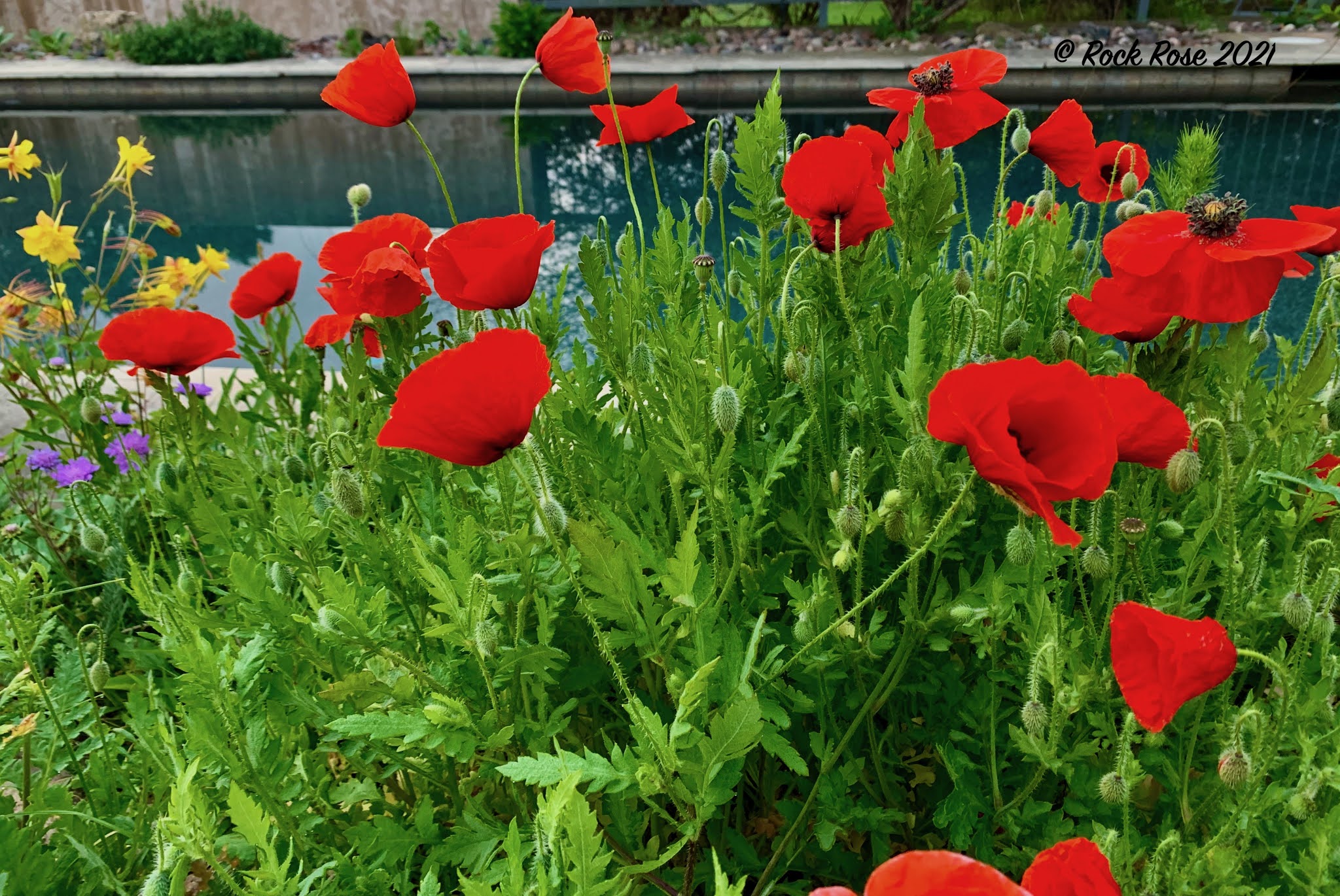
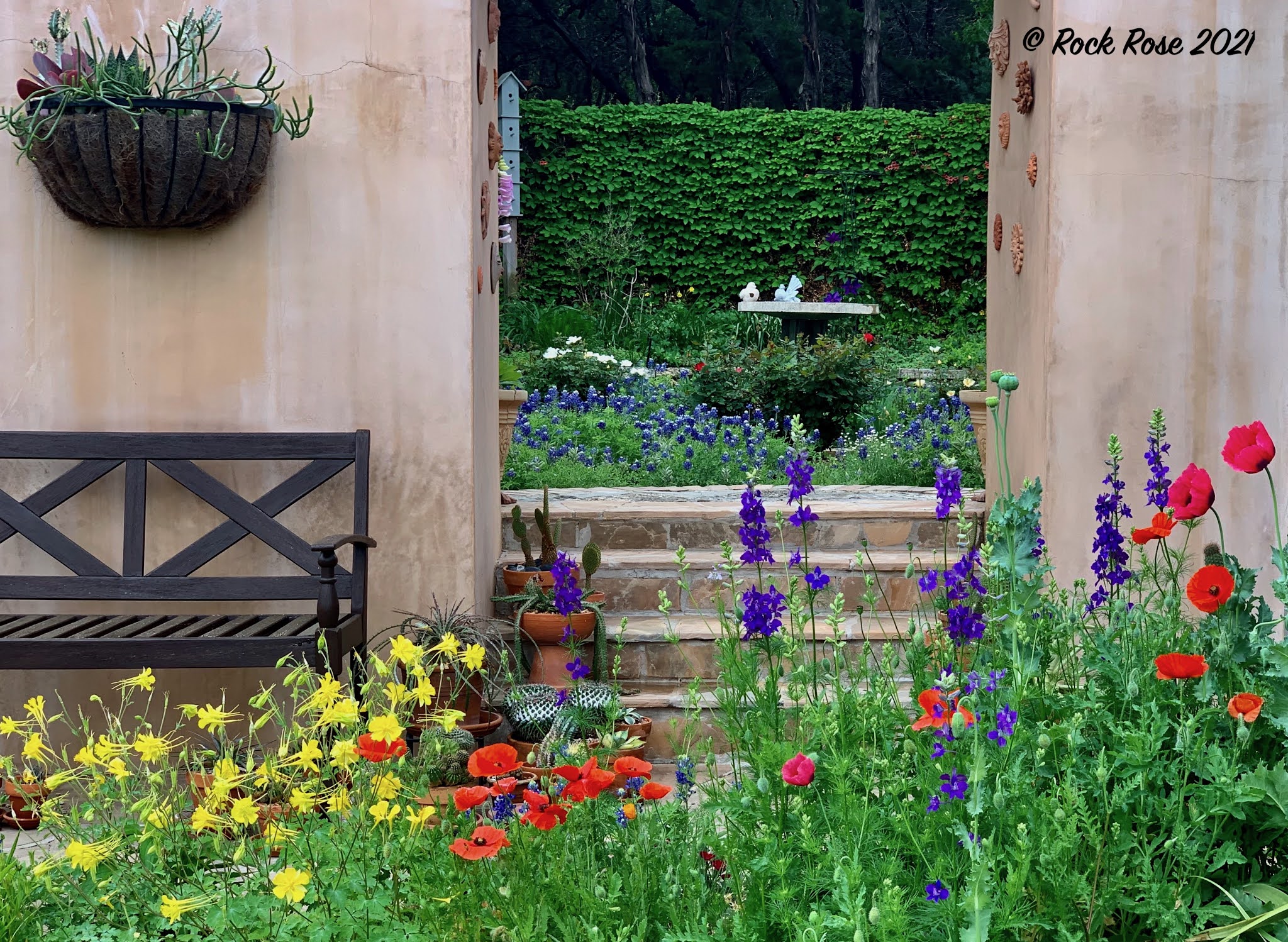
One of my favorite views is standing in the sunken garden and looking up to the Sun and Moon Archway. A mix of columbine, larkspur and poppies.
 

The gopher plant, Euphorbia rigida, has flowered and gone to seed. Some of the longer leaves have been removed to leave a small cluster of seed heads for seed saving. Nigella hides the leaves of the faded daffodils above the  mealy blue sage and larkspur.
 

Late April and the wine cups begin to bloom and spread, and spread and spread! Frequent trims will keep them in order. 

There will be a few plants missing this year and they will be missed. Two beautiful Pride of Barbados were lost to the freeze. The seed had appeared from nowhere and we had several years of their summer blooms. There is however, a very small one growing between two of the ledgestones and possibly in a more favorable place. 


It's time to get out there and remove some of the more boisterous residents in the sunken garden.

Wednesday, October 21, 2015

WE'LL GROW WHERE WE WANT TO GROW

It would appear that most of the time I don't have much say in where plants are going to grow. I would like them in the beds. They would like to grow in the pathways.


This is the scene between two of the beds in the vegetable garden and is played out in may places in the garden. Here's another grouping slap bang in the middle of the two beds. They all want to be in the same place. Mexican feather grass, alyssum, narrow-leaf zinnia, Zinnia linearis, and a gaillardia, Gaillardia pulchella.


My job is to do some weeding out so that we can actually walk through the area. As usual the ruby crystal grass seedlings have been abundant. I must have pulled out over 50.


It is hard to believe that 4 weeks ago there was nothing growing here except the mealy blue sage, Salvia farinacea.  More narrow-leaf zinnia, Zinnia linearis, dahlberg daisy, Dyssodia tenuifolia and gomphrena, Gomphrena globosa.


The one disappointment this year has been the seedling chocolate daisy, which seems determined to co-habit with another seedling gopher plant. You can see the pair here in the lower center of the photo. I am wondering how this is going to play out. Should I make the choice for them?
This is the sunken garden where I rely on plants to self-seed.


Another plant that is in abundance this year is the native frost weed, Verbesina virginica. I saw this being sold as a shade plant at a recent Lady Bird Johnson Wildflower center sale. In my garden it has seeded with abundance this year in full sun. Not only does it put on this floral show in the fall, but when we have a frost it will exude water from the stem which will create  incredible crystal like structures. For now it is a favorite of the bees.


It is always a thrill for me to find a special plant has reseeded. Such is the case with this Philippine violet. It found a spot right along the edge of the path. I hope I can get it out without damage when it loses its leaves.


A similar seedling along the edge of the walkway to the patio was never removed. It is a good job that it dies back every winter because it is now too late to move it. Why do they always choose the edges?


This garden just wouldn't be the same without all the help I get from mother nature.

Saturday, April 6, 2013

BE CAREFUL WHERE YOU WALK

If I have said this once I have said it a thousand times. Is it any wonder. And what happened to the resolution that I would keep the pathways cleared this year?


I can't help that the rose Zephirine drouhin happened to start growing right at the top of the ramp. We can't use this entrance any more. Even without the rose the bluebonnets bar entry at the bottom. This ramp was supposed to make it easy to get the wheelbarrow up into the garden!


And do be careful as you go round this corner, please.


I wouldn't even try to walk this way.


Or this.


It's getting tough to get to the water barrels.


And those bluebonnets are taking over in the English garden once again.


And soon you will have to jump over the trailing wine cup. Ah, well. Maybe next year.

Tuesday, April 3, 2012

FLORAL FRENZY

 With unseasonably warm temperatures day after day the whole garden wants to be a part of a floral frenzy.


Damianita and mealy blue sage.


Claret cup cactus, Echinocereus trilochidiatus.


Pink poppies.


An unknown yellow iris. This one blooms a little later than the others.


Zepherine drouin in the back corner. The amazing thing about this rose is that it grew from a root that grew through the bottom of a potted cutting growing in this very spot. When I removed the pot I noticed this wiry shoot growing between the limestone path. It grew into this lovely arching rose. No extra water or fertilizer and yet it blooms faithfully every year. It is the same pink as the bush knockout in front of the wall but has one difference. It is extremely fragrant. The mother plant grows in the front courtyard.


Mock orange, Philadelphus coronarius Natchez. My only regret is that I didn't seek out the native one which has a fragrance.

Friday, April 15, 2011

GARDEN BLOGGERS' BLOOM DAY, APRIL 2011

Can it be that there are still blooms left in the garden, after our weeks of endless heat with no rain. It's time for those northern gardens and other gardens around the world to take over and show us their blooms. Join Carol, at Maydreams and share your pretty flowers.

I like to see long shots of the garden but there is a time and a place for close ups of flowers and today is the day. Bloom day.

It was hard to believe that the mock orange would flower this spring. After all it flowered twice last year. At its normal time in April and then again in late October. We had such a mild, summer-like fall it was clearly confused. But it did.

I love the pink evening primrose when it spills out from under the Salvia greggii. So what if it's invasive. I just keep pulling it out where I don't want it.

Frilly pink poppies. I'm doing some serious pulling of the single flowered variety. I love this one. But what a disappointment that there were no purple ones this year.

The first of the purple cone flowers.

and Love-in-a-mist, Nigella. Great for dried seed heads.

The first rock rose bloom.

And those nasturtiums. Although I sampled the flowers when we were at Red Butte Gardens last year, they haven't yet appeared in my salad bowl.

And some poor gaillardia, with monstrose form.

Lots of flowers on the chive. More flowers for the salad bowl.

It remains to be seen if these will develop into full sized pomegranates. The tree definitely has a problem. Boo hoo.


Sedums, Sedum potosenum, sparkle with star shaped flowers.

Dahlberg daisy and wine cups in the sunken garden.

A mass of blue eyed grass, Sisyrinchium are still open at 8 o'clock in the evening.

I hope this guy didn't drop in for dinner.

Mealy blue sage, Salvia victoria, can be a bit of a pest. After it has flowered I cut it back and it blooms again and again. The goldfinches love the seeds in the fall.

The first rose campion, Lychnis coronaria, flower. The dry winter means there won't be so many this year.

But there will always be lots of blanket flowers, Gaillardia spec.,

We trimmed back the cedars in the English garden this year and the Texas clematis Clematis pitcheri, really appreciates getting more sun. So much so that David extended the trellis.

This columbine has reproduced itself in the master Spanish oak garden. It makes a welcome change from the Hinckley's yellow.

More flowering sedum.
Hope you are enjoying bloom day in your garden. Thanks Carol, for hosting