My Blog List

Showing posts with label penstemon. Show all posts

Friday, August 4, 2023

A STUNNING DISPLAY OF YELLOW LUPINS

Sixteen miles north of Ketchum, Idaho, we turned onto Baker Rd. The road is a dirt road which travels about 10 miles up the valley, climbing 1000' to the trail heads for Baker Lake and Osberg Ridgeline Trail. We have hiked Baker many times but this time we were to take the Osberg Trail.

 The hillsides here were changed dramatically 10 years ago when a major forest fire swept though here burning much of the forest. It is hard to imagine a great trail climbing up through the burnt out trees but we were in for a surprise. 

It was a chance meeting with a couple who were summer volunteers at the Sawtooth Visitor Center. We had met them in Organpipe NM in February and as they told us they would be volunteering there this summer we were camping close by we popped in to see them. They told us about the fabulous stands of fireweed, Chamaenerion angustifolium, growing along the hillside. Fireweed is known as a pioneer plant, quickly colonizing areas of burnt or disturbed land. We couldn't miss out on the opportunity to see them.

The trail first dropped down to cross the creek where monkey flowers, Mimulus, lewisii, and Mountain shooting star, Dodecatheon, find their perfect niche.
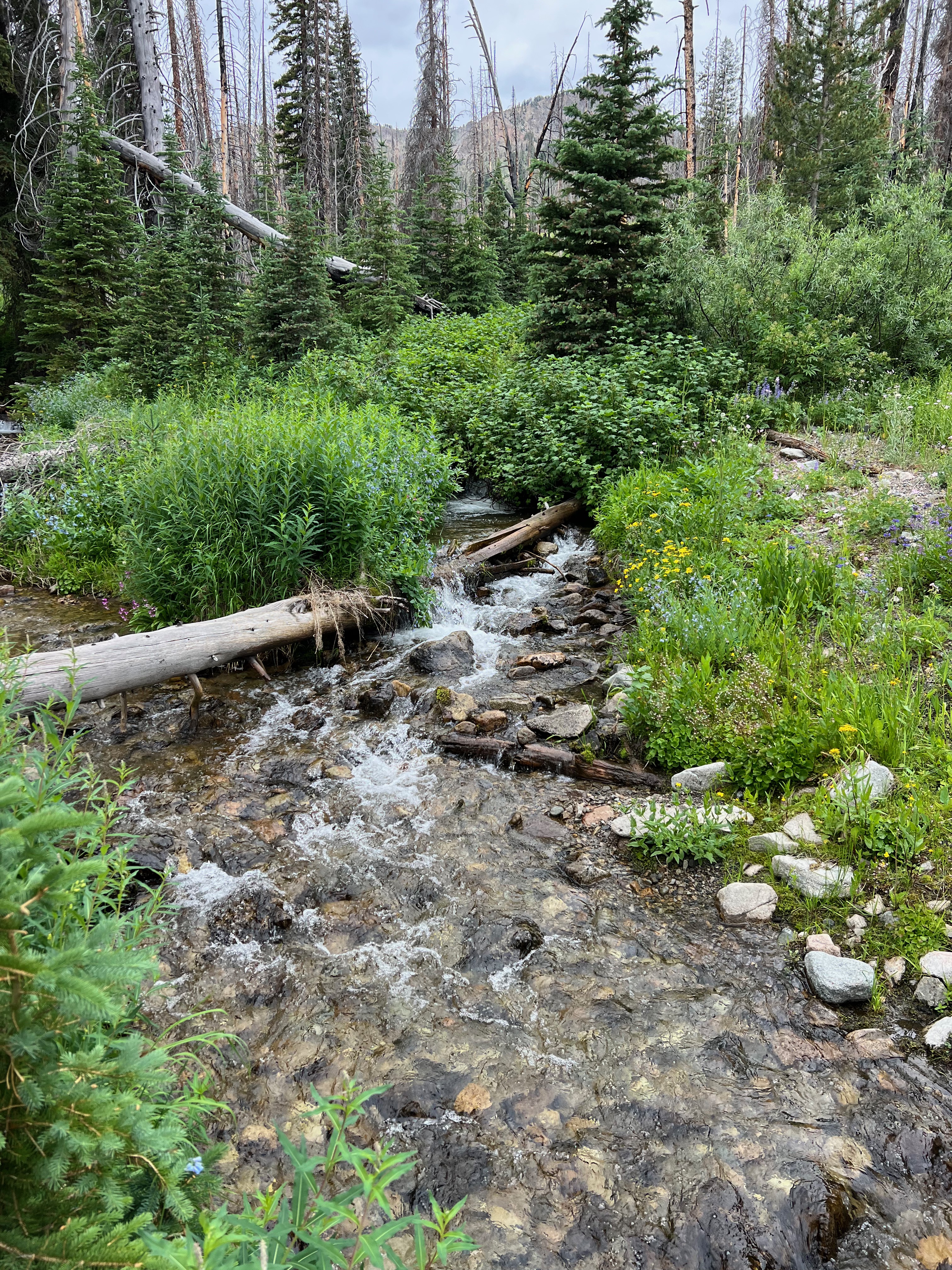


 Elegant camas, Anticlea elegans

We then began a steady climb up through the forest. As usual I was stopping frequently to take photos. 


 Sticky geranium, Geranium viscosissimum, and Streambank wild hollyhock


Mountain dandelion, Agosteris

Lots of fireweed but only the odd one blooming. They are a few weeks away from blooming, their flowers only yet in tight bud, which surprised me. I had imagined a huge display of pink would greet us. Maybe further along.


It's hard to keep a good hiking pace going when you constantly stop to take a photo. It is not often I spot Monkshood, a plant with which I was so familiar in England. and along the edges of the trail penstemons. Some pale in color some bright purple.

 I will forever call them bluebonnets after living in Texas. Here I must call them lupins as they are much paler in color, sometimes verging on white with tinges of pink and yellow. 


White yarrow against a burnt tree stump. 


 All these wildflowers are familiar characters in the Sawtooth Mountains. 


Lewis's blue flax, Linum lewisii above.

 and phlox, Leptosiphone nuttallii.


 And the gorgeous white Mariposa lily, Calochortus eurycarpus. But the best display was yet to come as we spotted large swathes of yellow on the bare hillsides above.


 The lupins had kindly left open a narrow trail through which we could walk without disturbing their beauty.


Even David, and this is rare, took out his phone and began taking photos.


And here a white lupin alone among the yellow.

We were absolutely besotted with the spectacle before our eyes. How fortunate we were to have caught the display at its peak and on a perfect cloudy day. All the way down I was trying to come up with adjectives that would best describe the scene we had witnessed. Magnificent, spectacular, mind blowing, stunning? and then I remembered a little bit of British slang, I thought gobsmacking might just fit the bill. 

So it wasn't fireweed but lupins that were putting on a show. But there is no doubt that fireweed will have its turn in the coming weeks.


Saturday, March 18, 2023

HOME IS WHERE THE GARDEN IS

We recently returned home from a wonderful trip to Organ Pipe Cactus NP. It is only 3 hours away and we towed our trailer there, spending 6 nights. When it came time to leave I was wishing we could stay longer but then arriving back at our house I felt, for the first time, that this was coming home. There were many things I had been missing over the year but one of them was enthusiasm for writing a blog post, as well as continuing work in the garden. I began to feel as though the whole blogging thing was at an end. I started but failed to finish several posts. I wasn't even reading any blogger posts. It was a missing part of my life that I had enjoyed so much. Feeling in a much more positive mood I am hoping to revive it. 

While we were gone Oro Valley was treated to 4" of snow. The internet was full of pretty photos of the saguaros and all trees dressed in white. Oops! I had already put several cactus and succulents outside. It was as though I was being encouraged to stop gardening in pots in a harsh summer climate with occasional surprise winters. My Mexican lime tree, the least hardy of all the citrus and still in its pot, had been put outside again. It was in full flower as we left. 

We left the highway and made our way across the desert floor and into the neighborhoods surrounding the house I couldn't help but notice the damage on many of the bushes already in leaf. The brittle bushes were brittle! I didn't hold out much hope for some of my plants and particularly my trailing lantana which had survived several freezes, the pots of spring flowers, the blooming lime tree. As we pulled into the driveway I was greeted by the lantana, still blooming and the first of the penstemons, P. greggi. 


The flowering lantana was a surprise. I wonder if this area is more sheltered. Is it possible that being at the high spot on the street we get the benefit of any frost rolling away. Having previously lived years in a low frost pocket this will be a treat. 

I walked out onto the patio and startled a big, fat rabbit. It was feasting on the wild red flax I had so lovingly and patiently grown from seed. Eaten down to a couple of inches. Poppies and nigella were left intact. The good news is the flax is now growing again and possibly better for the pruning. It is now protected from nibblers, at least for the time being. A firecracker penstemon blooming behind the red flax plant.The problem here is that I can keep the javelinas out but the smaller critters are a devil for eating smaller succulents, the fresh centers of young agave and small cactus. I am protecting a few small plants with the wire waste baskets I picked up at the dollar store.


The rabbit really likes the chocolate daisy-well who doesn't- and I was successful in starting some from seed last year so I have quite a few to protect. More trips to the dollar store in my future.

The grapefruit tree, planted last spring was also on my worry list but it came through the snow like a trooper and is now making flowers buds. Will we have grapefruit this year? I have learnt that citrus are incredibly fussy and the slightest thing to upset them will make them drop their fruit. The wrong kind of watering is number one. They must have deep watering and be allowed to dry out some between watering.

In the event it doesn't produce I can fall back on the 3 neighborhood grapefuit trees which have provided us with a morning grapefruit since the beginning of the year. 

The self watering planter boxes I picked up an estate sale for a few dollars survived a week away. I filled up the tank before I left and the Swiss chard and herbs were looking very good. I like these boxes so much I have just ordered 3 more. You can find them https://www.agardenpatch.com


 I plan to use the area under the bedroom window, with the boxes raised up on blocks and  partially shaded during the summer. David is in the process of adding an irrigation line. In the past we have used a battery powered line for pots, but I always have concern about leaving the house water on when we leave. This way watering will be independent of the house line. David visited the sprinkler parts store where they kitted him out with everything he needed. Our irrigation is drip feed as the most important thing here is long slow watering.


The ground here is nothing but desert sand so is fairly easy to dig a trench by hand, following the two other lines, to trees and shrubs. Well done David. The hard part will be deciding where to put the emitters as it is usual in the desert to put the emitter in the pipe rather than at the end of the 1/4" line. This will be my job. The boxes should arrive this week and then we will set up the boxes and emitters. 

Lots of plants are beginning to break dormancy including the bougainvillea, anacacho orchid tree, and Meyer lemon.


There are small buds on the lemon that was planted in the ground and the calamondin is once again flowering like crazy. I think it may be another stress bloom where no fruit sets. 


Stay tuned for views of the desert superbloom.

Thursday, May 7, 2020

MAY IN THE SUNKEN GARDEN.

I am often surprised by the continuation of flowering in the sunken garden into May and June. As I remove the spent blooms from early flowering annuals such as Nigella, bluebonnets, poppies and last years blanket flowers there is a whole new cast of characters waiting in the wings, some perennial some annual.


The red in the foreground is the native Rock Penstemon, Penstemon baccharifolius, which I cut back early this spring. It's another red flower I have come to love and a favorite of there humming bird. It absolutely demands dry calcarious soils which is just what it gets in the sunken garden. No amendments necessary. 


Another pretty red annual is the scarlet flax, Linum grandiflorum, seen here with coreopsis and gulf coast penstemon. 


Last year there was a lamb's ear plant about 6 feet away from here which withered during the summer. This one seeded here and grew over the winter and I hope some of its seeds will find a happy place to grow.


There are sprinklings of this coreopsis in just about every garden I have. The original was from a packet of seeds planted nearly 20 years ago. It does get a little tall and floppy so I had to stake it up. 


Keeping the trailing winecup, Callirhoe involucrata, under control is not easy. It will run across the paving as well as climb as much as 4' among taller plants.


Square-bud primrose, Calylophus berlandieri, with a few seed heads of Nigella and one of two stragglers.


There are several dwarf day lilies including these two which do well along the edges of the rocks. 


And scabiosa, which blooms all through summer and even during a mild winter.


And the common mullein, Verbascum thapsus, of which there are 5 in the sunken garden, is just beginning to flower. It is an invasive species having been introduced from Europe.


It gives me great pleasure to walk out there in the morning and see the new blooms of the day. Any yes it is constant work and will they all be there next year-probably because I just love them too much not to allow them to seed.
And who will be up next? The gauras, coneflowers, small flowering coreopsis and the prickly pear cactus. 

Sunday, April 17, 2016

YES! YOU CAN HAVE ALLIUMS

It's one plant I have never seen growing in a garden in Texas. Many years ago I bought a packet of allium bulbs. They were purple and looked quite large on the packet. They were no bigger than a nickle when they flowered.......one time and never to be seen again. I think they may have been drumstick alliums but they were too tiny to appreciate their blooms.


So when a gardening friend gave me some multiplying onions and they went to flower I thought to myself that they would look very attractive in the garden. And so they do. And the red admiral butterflies adore the flowers. And they come back year after year. And there is absolutely nothing wrong with white.

That's what I was saying when the first of my foxgloves started to open. A look of disappointment did pass across my face. I had picked up 6, 6" pots at my local nursery in January. I potted them up and actually took them over to my neighbors house to care for them while we were gone for the month of February. One thing an English girl has to have is her foxgloves.


But as the week wore on the flowers began to take on more of a pink tinge and today they are feeling extremely at home in the rain.


They have a little more pink in them than the flowers we call 'foxgloves' in Texas. That is the Penstemon cobaea, which I also have in my garden. You can see the resemblance.


I'm hoping there may be a diversity of color in the other 5 of my plants. Maybe something like this wild foxglove growing in a hedgerow in England.


The great thing about foxgloves is that for me they flower after all the bluebonnets and other early wildflowers have faded and they go on flowering well into May, sending up many bloom stalks on the one plant. They are well worth the effort of finding those 4" pots in the late winter.