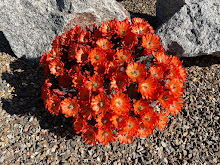
In a remote corner of southwest Texas, where the Rio Grande River makes a great arching sweep on its way to the Gulf of Mexico, lies Big Bend National Park. The one million acres of public land with dramatic mountains and desert landscapes is located entirely within the Chihuahuan Desert. Because it is so far from any urban area it is one of the least visited of the National Parks. We are indeed fortunate that it is only 500 miles from our home! Along with friends from DC we spent 3 wonderful days camping in the park this week. The weather was perfect and the hiking outstanding. Even with the lack of rainfall that the area has experienced this year there were plenty of interesting flowers to photograph. The ocotillo, shown above, can be relied upon to bloom even without rainfall but will only produce leaves after rain has fallen.

Blind Pricklypear (
Opuntia rufida)
Many of the pricklypear were in flower. Some orange some yellow and some were getting ready to put on a splendid show in the days to come.

Our first hike was on the Hot Springs trail where we witnessed some of the destruction caused by tropical storm Lowell last September. So much rain fell on the watershed of the Rio Conchos (Mexico) which drains into the Rio Grande, that the dams spilt over sending tons of mud and silt down into the park. The park rangers considered the deluge of water a good event as it also cleared out tons of trees that were blocking the river upstream and preventing the normal flood cycles. However, it left behind several inches of mud which has now dried hard and cracked.

The earlier part of this 6 mile round trip hike winds up the side of a limestone cliff to the top of the bluffs overlooking the Hot Springs Canyon. Along the way we saw several cactus in flower.

Claret cup cactus (
Echinocereus coccineus)

Strawberry cactus (
Echinocereus enneacanthus)
Texas rainbow cactus (
Echinocereus dasyacanthus)

We spotted this fossil ammonite in the trail.
When we came down to river level we saw cascades of the Yellow Rocknettle, Eucnide bartonioides.

Down at river level we enjoyed a soak in the hot springs. You can see the Rio Grande behind the pool.

Our second hike was to Cattail Falls at the end of Oak Creek Canyon. Crossing the desert floor before entering the canyon we passed through a forest of sotol.

I am familiar with this plant as I used to have one in my front garden. It very quickly outgrew the space and was very difficult to garden around as you can see from the dangerous teeth on the leaves. It was removed and is now growing where it has plenty of room.

Once in the canyon the vegetation became more lush with maidenhair ferns, columbines and this delicate orchid which we have yet to identify.

For the first time I was able to identify poison oak. Very similar to poison ivy.

On the way out we spotted this the brown flowered cactus among the dead sotol leaves. It is one of the earliest cactuses to bloom.

Brown-flowered cactus (
echinocereus chloranthus)
Later a short hike took us across Terlingua Creek into the Santa Elena Canyon. As with the rest of the park the other side of the river is Mexico and the walls are sheer on the Mexican side. The US side affords just enough room to hike some distance into the canyon until the canyon wall meets the river.

Although the trail was not our favorite the hike down to the window was by far the most spectacular. There was a strong wind blowing through the gap towards us otherwise there would have been no way we could have stood on the edge. Even so you can see my knees are a little bent.

We saw many Mexican Buckeye and Flame acanthus along the trail as well as numerous unidentified bushes and trees.

One of the highlights of the trip was the frequent sighting of the Vermillion flycatcher around the campground. I believe this is the extent of this flycatchers range into the USA. As you can see it was difficult to get a shot.

As was the photo of the Javelina- taken from the car.

It was a great trip and I have no doubt we will be out there again in the not too distant future.
 Thanks to Carol at Maydreams gardens we are able to share our gardens each month. Damianita's sunny blossoms are a sure sign that it is April in Texas. It is one of a few deer resistant flowering plants for outside the walls.
 Inside or out the fragrant Trachelospermum jasminoides perfumes the air. Here by the front door it wafts into the house when the door is opened. I have two varieties of this evergreen vine. This one has a yellow tinge to the flower.
 In the back garden is the white variety.
 Two more yellow blooms showed up this week. Zexmania-
 Englemann's daisy, Englemannia pinnatifida.
 It was a surprise to see love-in-a-mist, Nigella damascena, in its white form this year as last year they were all blue. After the flowers fade the seed pods make a lovely dried bouquet.
 Under the Lady Banks rose, lyre leaf sage, Salvia lyrata, lights up a shady spot. It makes a great ground cover and re seeds easily.
 Their leaves are bright green with darker markings.
 The first blooms of Lantana horrida.
 Scutellaria wrightii.
 Such an easy , reliable plant. Gulf coast penstemon, Penstemon tenuis.
 It makes me wonder if there will be anything left to bloom in May!