So here I am after a full day outside. Walked 5 miles, worked outside until I was dropping, showered then set to work on the pomegranates.
I need a little entertainment while I work and today it was listening to an episode of Gardners' Question Time on BBC Radio 4. I can't begin to tell you how much I learn listening to this show.
Recently I learnt that all those nitrogen fixing nodules on the roots of legumes are almost completely depleted after flowering. So when I strip my bluebonnet nodules off, after flowering, and turn them into the soil there is little nitrogen left. I have to do it before flowering. As though I would do that! But, I am growing a cover crop of Austrian peas, in two of my veggy. beds, this year and I will be digging them in.
I learnt that the reason one clump of narcissus failed to bloom last year is because they are getting far too much shade now, underneath the yaupon holly. So I dug them up and replanted in sunnier locations. There were 39!!
Earthworms don't like to be disturbed so don't be turning over the bed each time.
So the show I listened to today was from the village of Walsham le Willows in Surrey. I think you would find the show interesting and highly entertaining and available as a podcast.
At the very end, as I removed the arils from another pomegranate, I learnt that it was unlikely to be the the apple which tempted Eve. More than likely it was the pomegranate. Who wouldn't be tempted by those plump little beauties
Monday, November 14, 2011
Saturday, November 12, 2011
JUST WHEN YOU THINK IT WILL LAST FOREVER
Just when you think it will last forever summer is over in a flash. Jack Frost pays your garden a visit and takes away with him much of your lingering color.
We have had two freezes in the last two weeks. The first one dipped into the 20s. It was just for a few hours but what a difference those few hours made. Gone are the tithonia, gomphrena, most of the zinnias. The garden is taking on her winter cloak. A sudden bareness.
Yesterday, in a more sheltered, shady spot by the front entry gate, it was time to deal with the mountain of potted pothos that had grown during the summer, trailing and rooting alongside the wall. After taking a few cuttings, to root in a glass jar, I sat down and began a serious cutback. I was just pointing out to a visitor last week that I never sit on this bench. I was wrong.
It was the perfect place to sit and do the job. I also trimmed the tips of the A. demettiana, which will go inside for the winter. I'm not the one who has to carry this inside and I'm very cognizant of things that could cause eye damage these days.
Then I turned my attention to the sunken garden pulling out the faded zinnias and the masses of gomphrena.
What lies beneath would make a good title for a posting. So many things come to light after removing the summer planting. This ice plant can now enjoy the spotlight.
Billowing mounds of alyssum need to be cut back so that they will once again take on a more compact form.
It isn't easy to cut back flowering plants but I am thinking now of spring. I want my alyssum to look like this one which was cut back to nothing several weeks ago. Although I love the deep purple one I have all shades from purple down to white. It is another of my reliable re-seeders. The bees love it and it perfumes the air with its sweet honey fragrance.
While crouching down removing errant seedlings and weeds I noticed that the blue gilia, Gilia rigidula, is once again in flower. I have never seen this plant in a nursery and I don't know why because though a delicate looking and diminutive plant it is as tough as nails. Several plants on the chalky hillside have gone without water all summer and although not blooming like this one are starting to leaf out again. It seems to seed readily although I have yet to see the seeds. This one is growing by the rock in the center of the sunken garden. The soil is poor and dry and the constant shedding of the surface of the stone makes for a very alkaline soil.
I am certainly going to try to propagate this little beauty.
We have had two freezes in the last two weeks. The first one dipped into the 20s. It was just for a few hours but what a difference those few hours made. Gone are the tithonia, gomphrena, most of the zinnias. The garden is taking on her winter cloak. A sudden bareness.
Yesterday, in a more sheltered, shady spot by the front entry gate, it was time to deal with the mountain of potted pothos that had grown during the summer, trailing and rooting alongside the wall. After taking a few cuttings, to root in a glass jar, I sat down and began a serious cutback. I was just pointing out to a visitor last week that I never sit on this bench. I was wrong.
It was the perfect place to sit and do the job. I also trimmed the tips of the A. demettiana, which will go inside for the winter. I'm not the one who has to carry this inside and I'm very cognizant of things that could cause eye damage these days.
Then I turned my attention to the sunken garden pulling out the faded zinnias and the masses of gomphrena.
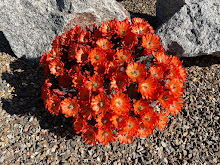
What lies beneath would make a good title for a posting. So many things come to light after removing the summer planting. This ice plant can now enjoy the spotlight.
Billowing mounds of alyssum need to be cut back so that they will once again take on a more compact form.
It isn't easy to cut back flowering plants but I am thinking now of spring. I want my alyssum to look like this one which was cut back to nothing several weeks ago. Although I love the deep purple one I have all shades from purple down to white. It is another of my reliable re-seeders. The bees love it and it perfumes the air with its sweet honey fragrance.
While crouching down removing errant seedlings and weeds I noticed that the blue gilia, Gilia rigidula, is once again in flower. I have never seen this plant in a nursery and I don't know why because though a delicate looking and diminutive plant it is as tough as nails. Several plants on the chalky hillside have gone without water all summer and although not blooming like this one are starting to leaf out again. It seems to seed readily although I have yet to see the seeds. This one is growing by the rock in the center of the sunken garden. The soil is poor and dry and the constant shedding of the surface of the stone makes for a very alkaline soil.
I am certainly going to try to propagate this little beauty.
Labels:
A. desmettiana,
Blue gilia,
frost damage,
ice plant
Thursday, November 10, 2011
11/11/11/11
I will always think of this day in November as Remembrance Day and hear the sounds of Elgar's Nimrod echoing in my ears from having watched the services and poppy wreath laying at the Cenotaph in Whitehall, London, when I was young.
Originally this day was called Armistice Day, to commemorate the end of fighting in WW I and the armistice signed on November 11th 1918. After the end of WW II it became known as Remembrance Day in England and Veterans Day in America.
One chilly November day we walked between the rows of gravestones at the British Cemetery in France.
Then walked those very beaches where so many lost their lives.
The WW I battlefields are known collectively as the Flanders Fields. The ground was so disturbed by mortar shells that it brought to the surface thousands of poppy seeds which bloomed the following year. The red corn poppy became the emblem of the fallen because of this and was immortalized in the words of John McCrae in his poem The Flanders Fields.
Originally this day was called Armistice Day, to commemorate the end of fighting in WW I and the armistice signed on November 11th 1918. After the end of WW II it became known as Remembrance Day in England and Veterans Day in America.
One chilly November day we walked between the rows of gravestones at the British Cemetery in France.
Then walked those very beaches where so many lost their lives.
The WW I battlefields are known collectively as the Flanders Fields. The ground was so disturbed by mortar shells that it brought to the surface thousands of poppy seeds which bloomed the following year. The red corn poppy became the emblem of the fallen because of this and was immortalized in the words of John McCrae in his poem The Flanders Fields.
Tuesday, November 8, 2011
THIS YEAR I'M GIVING THEM WHISKY
I think I have found a use for the bottle of whisky that has been languishing on the shelf for the last ten years. Here's the scoop.
Are you always disappointed in how your paperwhites produce long leggy leaves and blooms, which eventually topple over? Someone has found the answer and I just learnt about it.
Give them a tot of alcohol and it will stunt their growth without diminishing the bloom. You can read all about it here.
In the past I have potted up paperwhites in a low bowl filled with stones and water. They always disappoint me with their floppy blooms and foliage. Last year I bought the bulbs but ended up putting them in the ground and did enjoy their blooms. After the foliage died back I removed the bulbs leaving them in the potting shed over the summer. My plan was to put them back in the garden sometime after Christmas. I've changed my mind.
Most of these bulbs will not produce a flower this year so they are going back in the ground.
The largest I put in the hyacinth jar. I filled it with water and will wait until it has produced a 2" green shoot. Then it will get its holiday tipple.
I will pour off the water and replace with a solution of 1 part whisky to 7 parts water. This dilution will give 6% alcohol, the recommended dilution. Any spirits can be used as well as rubbing alcohol (which would require a different dilution). Don't use beer or wine as they contain sugars, which is just as well, in this house!
I was telling my husband about this over breakfast this morning. He said it must have an effect on water uptake. That's a chemist for you!
Are you always disappointed in how your paperwhites produce long leggy leaves and blooms, which eventually topple over? Someone has found the answer and I just learnt about it.
In the past I have potted up paperwhites in a low bowl filled with stones and water. They always disappoint me with their floppy blooms and foliage. Last year I bought the bulbs but ended up putting them in the ground and did enjoy their blooms. After the foliage died back I removed the bulbs leaving them in the potting shed over the summer. My plan was to put them back in the garden sometime after Christmas. I've changed my mind.
Most of these bulbs will not produce a flower this year so they are going back in the ground.
The largest I put in the hyacinth jar. I filled it with water and will wait until it has produced a 2" green shoot. Then it will get its holiday tipple.
I will pour off the water and replace with a solution of 1 part whisky to 7 parts water. This dilution will give 6% alcohol, the recommended dilution. Any spirits can be used as well as rubbing alcohol (which would require a different dilution). Don't use beer or wine as they contain sugars, which is just as well, in this house!
I was telling my husband about this over breakfast this morning. He said it must have an effect on water uptake. That's a chemist for you!
Sunday, November 6, 2011
THOSE WALLS
All who come to visit our garden are impressed by the walls that surround our house. They really are the result of an architect who listened to his client.
Let me quote here something I read recently. In 1220 King Henry III gave these instructions to his bailiff.
'to make round about the garden of our queen two walls, good and high, so that no one may be able to enter, with a becoming and honorable herbary near our fish pond, in which the same queen may be able to amuse herself'
Now, I am no queen and the idea here was not to keep people out but to keep out deer, and yes I do 'amuse' myself inside these walls, although many would not call it amusement. I don't have a fishpond, although I am so entranced by the tank ponds I see in my fellow blogging gardeners' gardens that I may just have to find a spot for a small one. In fact I think I may have just the spot!
Maybe Henry was the first to ask for such walls. If he was, then he started something because ever since then people have been building walls around their gardens. They may have used brick, stone, wood fences, tall hedges, but most houses have their 'walled' gardens. Ours may be a little different because they do not delineate the property, as many do, but rather create an oasis within our property.
The land slopes across the property and so the house, which is a single story, was built on three levels. Just a foot between each level. Then a long wall was built out from the where one level drops, with an archway and several 'windows'. This created a garden areas on the higher level, which we call our English garden, and our 'sunken garden' on the lower.
Here is a glimpse of what we had undertaken in asking for walls.
The walls were there but then it was up to us. You can see what we started with. We sit completely on solid ledge stone although they did bring in a load of 'red death'.
The first project was the short dry stone retaining wall which followed the curve of the wall. I saved every flat rock that was exposed during construction, making a huge pile, from which I built the wall.
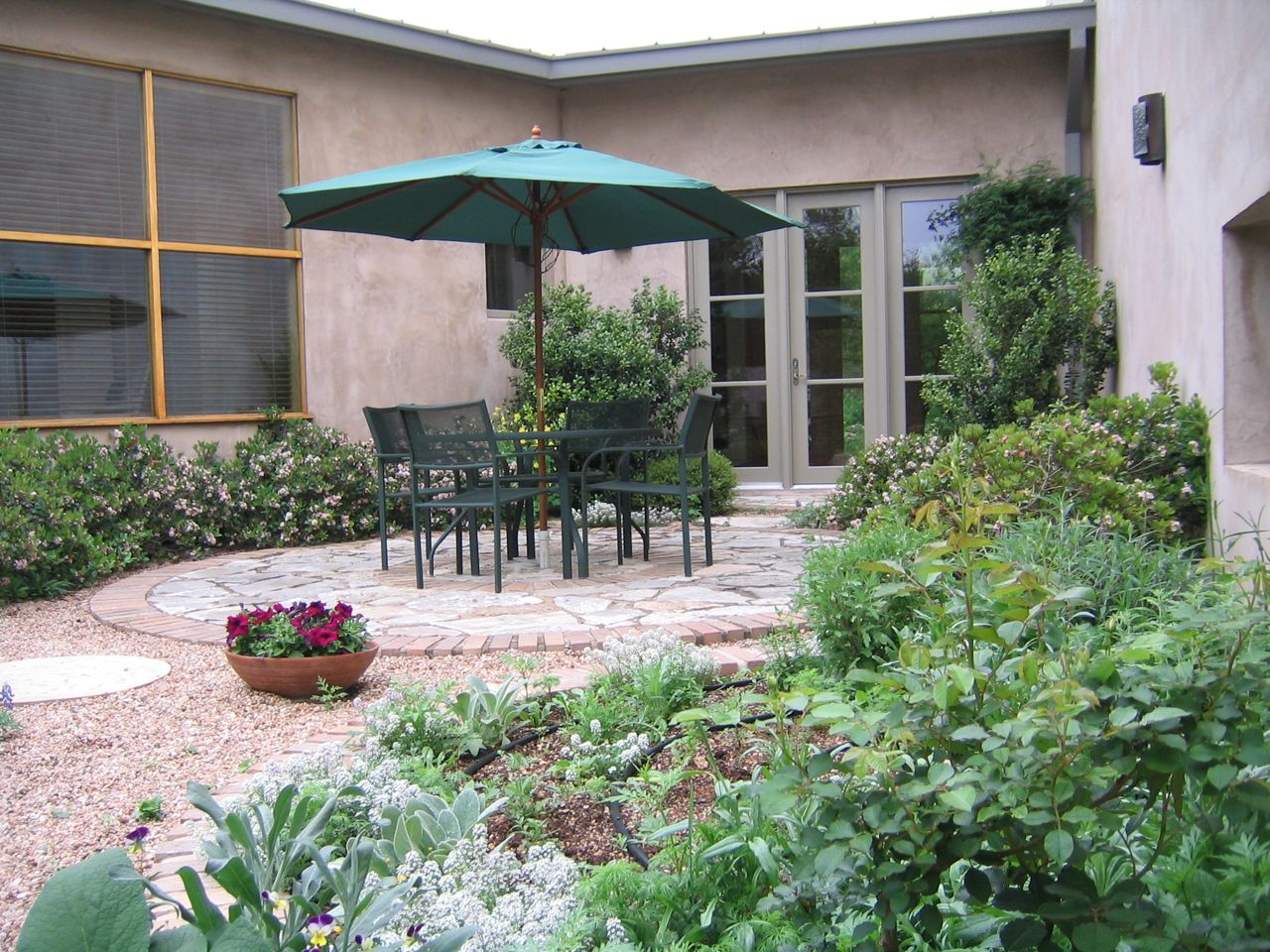
This curved wall really set the stage for the rest of the garden. What do you do when you have several angles and a curved wall? The easiest thing is to make everything else circular. The brick came from the Habitat for Humanity re-store. A bargain for a palette of bricks donated by a builder. More flat stones from the property filled in the brick edging. This was a project we worked on together. No plans on paper, just a circle marked out on the ground using string and a stick. I always liked doing jigsaw puzzles.
David made the circular pavers to complement the other circles and used the left over brick to make bed edging and the bird bath circle.
We eat outside when at all possible and so created multiple places to eat at different times of the year. Although this wasn't the first project we tackled I really think it was the most rewarding.
Let me quote here something I read recently. In 1220 King Henry III gave these instructions to his bailiff.
'to make round about the garden of our queen two walls, good and high, so that no one may be able to enter, with a becoming and honorable herbary near our fish pond, in which the same queen may be able to amuse herself'
Now, I am no queen and the idea here was not to keep people out but to keep out deer, and yes I do 'amuse' myself inside these walls, although many would not call it amusement. I don't have a fishpond, although I am so entranced by the tank ponds I see in my fellow blogging gardeners' gardens that I may just have to find a spot for a small one. In fact I think I may have just the spot!
Maybe Henry was the first to ask for such walls. If he was, then he started something because ever since then people have been building walls around their gardens. They may have used brick, stone, wood fences, tall hedges, but most houses have their 'walled' gardens. Ours may be a little different because they do not delineate the property, as many do, but rather create an oasis within our property.
The land slopes across the property and so the house, which is a single story, was built on three levels. Just a foot between each level. Then a long wall was built out from the where one level drops, with an archway and several 'windows'. This created a garden areas on the higher level, which we call our English garden, and our 'sunken garden' on the lower.
Here is a glimpse of what we had undertaken in asking for walls.
The walls were there but then it was up to us. You can see what we started with. We sit completely on solid ledge stone although they did bring in a load of 'red death'.
The first project was the short dry stone retaining wall which followed the curve of the wall. I saved every flat rock that was exposed during construction, making a huge pile, from which I built the wall.
This curved wall really set the stage for the rest of the garden. What do you do when you have several angles and a curved wall? The easiest thing is to make everything else circular. The brick came from the Habitat for Humanity re-store. A bargain for a palette of bricks donated by a builder. More flat stones from the property filled in the brick edging. This was a project we worked on together. No plans on paper, just a circle marked out on the ground using string and a stick. I always liked doing jigsaw puzzles.
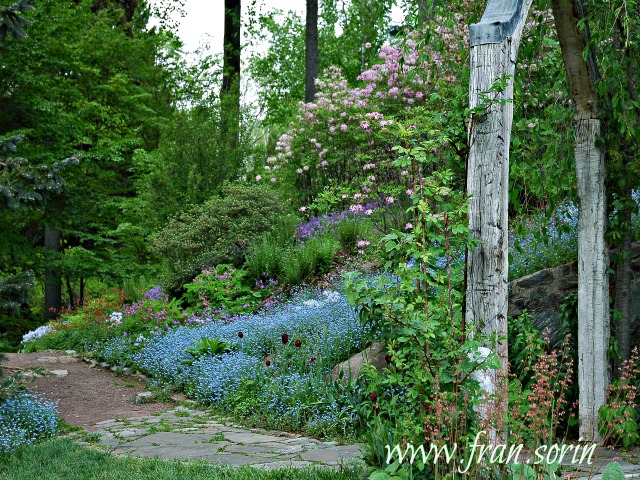
Spring in the English Garden
David made the circular pavers to complement the other circles and used the left over brick to make bed edging and the bird bath circle.
We eat outside when at all possible and so created multiple places to eat at different times of the year. Although this wasn't the first project we tackled I really think it was the most rewarding.
Saturday, November 5, 2011
WHO WILL BUY MY BEAUTIFUL POMEGRANATES?
Yesterday I picked the remaining pomegranates from the tree.
Yesterday the pomegranates were on sale at the grocery store! You really do have to wonder why so expensive when the trees are so prolific, easy to grow, and demand nothing in the way of fertilizer and water.
You don't even have to do the work of removing the arils anymore. At Costco they sell tubs of those ruby red seeds, albeit for a rather inflated price.
For a tree that is in complete decline it did pretty well this year. I think the main culprit must be a root fungus which started to show itself a couple of years ago after an unusually wet summer. The drainage may not have been quite adequate for such a wet season. The bark began to peel and branches slowly began to die back. Even so in its dying throes it produced an amazing crop. There are new sprouts coming from below so I am still undecided as to whether to remove the whole tree. For now another of the main trunks will be removed. I'm taking the 'never say die' attitude. I just don't want to think about a year without pomegranates.
Yesterday the pomegranates were on sale at the grocery store! You really do have to wonder why so expensive when the trees are so prolific, easy to grow, and demand nothing in the way of fertilizer and water.
You don't even have to do the work of removing the arils anymore. At Costco they sell tubs of those ruby red seeds, albeit for a rather inflated price.
For a tree that is in complete decline it did pretty well this year. I think the main culprit must be a root fungus which started to show itself a couple of years ago after an unusually wet summer. The drainage may not have been quite adequate for such a wet season. The bark began to peel and branches slowly began to die back. Even so in its dying throes it produced an amazing crop. There are new sprouts coming from below so I am still undecided as to whether to remove the whole tree. For now another of the main trunks will be removed. I'm taking the 'never say die' attitude. I just don't want to think about a year without pomegranates.
Friday, November 4, 2011
GARDENERS, WEAR YOUR SUNGLASSES!
No! This was not part of my Halloween costume.
It was the result of surgery that I underwent on Wednesday to remove a lesion from the conjunctiva of my eye. Sounds nasty. Not one of the best of life's experiences, but let me warn you. The sun probably did this. All those hours of gardening outside, eyes unprotected. How come when I hike and I am at the beach I always wear sunglasses. But I go out into the garden and never think about putting on sunglasses. That will be changing from now on.
The Dr told me that this is not uncommon, although it is less common now than it was years ago. That was because people generally worked outside more and generally spent more time outdoors.
So, take this as a gentle warning. Don't just put on sunscreen put on the sunglasses too.
It was the result of surgery that I underwent on Wednesday to remove a lesion from the conjunctiva of my eye. Sounds nasty. Not one of the best of life's experiences, but let me warn you. The sun probably did this. All those hours of gardening outside, eyes unprotected. How come when I hike and I am at the beach I always wear sunglasses. But I go out into the garden and never think about putting on sunglasses. That will be changing from now on.
The Dr told me that this is not uncommon, although it is less common now than it was years ago. That was because people generally worked outside more and generally spent more time outdoors.
So, take this as a gentle warning. Don't just put on sunscreen put on the sunglasses too.
Thursday, November 3, 2011
TONIGHT'S THE NIGHT
On Sunday I cleaned out the greenhouse. The winter home for my more tender plants.
It seems it was perfectly timed. A cold front is moving through Austin as I write. The wind is banging on the gates, lashing at the trees and making me nervous about a promised frost, for the hill country, tonight. We live on the Edwards Plateau, above Austin, and with the temperature likely to dip to 38 in town I know there is a risk of frost here. I will be moving my tender plants inside during the day today.
Do you like my benches? This was another one of David's projects. Isn't he the perfect husband for a gardening girl to have? I am so lucky.
It seems it was perfectly timed. A cold front is moving through Austin as I write. The wind is banging on the gates, lashing at the trees and making me nervous about a promised frost, for the hill country, tonight. We live on the Edwards Plateau, above Austin, and with the temperature likely to dip to 38 in town I know there is a risk of frost here. I will be moving my tender plants inside during the day today.
Do you like my benches? This was another one of David's projects. Isn't he the perfect husband for a gardening girl to have? I am so lucky.
Wednesday, November 2, 2011
FRUITS, NUTS AND SPICES
It would be a little difficult for you to ascertain the size of this botanical object without anything alongside to give you some perspective. It is actually 5" long and if you were to shake it you might think it was a rattle. Any idea?
You won't find it growing in my Texas garden. In fact this pod fell or was picked off the tree some time in 1941. That was when my father, who was stationed in Southern Rhodesia during WW2, (Zimbabwe in today's world), picked it up. It went back with him to England in his kit, along with some simple native wood carvings. It went to show and tell with me, when I was a little girl, and 3 years ago it sailed across the Atlantic and ended up in Texas. Why would I keep such an item? Who knows.
This is what it might have looked like when it was on the tree.
And this is what it would have looked like if it had chance to ripen. Those white coated seeds in the center are cocoa beans. Who would have thought.
I wasn't in Africa when I photographed this pod. I was on a mountain biking ride in St Lucia. We actually tasted the flesh around the seeds. It had a familiar taste not unlike cherimoya.
It was an interesting bike ride for a gardener whose eyes were glued to the flowers and foliage rather than the path.
We stopped again to look at a nutmeg tree.( I have a few nutmegs that I have had for at least 20 years). They are still fragrant when grated. That red lace-like covering over the nutmeg is mace. Dried and ground it has a more delicate flavor than nutmeg but like nutmeg is used to flavor potato dishes, baked goods and mulled wine.
The flowers on this tree will eventually produce coffee berries.
Can you guess the name of this fruit?
This is the ripe fruit growing on a small evergreen tree.
The yellow pear shaped structure is not the true fruit. The kidney shaped drupe growing at the bottom of the pear is the true fruit and contains one seed which is encapsulated in a hard double shell. The shell contains an allergenic phenolic resin called anacardic acid which must be removed by roasting. Because the smoke from the roasting is irritating to the lungs, roasting must be done outside.
Doesn't this give you a new appreciation for the cashew nut? No wonder they are so expensive.
You won't find it growing in my Texas garden. In fact this pod fell or was picked off the tree some time in 1941. That was when my father, who was stationed in Southern Rhodesia during WW2, (Zimbabwe in today's world), picked it up. It went back with him to England in his kit, along with some simple native wood carvings. It went to show and tell with me, when I was a little girl, and 3 years ago it sailed across the Atlantic and ended up in Texas. Why would I keep such an item? Who knows.
This is what it might have looked like when it was on the tree.
And this is what it would have looked like if it had chance to ripen. Those white coated seeds in the center are cocoa beans. Who would have thought.
I wasn't in Africa when I photographed this pod. I was on a mountain biking ride in St Lucia. We actually tasted the flesh around the seeds. It had a familiar taste not unlike cherimoya.
It was an interesting bike ride for a gardener whose eyes were glued to the flowers and foliage rather than the path.
We stopped again to look at a nutmeg tree.( I have a few nutmegs that I have had for at least 20 years). They are still fragrant when grated. That red lace-like covering over the nutmeg is mace. Dried and ground it has a more delicate flavor than nutmeg but like nutmeg is used to flavor potato dishes, baked goods and mulled wine.
The flowers on this tree will eventually produce coffee berries.
Can you guess the name of this fruit?
This is the ripe fruit growing on a small evergreen tree.
The yellow pear shaped structure is not the true fruit. The kidney shaped drupe growing at the bottom of the pear is the true fruit and contains one seed which is encapsulated in a hard double shell. The shell contains an allergenic phenolic resin called anacardic acid which must be removed by roasting. Because the smoke from the roasting is irritating to the lungs, roasting must be done outside.
Doesn't this give you a new appreciation for the cashew nut? No wonder they are so expensive.
Tuesday, November 1, 2011
ONE MAN'S ASH TRAY IS ANOTHER MAN'S...........
One morning I was out watering and water collected in a depression in one of our rocks. A little bird came to drink from the water. It wasn't at all shy about my presence.
We have multiple bird baths and a bubbling water feature but there is always room for more. Driving into the neighborhood on Friday I saw a sign to an estate sale. I pulled in to see if they had anything garden wise. Nothing of interest except half buried in the ground outside I saw this stone with water in it. When I asked about this forgotten piece of stone they told me $1. I'll take it. As I walked away the man said, "I think it was an ash tray" Then I saw the two places on the side to put a cigarette. Oh well, the birds won't mind I'm sure. I scrubbed it out and half buried it in the gravel.
Subscribe to:
Posts (Atom)