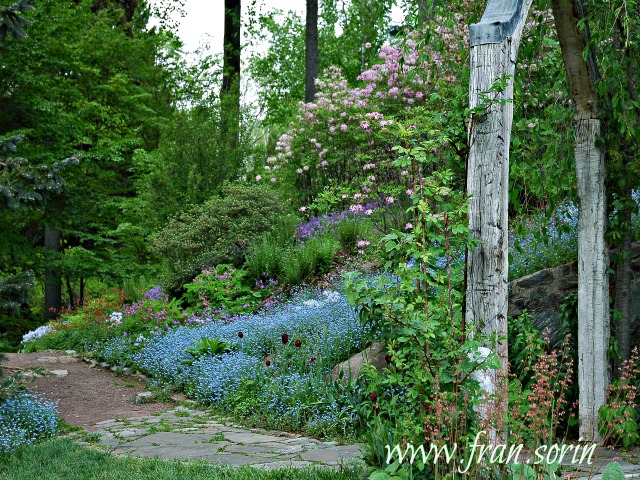
NATIONAL HERB CENTER, June 25th 2012
Just north of Banbury, near the village of Warmington, is the National Herb Center. It was our first stop on Monday morning. The sun is shining!
And on the air the wonderful smell of all those herbs. They are organized by family and there are so many. So many different thymes, rosemaries and sages.
As well as the plants for sale there are several demonstration gardens and nature trails. When someone identified this large shrub as a rock rose then I certainly needed to have my photograph taken with it.
The herb center has a commanding view over 3 counties. More than just a shop and garden center the trails lead down through countryside where, if lucky, you might catch sight of badgers, foxes and partridge. A maze, still in its infancy, will delight children in future years. For me a visit to the shop and a small garden purchase completed the visit.
Our next stop was to be Stowe Landscape Gardens. A strange name for an estate, and although I knew that this was the site of the famous Stowe School, I knew nothing about the gardens.
STOWE LANDSCAPE GARDENS
The estate has a long history from its beginnings as a modest walled garden in the village of Stowe to the present day. Various people have owned Stowe and left their mark on the gardens, but it was Lord Cobham, reputed to be wealthier than the king of England who made a statement in the gardens.
That statement clearly shouted out 'wealth'. This was once the main entrance to the property, and we stop to take a photograph of a scene meant to impress. That was what the wealthy liked to do and what better way to do it than creating a magnificent estate with incredible vistas, lakes and temples. At the time the estate came into the hands of Lord Cobham the head gardener was Lancelot 'Capability' Brown.
Although often credited with having started the so called 'Landskip' style, it was well under way by the time Brown came to Stowe although he did develop and popularize the movement. He was considered to be a great gardener but was also an astute business man. "It has great capabilities" was his favorite phrase, and so he became known as Capability Brown.
Suddenly everyone was tearing out their formal features, an example of which can still be seen today at Westbury Court Garden, and replacing them with man-made countryside; irregular lakes, low hills, clumps of trees and streams which had their course altered to bring them into view.
There were to be no more fences, no straight lines. Pathways must wind through the estate, kitchen gardens set miles away from the house. Nothing must interrupt the view of his artificial countryside.
The Temple of British Worthies.
The Queen's Temple, where a music student, from the school, appeared to be sitting a practical, piano exam.
There were many notable foreign and British dignitaries, and famous men of their time who came ot Stowe. Among them in 1786 John Adams and Thomas Jefferson who wrote that they didn't think ' the embellishments to the landscape, made by the owners of this great country, would suit the more rugged American countryside' I think he was right.
We now had quite a drive to reach our next destination.
ANGLESEY ABBEY AND GARDENS
Gardens of Anglesey Abbey were created by Lord Fairhaven. They are a mixture of formal design and open parkland. He chose the more common plants that would grow easily in the alkaline soils of the area. If we were expecting to find a ruined abbey we were in for a surprise. Although originally there was an Augustinian priory, the priory was destroyed during the dissolution of the monasteries. From then on subsequent occupants built, rebuilt and renovated until the building as it is today. Unfortunately the house was closed so we headed straight out into the gardens.
Our walk took us along the winding pathway though the winter garden.
A beautiful sculptural stand of silver birch.
And a seating area planted with Festuca.
The rose gardens.
The semicircular lawn with herbaceous border.
The formal garden with its planting of young dahlias, probably delayed by the cold summer.
And evidence of the rainy summer the whole of England was having.
Time to move on to our B&B for the night, West Stowe Hall. We were in for a wonderful surprise. Let me take you there tomorrow!
Thursday, July 26, 2012
Monday, July 23, 2012
SO WHAT'S GOING ON IN MY OWN GARDEN?
Three weeks away in a dream world of gardens and then the reality of one own's garden in the tough Texas climate.
At least we returned to some pretty good rains and the garden perked up immediately. We have resumed our breakfasts in the front garden and sitting for a few moments after breakfast gives me time to notice what is going on there.
The plants in the hypertufa bowls survived without any additional watering but they certainly looked a little yellowed. The great thing about succulents is how they perk right up when they do get water.
In the spring I planted a couple of new plants along the dry creek. One is a narrow leaf primrose which just put out a new flower. Now where is that label that I saved so carefully?
The other trailing germander, Teucrium cossonii ssp majoricum. It also put out a new flower today. I think the major time for blooming in both these plants will be the spring. For now I am happy that they made it so far. It was not an easy spring to put in new plants with the heat arriving very early and little rain.
The wider view is what I see while eating breakfast. A spear of sunlight just piercing the cutout in the breezeway wall. Later on in the afternoon the sun will beat down mercilessly in this garden.
The back of the vegetable garden will get a new look this fall with the installation of a tank in the corner of the potting shed. And I promise to keep this area free from plants next year. Well, maybe just the odd one. It takes too much time pulling them out.
The herb garden is holding its own.
Behind the pool the narrow leaf zinnias have softened the edge of the path.
and the gomphrena 'fireworks' is putting on a great show. All in all for late July things are looking pretty good.
At least we returned to some pretty good rains and the garden perked up immediately. We have resumed our breakfasts in the front garden and sitting for a few moments after breakfast gives me time to notice what is going on there.
The plants in the hypertufa bowls survived without any additional watering but they certainly looked a little yellowed. The great thing about succulents is how they perk right up when they do get water.
In the spring I planted a couple of new plants along the dry creek. One is a narrow leaf primrose which just put out a new flower. Now where is that label that I saved so carefully?
The other trailing germander, Teucrium cossonii ssp majoricum. It also put out a new flower today. I think the major time for blooming in both these plants will be the spring. For now I am happy that they made it so far. It was not an easy spring to put in new plants with the heat arriving very early and little rain.
The wider view is what I see while eating breakfast. A spear of sunlight just piercing the cutout in the breezeway wall. Later on in the afternoon the sun will beat down mercilessly in this garden.
The back of the vegetable garden will get a new look this fall with the installation of a tank in the corner of the potting shed. And I promise to keep this area free from plants next year. Well, maybe just the odd one. It takes too much time pulling them out.
The herb garden is holding its own.
Behind the pool the narrow leaf zinnias have softened the edge of the path.
and the gomphrena 'fireworks' is putting on a great show. All in all for late July things are looking pretty good.
Saturday, July 21, 2012
WESTBURY COURT GARDENS, CHEDWORTH ROMAN VILLA , NGS MILTON CHENEY
Sunday June 25th
We don't have far to go on this Sunday morning and there is little traffic on the roads. Westbury Court Gardens is but a few miles away from our stop for the night. We leave not a single thing visible in the car, but then here the small parking lot is watched over by the lady attendant at the gardens. The small size of the car park leads you to believe that this might be a less visited place. Would that be because there is no grand house anymore?
WESTBURY COURT GARDEN(NT)
These gardens are all that remain of what was once a vast estate created between 1696 and 1705 by Maynard Colchester 1. The engraving below done by Johannes Kip in 1712 shows the house and gardens in all its formal glory.
When visiting gardens in England one of the things that becomes apparent is the different style of gardening throughout the ages. Today we were to learn more and with subsequent visits to gardens we will have a very good time line of gardening through the ages. Westbury is important because it is a rare survival of a Dutch style garden.
So what was a late 17th and 18th century Anglo-Dutch garden. Remembering that William of Orange reigned in England from 1689-1702it is easy to see why the Dutch influence was prominent in gardens of the time. The long canal which is 449' long stretches from the Dutch style pavilion to the gates at the road.
.
Many compartments hedged with yews and box and separated by function. Narrow canals with statuary.
Parterres in which the most important thing were the annual plantings. They created a mound called a 'carp's back' on which three rows of annuals were planted each 1' apart. This way the individual plant could be admired.
The vegetable gardens were planted mainly with vegetables, soft fruits and herbs. Plants like tomatoes, eggplant, potatoes and scarlet runner beans were grown as ornamentals. These plants had only recently been introduced and still regarded with suspicion.
The summer house and the walled garden was probably added by Maynard Colchester 11. He also demolished the late Elizabethen house of his father and built a palladian mantion. Later still this was replaced by a 19century country house.
Views of the church steeple from the walled garden.
The 150 year old tulip tree, Liriodendron tulipifera, which we were lucky to see in flower.
and this 400year old Holm oak or holly oak, Quercus ilex.
Westbury Court Gardens survived the major change in gardening which occurred during the Landscape
movement of the 18th century when the more natural approach to design was introduced by gardeners such as Capability Brown. In Victorian times water gardens came into favor once more and so the gardens survived.
When, in 1967 the site was under threat from the building of a housing estate, the National Trust were persuaded to take on a project they had never done before; the restoration of a garden. They were able to do so using the accounts of Maynard Colchester 1, the above engraving and remains of the planting scheme and hardscape.
Today we can all enjoy this slice of garden history.
CHEDWORTH ROMAN VILLA(NT)
On the way to our next destination we made a slight detour to visit the ruins of Chedworth Roman Villa. In order to reach the ruins the road took us deep into the English countryside along single track roads. David became very adept at finding places along the road into which to squeeze while the farming tractor passed by. There was no way the tractor was reversing back up the lane. At one point we thought we were lost. It seems we came in from an unusual direction where signage was at a minimum. We finally arrived at the very popular site and the sun was shining.
Chedworth was discovered by a game keeper in 1864 while out hunting for ferrets. He came across some loose pieces of mosaic, or tesserae as they are known. The owner, Lord Eldon, excavated the site protecting it from the elements by building timber shelters over the mosaic floors. When he sold the property in the 1920s it was purchased for the nation through public subscription.
The villa was a luxurious country house probably at its finest during the fourth century. You can see from the map that it was not far from the Roman town of Cirencester and the Fosse Way.
This year the site opened with new buildings to protect the wonderful mosaics. Imagine, all those years under dirt and rubble.
The underground heating system.
The natural spring close to the villa which probably resulted in their choosing this site. Still flowing hundreds of years later.
We now left to make our way towards Banbury in Oxfordshire. I had discovered a National Garden Scheme Open gardens for charity, that afternoon, in the village of Middleton Cheney and decided we should end our day with a visit to the 5 gardens on the tour. To this end I booked a B&B in the village of nearby Charlton with dinner in.
MIDDLETON CHENEY OPEN GARDENS
I'm sure all the participants in the garden tour were happy to have the sun shining on their beautiful gardens. there was a scent of roses on the air at the first two we visited. Two cottage back gardens side by side and sharing a common entrance.
The first with a beautifully designed water feature.
You know how much I want a head pot for my trailing Huernia but I could go for this one and a Mexican feather grass or mop of sedge for the hair.
Next door, with just enough room, this delightful summer house. A must in the temperamental English climate. We didn't have a summer house in our garden when I was growing up but I remember my mother used to like to sit in the greenhouse!
Various stone and brick walls around the house with these lovely stone tablets. I saw so many int he nurseries but they were just too heavy to bring home.
This was to be a walking tour of gardens and using the map provided we walked to the next garden. I think we have to say that Margaret's garden was to become the favorite. She took the time to take us around, giving us a private tour. I dare say she was rather taken by the fact that folks from Texas had found their way to her garden.
Even in the small suburban garden there were so many nooks and crannies to explore.
Places to sit in the shade.
In the front garden the different varieties of flowers were a feast for the eyes.
And peaking though the arbor this lovely font planter.
Our walk brought us to the garden well suited to someone with mobility issues.
Nicely designed raised beds with wide gravel walkways in between.
As David talked with the lady of the garden about puffins and where to see them best, I took myself off to explore. I noticed two identical chairs on either side of the little pond. A perfect place to sit and enjoy the scene.
They were serving afternoon tea in the next garden and delightful as it was we couldn't have found a place to sit had we decided to stop for tea. Plus, we knew tea awaited us at our B&B!
Our final stop of the day and a large garden with a more typical expanse of lawn surrounded by plantings.
I did like the way they had tucked the little shed down the side and there was my favorite foxglove.
It had been a great day and tea awaited in the sitting room at Home Farm in Charlton.
Followed later by dinner.
And then bed!
We don't have far to go on this Sunday morning and there is little traffic on the roads. Westbury Court Gardens is but a few miles away from our stop for the night. We leave not a single thing visible in the car, but then here the small parking lot is watched over by the lady attendant at the gardens. The small size of the car park leads you to believe that this might be a less visited place. Would that be because there is no grand house anymore?
WESTBURY COURT GARDEN(NT)
These gardens are all that remain of what was once a vast estate created between 1696 and 1705 by Maynard Colchester 1. The engraving below done by Johannes Kip in 1712 shows the house and gardens in all its formal glory.
When visiting gardens in England one of the things that becomes apparent is the different style of gardening throughout the ages. Today we were to learn more and with subsequent visits to gardens we will have a very good time line of gardening through the ages. Westbury is important because it is a rare survival of a Dutch style garden.
So what was a late 17th and 18th century Anglo-Dutch garden. Remembering that William of Orange reigned in England from 1689-1702it is easy to see why the Dutch influence was prominent in gardens of the time. The long canal which is 449' long stretches from the Dutch style pavilion to the gates at the road.
.
Many compartments hedged with yews and box and separated by function. Narrow canals with statuary.
Parterres in which the most important thing were the annual plantings. They created a mound called a 'carp's back' on which three rows of annuals were planted each 1' apart. This way the individual plant could be admired.
The vegetable gardens were planted mainly with vegetables, soft fruits and herbs. Plants like tomatoes, eggplant, potatoes and scarlet runner beans were grown as ornamentals. These plants had only recently been introduced and still regarded with suspicion.
The summer house and the walled garden was probably added by Maynard Colchester 11. He also demolished the late Elizabethen house of his father and built a palladian mantion. Later still this was replaced by a 19century country house.
Views of the church steeple from the walled garden.
The 150 year old tulip tree, Liriodendron tulipifera, which we were lucky to see in flower.
and this 400year old Holm oak or holly oak, Quercus ilex.
Westbury Court Gardens survived the major change in gardening which occurred during the Landscape
movement of the 18th century when the more natural approach to design was introduced by gardeners such as Capability Brown. In Victorian times water gardens came into favor once more and so the gardens survived.
When, in 1967 the site was under threat from the building of a housing estate, the National Trust were persuaded to take on a project they had never done before; the restoration of a garden. They were able to do so using the accounts of Maynard Colchester 1, the above engraving and remains of the planting scheme and hardscape.
Today we can all enjoy this slice of garden history.
CHEDWORTH ROMAN VILLA(NT)
On the way to our next destination we made a slight detour to visit the ruins of Chedworth Roman Villa. In order to reach the ruins the road took us deep into the English countryside along single track roads. David became very adept at finding places along the road into which to squeeze while the farming tractor passed by. There was no way the tractor was reversing back up the lane. At one point we thought we were lost. It seems we came in from an unusual direction where signage was at a minimum. We finally arrived at the very popular site and the sun was shining.
Chedworth was discovered by a game keeper in 1864 while out hunting for ferrets. He came across some loose pieces of mosaic, or tesserae as they are known. The owner, Lord Eldon, excavated the site protecting it from the elements by building timber shelters over the mosaic floors. When he sold the property in the 1920s it was purchased for the nation through public subscription.
The villa was a luxurious country house probably at its finest during the fourth century. You can see from the map that it was not far from the Roman town of Cirencester and the Fosse Way.
This year the site opened with new buildings to protect the wonderful mosaics. Imagine, all those years under dirt and rubble.
The underground heating system.
The natural spring close to the villa which probably resulted in their choosing this site. Still flowing hundreds of years later.
We now left to make our way towards Banbury in Oxfordshire. I had discovered a National Garden Scheme Open gardens for charity, that afternoon, in the village of Middleton Cheney and decided we should end our day with a visit to the 5 gardens on the tour. To this end I booked a B&B in the village of nearby Charlton with dinner in.
MIDDLETON CHENEY OPEN GARDENS
I'm sure all the participants in the garden tour were happy to have the sun shining on their beautiful gardens. there was a scent of roses on the air at the first two we visited. Two cottage back gardens side by side and sharing a common entrance.
The first with a beautifully designed water feature.
You know how much I want a head pot for my trailing Huernia but I could go for this one and a Mexican feather grass or mop of sedge for the hair.
Next door, with just enough room, this delightful summer house. A must in the temperamental English climate. We didn't have a summer house in our garden when I was growing up but I remember my mother used to like to sit in the greenhouse!
Various stone and brick walls around the house with these lovely stone tablets. I saw so many int he nurseries but they were just too heavy to bring home.
This was to be a walking tour of gardens and using the map provided we walked to the next garden. I think we have to say that Margaret's garden was to become the favorite. She took the time to take us around, giving us a private tour. I dare say she was rather taken by the fact that folks from Texas had found their way to her garden.
Even in the small suburban garden there were so many nooks and crannies to explore.
Places to sit in the shade.
In the front garden the different varieties of flowers were a feast for the eyes.
And peaking though the arbor this lovely font planter.
Our walk brought us to the garden well suited to someone with mobility issues.
Nicely designed raised beds with wide gravel walkways in between.
As David talked with the lady of the garden about puffins and where to see them best, I took myself off to explore. I noticed two identical chairs on either side of the little pond. A perfect place to sit and enjoy the scene.
They were serving afternoon tea in the next garden and delightful as it was we couldn't have found a place to sit had we decided to stop for tea. Plus, we knew tea awaited us at our B&B!
Our final stop of the day and a large garden with a more typical expanse of lawn surrounded by plantings.
I did like the way they had tucked the little shed down the side and there was my favorite foxglove.
It had been a great day and tea awaited in the sitting room at Home Farm in Charlton.
Followed later by dinner.
And then bed!
Subscribe to:
Posts (Atom)