My Blog List

Wednesday, October 2, 2013

BLOGGERS' CELEBRATION OF THE NATIONAL PARKS, LASSEN VOLCANIC PARK

My garden friend Pam Penick, invites us to share our stories of visits to National Parks during the month of October. The link is here If you would like to share your trip to a National Park leave a comment on her posting and a link to the park you have visited. Your visit will  be added to the original list of parks. This would be your only opportunity to visit  the parks today because they are all closed. Foreign visitors must be as disappointed as I was the first time I went to Paris and the Louvre was closed for a strike.

During the early 80s, traveling in our VW camper, our family visited almost every National Park in the west. Now with a larger and more comfortable vehicle we find ourselves retracing our footsteps. Two years ago on our return from the Seattle Garden Bloggers' Fling, we crossed into Lassen Volcanic National Park. It was one of the parks we had never visited. We settled ourselves on the campsite for a couple of days and prepared for some hiking and wildflower spotting. I knew it was going to be good because we were at altitude and it had been a very late summer as you will soon see.

LASSEN VOLCANIC NATIONAL PARK
 You might think we were in Texas with these pretty bluebonnets but they are a lot taller than the ones that grow in my part of Texas. (Did you know that Texas has 6 bluebonnets and they are all considered the State flower).


It is a surprise to see this yellow one, although I have seen ones with mixed yellow and blue flowers.


Our first hike took us up to the place where we could see volcanic activity, with fumaroles and mud pots and stinky sulphurous air are reminiscent of Yellowstone National Park. The land laid to waste by unfavorable growing conditions.

But first we had to cross snowfields with deep snow and well worn packed trails. I sure am glad I had my hiking boots, poles and sun glasses. It is a warm day and it isn't long before I take off my jacket.

Later we pass semi-frozen lakes. Sorry David, no fly fishing today!

This is one of the lesser known National Parks situated in Northeastern California and boasting the largest plug dome volcano in the world, Lassen Peak. It last erupted in 1915.

We spent 2 days in the park, hiking the trails and enjoying the clear mountain air and the cool nights. Here are a few photos in celebration one of our great National Parks.

Mountain goat!

This boulder was moved here by the action of a glacier.


There were plenty of scenic hikes from windblown mountain tops.
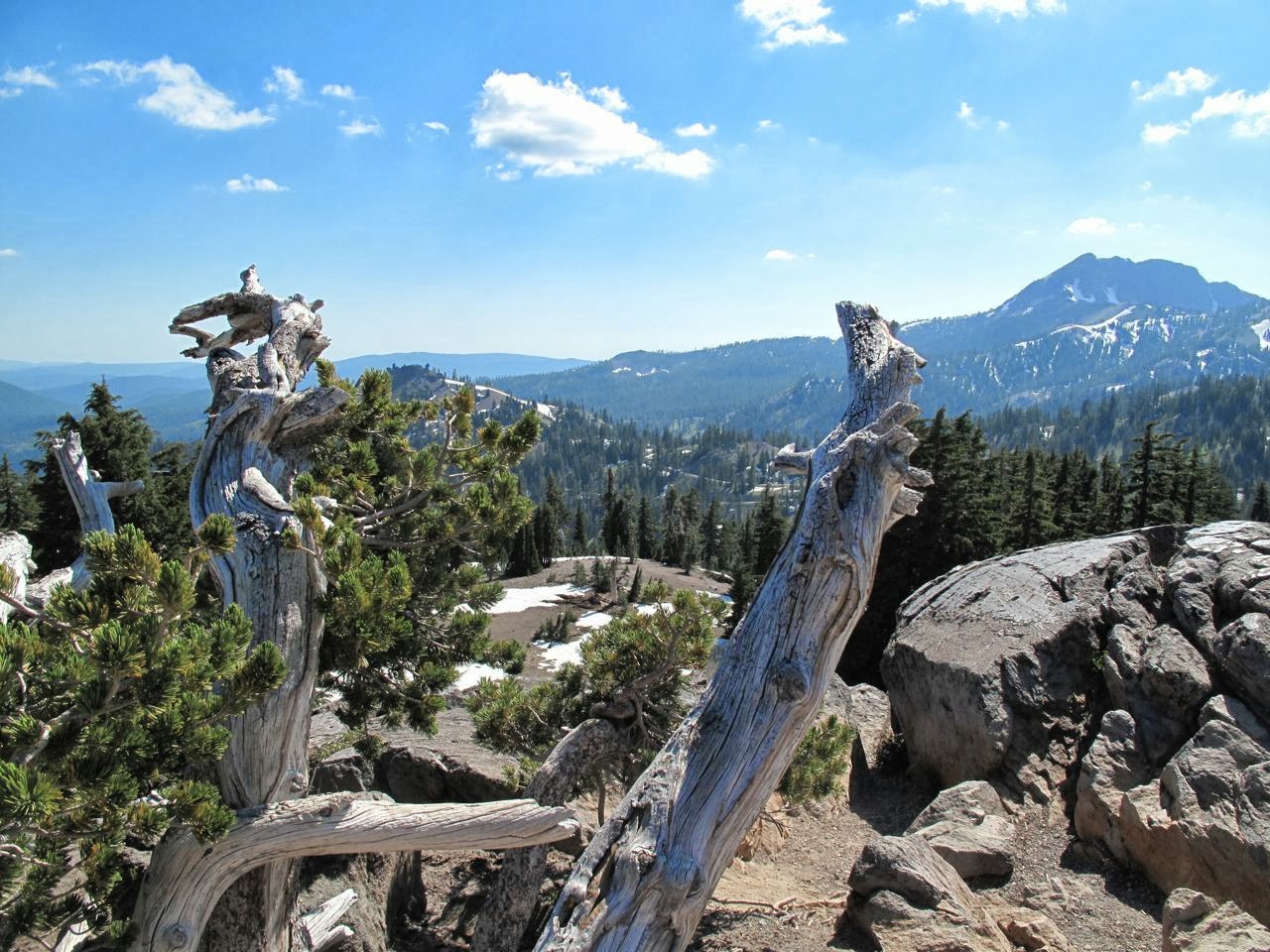

to forests with rushing streams.


False hellebore.

Rock penstemon

Early morning views of Mount Lassen from Manzanita Lake.

I enjoyed my trip down memory lane. I hope you did too. Let's hope the parks will soon be open again for all to enjoy.


Tuesday, October 1, 2013

IT'S EASY TO GIVE THE WRONG IMPRESSION

It is all too easy to make it look as though your garden is nothing but perfection. The tight shot of that beautiful blooming plant belies what is going on around it. The same is true of wider shots of the garden. They may not be all they seem. At least to the owner/gardener.


Take this shot of the dry creek taken from the driveway. Your eye might pass over all that green growth in the gravel. It is a mixture of zexmenia, feather grass and oak sprouts with a few rain lilies thrown in. It will probably take a whole morning to clean up to my satisfaction. If you have live oak trees you know the oak sprouts just keep coming back and have to be trimmed time and time again.The granite area you see at the top of the picture is another story.


When we took out the two large Texas sage bushes that had seeded in the granite I felt quite relieved. I loved the cleaner look. Well, I learnt something new about this plant. If you leave a little piece of root behind it will grow into a new plant. So there were 15 new Texas sage growing up, clustered together. I should have just taken a few pieces of root and stuck them in the ground in a place where I would like this bush to grow. Of course, I have potted them up until they make a good root mass and I can put them where I want them. It took an hour of my gardening time this morning.


I have mixed feelings about this scenario. Bluebonnet seedlings. Do they really have to clump together like this. I feel the need to save them from strangling each other. There are so many other places I would like to see them. The good news is that I am going to need some extras having discovered this morning that the decollate snails have a taste for the the seed leaves. They have eaten every one in my front garden. So having discovered this I spent an hour searching and removing every snail I could find. It's rather difficult for a snail to dig itself in in the gravel. Its broken cone is always sticking up in the air.


Down on my hands and knees I noticed this little plant beneath the Weber's agave. Is it a ghostly Eryngo? I have never grown this plant so I have no idea where it came from.


I also spotted something else growing and I am hoping it is standing cypress, Ipomopsis rubra. Will it send up that gorgeous red flower stalk next spring?


I couldn't possibly remove this frost weed, Verbesina virginica, even though it is crowding out the rose and spineless prickly pear at the back of the pool. You don't get to see the wide shot! In previous years it was on the berm outside the walls. I may never get to see the frosty stems when we have our first freeze because by then it will be long gone. For now the bees and I will enjoy the pretty white flowers.


The potager may look reasonably tidy but you should see all the weeds. It's a nightmare!

Friday, September 27, 2013

THE RIGHT PLACES TO SIT IN THE GARDEN

" The right places to sit in a garden have to be discovered. They cannot be decided in advance." So wrote Elizabeth West in her book, Hovel in the Hills.
This is my favorite place to sit in the garden but it wasn't always this way. This seating area was created when we began to realize that the two seating areas that came with the house didn't fit all our needs, which were to find a pleasant place to sit at all times of the day and year.


It's not that there is anything wrong with the seating patio at the back of the house. It is the perfect spot for early morning cups of tea, evening entertaining and a log fire is more than welcoming of an evening when there is a chill on the air.


There are splendid views of the sunken garden from here but this is not the place to sit to catch the warmth of a sunny winter's day. That was why we decided to make a seating area in our front courtyard.


Protected from the north wind by the high wall and facing south it is quite the little sun trap. I am sometimes lulled into sleep mode as I sit here listening to the sound of the water trickling over the sides of the water feature and the hum of bees on the sweet smelling blackfoot daisies.


Then I am reminded of something I need to attend to out there and the spell is broken. But as I said it was not always like that. To begin with there was nothing.


The plan came to me fairly quickly the first month we were in the house. It was a rainy July night when I looked out of the window and saw a swimming pool forming. When it rains in Texas it really rains. The small drain the builder had installed, with a few bull rocks around it, and which was to take water to the outside, had blocked. That was when the idea for a wet weather creek came into my head. That involved digging out the creek and bringing in the rocks to form the banks of the creek. We had plenty of those to hand. hen we hauled a ton of New Mexico river rock into the creek. We built a block wall along the back edge so that a rose could be planted there.
The slightly sunken area of gravel above the creek acts as a trap to slow down the rain. I notice that at the time I had already put a bench alongside the walkway from garage to house which brings me to my next seating area.


This spot catches the late afternoon sun. You wouldn't want to sit there in the summer but what a lovely place to sit in the winter. A cup of tea and a book! Ah, if only.
Returning to the back of the house we have a small dining are off the kitchen. It is a nice place to eat breakfast but only on cloudy summer days. The sun shines right in. We needed a place to eat our summer breakfast. There was a garden we hadn't even begun to tackle; the English garden. It already had a name because of the drystone wall I was building to create a raised bed around the curved outside wall. This garden was just crying out for circles and what better than a circular patio. And so the area went from this..


  to this and...


more recently, with the demise of the patio table a little refurbishment. Once again we can have breakfast in the English garden.


Just one more place to sit. The once Spanish oak garden has had a makeover too.


and I well remember what this looked like.


Now I think we have the whole seating thing just as we would like it. It took time and thought as to what we wanted and where we wanted it. As Elizabeth West said, none of this could be decided in advance. We needed to watch the sun, the weather and the seasons to find the best place to place our chairs. No more sitting on the driveway for us.

Wednesday, September 25, 2013

HAND-ME-UPS

If you don't know what  hand-me-ups are, just have a guess. Yes! They are items passed up to you by your children. This time I am just thrilled to find a new home for this wonderful female Bacchus. She   has replaced the sun who has been relegated to an outside wall!


This and several other items had been lying on the ground, down the side of my son's house, for more than 5 years. The last time we were there I asked what if anything he was going to do with them. "Take them" he said. They were loaded on our truck in a flash. I knew exactly where this lady was going to go. She would replace the sun, which had replaced the planter with the Huernia schneideriana, which had replaced the original green man. Don't anyone say I am not up for a change.

There were also 4 architectural relics on the ground, and those too have found a home among the Ficus repens ivy which covers this retaining wall.


I may just have to do a little more scouting around next time I visit. I think it is time to rename this garden.

Monday, September 23, 2013

THE NAKED LADIES HAVE ARRIVED

They come quietly in the night. You might miss them although I don't know why because they come every year about the same time. Sometimes you get advance warning from a garden friend about their arrival in their garden. This sends you rushing out into your own garden to look for signs of their arrival.


Borne on bare stem the Oxblood lilies, Rhodophiala bifida, began blooming just over a week ago but the wonderful weekend rain hurried them along. Now, multiple groups of the flower are blooming in my garden. The bulbs were first introduced into Texas by German Settlers and have become a favorite of southern gardeners. Mine were a passalong from Melissa, at Zanthan gardens. I remember going over to her house for a clump of the flowering bulbs. At home I enjoyed them in the house, in a bowl of water, until the flowers faded. Then I planted them in the ground.


The second naked lady to bloom was the red spider lily, Lycoris radiata. They don't seem to be quite as large this year but there are more of them. The first bulbs to arrive in the US were brought by Captain William Roberts. He brought 3 bulbs back from Japan planting them in his own garden. Now the bulbs have naturalized in many parts of the US south.
After the flowers fade the leaves begin to appear and continue their growth throughout the winter and into the late spring. If you plan to move the bulbs then the time will be after they have flowered.

Saturday, September 21, 2013

IN PRINT

When I opened the Austin American Statesman this morning there I was on the front page of the Lifestyles section.


I met with the author, Carolyn Lindell, a couple of weeks ago. She was planning to write an article on how the gardener can protect him or herself from aches and pains. I think she chose the right person to talk with. After all I have been gardening for over 45 years with not a care in the world until...... It was imperative that I do something about it and quickly. The two days spent lying on my back were enough for me to recognize that I don't do well when I can't get out in my garden. As though I didn't know that already, suffering from cabin fever after only one day spent indoors!
After a visit to the chiropractor I began serious exercises. Every morning as soon as I get up I take out my green gardening tools and go to work. As Carolyn mentions in the article I am rather amused by the color of the tools. The chiropractor gave me a green tennis ball. I already had the green child's ball. I bought the foam roller at a local store: all they had was green. The stretchy band came from a garage sale ($1) and a large body ball which is also green cost $2 at a garage sale. The rolling pin is brown. I don't believe I need anything else.
The article is well worth reading if you live in Austin and can get a hold of the paper. There is plenty of useful information.
I want to continue gardening as long as I can and I don't want aches and pains to stop me.

Friday, September 20, 2013

CHANGE IS GOOD

On Monday morning we began the task of exchanging the 4' water garden stock tank for a 5' tank. The 5' tank had been collecting rain water off the roof and had to be exchanged by the manufacturer because of extensive corrosion all over the interior surface. I had been thinking about the exchange for some time and with the new empty tank at hand there was no time like the present.


It took the whole morning. Before we began we made sure that the two of us could get that larger tank up into the garden. Then we needed to empty the tank and save all the water. Our large garbage cans served as holding tanks and several smaller  cans held all the plants. With the new tank in place we returned all the water and as many of the snails as possible! The additional water needed came from the rainwater tanks just a few feet away. Then the plants went back in. By afternoon the Helvola lilies were blooming again.


Water garden plants really are the most forgiving. It took 24 hours for the water to settle down and become crystal clear again and for the lily pads to find a new space in the water. Now they have so much more room to spread out.
I also removed the Texas mud baby, Echinodorus cordifolius  because, much as I adore its white flowers, it seemed to attract blackfly. For the time being it has been de-bugged and is settled into a smaller water garden along with some dwarf papyrus which had rooted in the water.
More changes are underway in other parts of my garden. Show me a gardener who has his garden exactly how he wants it and is just willing to sit back with smug satisfaction. I doubt you will find one.

Monday, September 16, 2013

ONE TOUGH LITTLE NATIVE

If you live among the limestone hills of Austin you might have noticed this little native make its appearance in September.


It is shaggy portulaca, Portulaca pilosa, a low growing trailing succulent. It is an annual but the seeds, which are formed in cup-shaped capsules, overwinter and seem to spread readily. I first noticed it growing in the decomposed granite out front. The flower only opens in full sun but then that isn't a problem here in Texas!
I later noticed the plant growing in one of the vegetable beds and mistook it for the much larger flowered portulaca I have. The leaves are similar but somewhat narrower.

Large flowering Mexican portulaca.
 I thought it would do well overhanging the hayrack planter on the potting shed wall, in which I had planted feather grasses following removal of the spring planting. Unfortunately the drip system failed in our long absence and the feather grasses died. Not so this little creeping plant. When watering was restored the plant came to life and is now in full bloom.


On this west facing wall, where temperatures are hot enough to fry an egg, I am happy that this little plant likes its new home. I am thinking that it would also make a nice rock garden addition.

Sunday, September 15, 2013

GARDEN BLOGGERS' BLOOM DAY, SEPTEMBER 2013

My flowers are happy to be featured once more on Garden Bloggers' Bloom Day, after a summer hiatus. Thanks to Carol, at Maydreams Gardens for hosting.
There are some plants which are late to appear in my garden. Plumbago, seen below is one. It disappears over the winter only to begin growing when summer days are at their most fierce. The little bee returned with me from our travels.


Blazing star, Liatris spicata, is also a late bloomer and is perfectly suited to the company of cactus and agaves in the dry limestone gravel.


This week the first of the oxblood lilies, Rhodophiala bifida, made their appearance. I almost missed them, situated as they are at the back of the rock garden. Maybe they deserve a place in the spotlight as they bloom for such a short period if time. More are to follow judging by the buds just showing.


In the stock tank water garden the first bloom on the crinum, a passalong from Pam Penick at Digging.


Fall obedient plant, Physostegia virginiana.


Gregs blue mistflower, Conoclinium greggii..


Sparks flying from Gomphrena 'fireworks' This is a plant that leaves an aroma of curry on the air when you brush up against it. Good thing it is in the potager.


In the same garden narrow leaf zinnia, Zinnia linearis, adds a punch of color.


Rudbeckia grows between the pads of the spineless prickly pear which render support.


Watering with a hose, on my return, revived many plants including this blackfoot daisy, Melampodium leucanthum, growing among the pink crystal grasses.


Rose 'Felcia' is blooming for the third time this year. You can't walk by this rose without stooping to smell her wonderful fragrance..


The purple skullcap, Scutellaria wrightii along with an annual seedling salvia.


From time to time the cross vine, Bignonia capreolata, sends out a spray of flowers.


A surprise blooming of the Texas clematis. I have always been disappointed in the color of this one which looks wishy-washy against the garden wall.


Migrating hummingbirds are having a field day with the flame acanthus, Anisacanthus quadrifidus.


The garden may be looking a little tired because of the heat and lack of rain but there are still plenty of blooms to enjoy.
Hope you are enjoying the blooms in your garden this September bloom day.