There is hardly a day goes by when I don't go out into the garden to snip a few herbs to add to my dinner. So when I came across a recipe that called for parsley, mint and basil it was easy to go out into the garden and gather what I needed. Recipe later. Imagine how much 3 bunches of those would have cost at the grocery store? Always one of the most expensive items, per weight, in the produce department.
I call this area the herb garden because this is where you will find most of my herbs.
From top left garlic chive, lemon balm, chives, basil,Mexican mint marigold, sage, oregano, Italian parsley with Swallowtail caterpillar, mint, rosemary, thyme and curly parsley. The parsley, being a biennial, is going to flower but I have started new plants for a new crop. It's easy to tuck in a few herbs among your flowers. Most will grow with a modicum of sunshine, especially the ones that don't flower. Chive flowers can be used in salads. Mexican marigold mint is our Texas substitute for French tarragon which is difficult for us to grow. I also have lemon grass in another part of the garden. A few stalks survived from the large plant I had growing for several years.
So let's get to the recipe. Apparently this comes from a restaurant called Fresco in NYC. Thank you Fresco. It's a winner at our house.
In a bowl toss baby spinach with ½ cup fresh torn basil, ½cup chopped mint, ½cup chopped flat leaf parsley, 1cup frozen green peas thawed, 2 T sliced spring onions. I made a vinaigrette with dijon mustard a dash of agave syrup and some juice from one of my Meyer lemons. Whisk in olive oil until taste is balanced. Season with salt and pepper and toss salad. Serve with grilled crostini topped with goat cheese. Enjoy.
Saturday, April 12, 2014
Wednesday, April 9, 2014
TAKE A TOUR OF OUR COURTYARD ENTRY GARDEN
Yesterday the garden hosted a lot of visitors. First in the early morning a friend and her out of town guests and then in the afternoon Marty Wingate brought a group of garden enthusiasts from the Seattle area on a Texas Bluebonnet tour. In the morning they visited Tate Moring's garden, followed by lunch at the Grove and then on to visit our garden. Those of you who have visited this garden know that we always bring people in through the side entry off the driveway. Maybe you would like to follow them.
The entry deck is where many of my overwintered cactus and succulents get to spend the summer. Not too much sun and when the sun does reach this garden it is filtered by the large overhanging live oak.
How fortunate that the queen was out to add her greetings. She has been indoors for a while because I did get rather tired of her incessant waving and banished her indoors. She has help from a solar panel in her ever present handbag. I would never have a gnome in my garden unless I was given one, as I was with HRH. Just a bit of a joke.
The Whale's Tongue agave is going to make the first impression. You see her before you even walk up the steps. But then eyes will be drawn to the sound of water coming from the disappearing fountain.
It's a favorite place for the finches and cardinals to come for water. You may recall having heard the history of the fountain. We found it in the alley behind our son's house in Dallas. The hexagonal piece of concrete once held a post, so the square hole in the center, with a couple of cross nails, was just perfect through which to feed the water. We had always had a water feature here but it was just a piece of limestone rock with a well positioned hole we had found in our wild areas. This was enormously heavy but the two of them managed to get it into our truck and somehow David, single handed, got it in place.
To reach the gravel patio you have to cross the little stone bridge.
Someone standing at the entrance yesterday said it was like Beth Chatto's gravel garden. What an enormous compliment that is.
Among the bluebonnets are pink and purple skull cap, Scutellaria wrightii, creeping germander, Teucrium cossonii Claret cup cactus, Echinocereus triglochidiatus, square-bud primrose, Calylophus drummondianus and blackfoot daisy, Melampodium leucanthum. No irrigation here.
You must smell Zephirine drouhin. She is the most fragrant of roses and as you bend over you will catch a glimpse of the flower stalk on the Mangave 'Macho mocha' I hope this doesn't mean the end because I don't see any pups and this one, a pass-a-long form Pam Penick at Digging, has taken a few years to achieve this size.
Sit down for a minute in the shade of the umbrella. A humming bird may come by to sip nectar from the Texas betony, Stachys coccinea, behind you.
I am definitely going more xeriscape on this side of the garden. Partly to reduce the work and to enable me to remove all irrigation. These plants will have to go it alone.
As you turn back Lady Banks' rose comes into view. She will be getting a big trim back after she finishes flowering, to give more light to the understory plants.
It isn't the easiest of gardens to visit because there are all kinds of plants growing in the gravel and if you know me you know how protective I am of those little seedlings. After all, they may be next year's plants. Hope you enjoyed the tour of this garden.
The entry deck is where many of my overwintered cactus and succulents get to spend the summer. Not too much sun and when the sun does reach this garden it is filtered by the large overhanging live oak.
How fortunate that the queen was out to add her greetings. She has been indoors for a while because I did get rather tired of her incessant waving and banished her indoors. She has help from a solar panel in her ever present handbag. I would never have a gnome in my garden unless I was given one, as I was with HRH. Just a bit of a joke.
The Whale's Tongue agave is going to make the first impression. You see her before you even walk up the steps. But then eyes will be drawn to the sound of water coming from the disappearing fountain.
It's a favorite place for the finches and cardinals to come for water. You may recall having heard the history of the fountain. We found it in the alley behind our son's house in Dallas. The hexagonal piece of concrete once held a post, so the square hole in the center, with a couple of cross nails, was just perfect through which to feed the water. We had always had a water feature here but it was just a piece of limestone rock with a well positioned hole we had found in our wild areas. This was enormously heavy but the two of them managed to get it into our truck and somehow David, single handed, got it in place.
To reach the gravel patio you have to cross the little stone bridge.
Someone standing at the entrance yesterday said it was like Beth Chatto's gravel garden. What an enormous compliment that is.
Among the bluebonnets are pink and purple skull cap, Scutellaria wrightii, creeping germander, Teucrium cossonii Claret cup cactus, Echinocereus triglochidiatus, square-bud primrose, Calylophus drummondianus and blackfoot daisy, Melampodium leucanthum. No irrigation here.
You must smell Zephirine drouhin. She is the most fragrant of roses and as you bend over you will catch a glimpse of the flower stalk on the Mangave 'Macho mocha' I hope this doesn't mean the end because I don't see any pups and this one, a pass-a-long form Pam Penick at Digging, has taken a few years to achieve this size.
Sit down for a minute in the shade of the umbrella. A humming bird may come by to sip nectar from the Texas betony, Stachys coccinea, behind you.
![]() |
| Texas betony |
As you turn back Lady Banks' rose comes into view. She will be getting a big trim back after she finishes flowering, to give more light to the understory plants.
It isn't the easiest of gardens to visit because there are all kinds of plants growing in the gravel and if you know me you know how protective I am of those little seedlings. After all, they may be next year's plants. Hope you enjoyed the tour of this garden.
Saturday, April 5, 2014
THE ROSES ARRIVE
Over the last few days Zepherine drouhin began to open blooms. This cerise, thornless, climbing rose has the sweetest fragrance. On the front courtyard wall, where we frequently drink our mid morning coffee and eat our lunch, who could not pause to take in her sweet perfume.
In the same garden, another thornless rose, the Lady Banks, Rose banksiae 'lutea' No fragrance but a reliable rose which covers her branches with clusters of pale yellow blooms every April. This year the blooms are smaller than I have ever seen them, due in part to our droughty winter and spring. So little rain has fallen that flowers everywhere are smaller than normal. At least she tried. I think that next week it will be Felicia's turn.
She wins me over again every year. There is always some point at which I say I am going to remove her but then spring arrives and once again I let her stay. I really need to learn how to prune her to the best. She is very vigorous and has this tendency to send out side shoots which grow forwards instead of laterally.
In the same garden, another thornless rose, the Lady Banks, Rose banksiae 'lutea' No fragrance but a reliable rose which covers her branches with clusters of pale yellow blooms every April. This year the blooms are smaller than I have ever seen them, due in part to our droughty winter and spring. So little rain has fallen that flowers everywhere are smaller than normal. At least she tried. I think that next week it will be Felicia's turn.
Friday, April 4, 2014
A TURN UP FOR THE BOOKS
I wonder if anyone is familiar with the expression, A turn up for the books. It was one I heard family say when they had an unexpected piece of good fortune. I just had one.
So here is mine. This chocolate daisy, Berlandiera lyrata. After 8 years of growing this plant it finally had a baby. I had watched the seedling over the past few weeks but wasn't completely sure about its identity until I saw the characteristic flower bud forming. Many times in the past I have seen similar leaves and they have all turned out to be blanket flowers.
It has settled itself in very close to mother, between one of the pavers in the vegetable garden, and has topped the mother plant to produce the first flower of the season.
I do have one other chocolate daisy in the sunken garden. It is back again this year opening multiple buds over the last few days. But for all its years of living there it has never once produced a baby.
It seems to favor this spot among pavers where its roots are protected. At the Wildflower Center chocolate daisies grow to be 3' tall but this one never gets much larger than this. It usually gets one cut back during the summer resulting in a further flush of blooms later in the season.
I year ago in October I planted this red veined sorrel in the herb garden. As soon as any leaves grew they would be eaten, probably by those decollate snails. I have made a concerted effort to reduce their numbers and suddenly leaves started to poke through the soil. After our terrible winter it is hard to believe that the plant had survived. Both plants have returned and hopefully will have a better year.
This may look like a regular bearded iris but it is a dwarf variety. It stands only 6" high. I picked this up in Boise at a Saturday market 3 years ago. It is the first time it has bloomed or rather the first time I have seen it bloom. Almost smothered by yarrow leaves I just caught a glimpse of it as I walked by. I think a more prominent location next year.
A real turn up for the books.
Monday, March 31, 2014
AWASH IN BLUEBONNETS
I don't need to drive out into the countryside to see bluebonnets. I have plenty of them right outside my door.
They are in front of the house in the granite parking area and down the side of the house.
I cannot walk down the side of the house without crushing a few. But times are difficult. A dry hot wind and no real rain for weeks on end means their leaves are beginning to shrivel.
Years ago, before we bought the lot, I used to walk through here. The area that I call the upper meadow was blanketed in bluebonnets in the spring. Our son, his wife and their little pup, Frisco, posed for a photo back in 2002 during a very bluebonnet spring.
After the seeds had matured I collected them to spread throughout the lot with resounding success. I even planted them across the road on my neighbors lot. I had hoped to see a similar blooming up there this year but lack of spring rain on the thin rocky soil has resulted in shriveled plants. But decomposed gravel seems to hold in moisture and the show in granite areas is as splendid as ever.
But I did find a new flower on the upper meadow. The pretty yellow Stemless Evening Primrose, Oenothera triloba. I'm hoping that it may be as prolific as the pink primrose.
They are in front of the house in the granite parking area and down the side of the house.
I cannot walk down the side of the house without crushing a few. But times are difficult. A dry hot wind and no real rain for weeks on end means their leaves are beginning to shrivel.
Years ago, before we bought the lot, I used to walk through here. The area that I call the upper meadow was blanketed in bluebonnets in the spring. Our son, his wife and their little pup, Frisco, posed for a photo back in 2002 during a very bluebonnet spring.
But I did find a new flower on the upper meadow. The pretty yellow Stemless Evening Primrose, Oenothera triloba. I'm hoping that it may be as prolific as the pink primrose.
Friday, March 28, 2014
LET THE IRIS SHOW BEGIN
If you had visited my garden 7 years ago there wouldn't have been a iris in sight. Now my garden has 4 different kinds and when the iris bloom I realize what I had been missing all those years.
All my iris are pass-a-longs from garden friends. This one came form Annie at The Transplantable Rose. Not only is this iris a beauty but it has a delicious peach fragrance.
My second iris came from Linda Hutson's garden. This is a phenomenal grower and has to be divided every two years for fear of it taking over the garden. For that reason it has been shared many times among my gardening friends.
But here is the strange thing. Last year I divided the clump closest to the house replanting some of the new rhizomes in the same place. This year the first one has opened in a much deeper color. What has happened here. I did a little investigating and found several gardeners having the same experience. and yet there are those who say this is impossible. They believe that the new colored iris was already there but had not yet reached bloom time. I suppose that is the most likely reason.
I will mark the plant when it finished flowering so that I can keep my eye on it, maybe moving it to its own location. away from the others. For now I will enjoy it.
My white cemetery iris, Iris albicans, is planted out in deer territory.
I have one more iris and the buds are ready to open. It spent 2 years in my vegetable garden but was relocated this past fall. It seems to have enjoyed the move because it is flowering much earlier this year.
Wednesday, March 26, 2014
51 REASONS TO GROW THIS PLANT
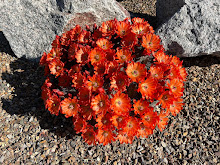
That may seem quite a tall order-to come up with 51 reasons why to grow a plant. At this time of the year it's easy. I just go outside and count the buds on my Claret Cup cactus, Echinocereus coccineus. They begin as tiny swellings just below the spines erupting through the tough, waxy skin of the cactus.
I have counted 51 in all but I will have to wait a while before the show begins. For most of the year the cactus grows quietly among the gravels in my garden before busting into bloom over a period of several weeks.
This year they are likely to have the whole show to themselves because there are few bluebonnets and blackfoot daisies where they are planted.
I just watch and wait for the show to begin.
Sunday, March 23, 2014
A MOST UNUSUAL GARDEN TOUR
Back in January I had the opportunity to take a most unexpected garden tour. After all, when you go to an airport you expect to sit in the departure lounge and wait; maybe drink a cup of coffee or browse the bookstore. You do not expect to visit a garden. To do so would be a gardener's dream.
But this is Changi Airport, Singapore and they do things differently here. They even print a brochure on all the gardens you can visit. Let's see there are 5 gardens in Terminal 1, where we are waiting for our flight, and the one I am making a bee line for is the Cactus Garden.
Cactus in Singapore? Where the humidity is shy of 100%. It must be indoors like the welcome air conditioned Dome in Garden on the Bay, which I will post about later.
Amazingly the garden is outside.
I sometimes think that you just can't go wrong when designing with agaves and cactus.
Throw in a few rocks and a few tree ferns and other ancient plants.
Maybe the odd metal sculpture like this saguaro.
Mulch with rocks and overlay with a few mat-forming sedums.
Maybe add some additional protection from the rain.
Add a few sculptures.
Is this like house leeks planted on the roofs of houses in England to ward away evil spirits?
I only had 10 minutes to rush around but if I am ever there again I will make a point of arriving with plenty of time to spare so I can visit all the gardens of Changi. In Terminal 1 additional to the Cactus Garden there is a Sculptural Tree Garden and a Lily Pad garden, Terminal 2 has a Bamboo Garden and a Sunflower Garden. Terminal 3 has a Butterfly Garden and Fern Garden. I won't even mention the pool, movie theatre etc. Who needs Duty Free!
Saturday, March 22, 2014
A WILDFLOWER I WOULDN'T BE WITHOUT
Yesterday I spotted the first bloom on my blue gilia, Gilia rigidula. I doubt you will ever see this flower at the nurseries and I have never seen it for sale at the Wildflower Center plant sales. Maybe it is just too delicate for most gardens.
I have a very special place for it. It is atop a dry stack wall where it is slowly spreading by seed. Furthermore I have a good view from my window. This plant is difficult to transplant and I consider myself fortunate that I was successful in this and that I gave it a happy home. It seems to love this chalky, stoney spot. Blue gilia is a member of the phlox family and usually makes a prolific bloom in spring. It also blooms periodically though out the summer, usually after rainfall.
Subscribe to:
Posts (Atom)