My Blog List

Sunday, October 1, 2017

THE AMALFI COAST AND TWO OF ITS VILLA GARDENS

This summer we spent a few days on the Amalfi coast, Italy, known for its rugged coastline and villages perched precariously on the cliffsides. We flew into Rome and picked up a car to drive down to Amalfi coast- our destination Ravello. After our usual problem negotiating airport exits and getting on the right road we were on our way, taking the main toll road down to Napoli where we left the road to head towards the coast. As we headed down this rough road into a small town we realized my directions on iPhone maps had mysteriously disappeared. We resorted to some printed directions which also proved to be useless as none of the streets had names. By good fortune David spotted a very old metal sign, "Amalfi". We took the narrow road as it twisted up into the hills through narrow tunnels and around difficult corners. At one place we stopped at a roadside fruit stand to pick up some peaches-our lunch. We were convinced that this was not the right road but pressed on regardless eventually seeing a sign which confirmed we were correct.


Having passed many tour buses parked along the sides of the road we were wondering where the people were. We were soon to find out. They were in Ravello. We followed the the narrow road with the arrow pointing to our hotel, through a tunnel and then into the Duomo square. There the road seemed to end. We were obviously wrong so turned around and went back to ask directions, only to discover we were right the first time and needed to retrace our path and turn down a very narrow lane  passing through an equally narrow archway. Not only was the archway full of tourists but the walls were hung with ceramics.


We tucked in the wing mirrors and edged our way though the people and ceramics. At the end was the gateway to the Hotel Rufolo. Relief. Thank goodness we wouldn't see the car again until we left.


We were to spend 4 nights here and had a busy itinerary planned, starting that afternoon with a visit to the Villa Rufolo of which we had a view through our bedroom window.


The villa was built in the 13th C by a wealthy merchant family but as with many large properties time and neglect played their part in bringing the villa into ruin. In 1851 the wealthy Scottish industrialist, Sir Francis Neville Reid, purchased the villa and began restoration of the villa and gardens.
The entrance to the villa is to one side of the Duomo square. It wasn't surprising that we thought we had made a mistake when we found ourselves driving past the entrance an hour ago.


We passed through the archway gazing up at the Moorish style decoration and remains of terra cotta spirals.


With more remnants of ancient structures. These kinds of scenes always stir my imagination.


And then into the most beautiful cloister with similar Moorish features. We couldn't resist a few photos with the red geraniums.


  And then out into the open with remains of the Sala dei Cavalieri or garden pavilion and the Torre Maggiore the oldest surviving part of the villa. 


Unfortunately we were not able to enter the tower as it was closed for the day.


No garden could have a more beautiful backdrop with the Gulf of Sorrento and the sculptural umbrella pines. Colorful beds of petunias and begonias add a splash of color. We were told that descendants of the original gardeners still care for the gardens.


I have never been particularly fond of this style of gardening. Growing up in England our local parks and even the center of our village had huge displays of what the English call 'bedding plants' in the summer. Sometimes you would see the town crest designed with flowers or the occasional clock. It was the style of the times obviously Sir Francis brought this touch to his Italian villa. It was bright and cheerful and perfect for the location.


It is hard to imagine these planting beds without their single or multi color planting.


But the most iconic view is looking down to the Church of the Annunziata. No color needed here save for the misty grey of the water.


Concerts are held here during the summer and the natural amphitheater below the gardens creates a permanent stage and seating. It wasn't easy trying to avoid the seating, big lights and speakers.
We moved quickly into the house as the lady sitting at the doorway told us it was about to close. There wasn't much to see as we walked from salon to salon. The rooms were bare with no furniture or wall hangings.


We had a big day tomorrow so early dinner which was, of course, outside. The bells began to ring. There is nothing quite so beautiful.

There is a hike called Il Sentiero deli Dei, Path of the Gods and that was today's plan.


We made an early start because we had to get to the head of the trail and that involved two bus rides from Ravello, first down to Amalfi and then bus from there to Bomerano. There were a number of us on the bus who were clearly setting out on the same trek-estimated to take 4 1/2 hours. I was wondering how I was going to manage as our weekend walk of 5 miles on flat ground is all I have done since the new hip. Still I had my hiking poles and they do help a lot on rough terrain and I was determined to do it. We alighted the bus asking a couple who spoke English the way to the head of the trail. 


We had initially been disappointed that there was a heavy mist which was going to obscure the views we had come to see, but in retrospect I don't think we could have done the hike if it had been in full sun. 


It was pretty misty most of the way until the sun began to peak through as we were nearing Nocelle with views of Positano below.


We finally arrived at the hamlet of Nocelle in about 3 hours after many steps, ascents and descents. At this point there were three choices. Take the bus to Positano, take the 1500 steps down to Arienzo and walk on to Positano or continue along the trail to Positano. We chose the latter option which was the wrong one. We should have done either of the other options. Although we were on a trail to begin with we finally had to walk up to the road which snaked around the mountains. Walking in full mid day sun was brutal. We finally arrived at a restaurant, la Tagliata and inquired as to when the next bus would pass by. With 20 minutes to wait we sat on the terrace and had a cold beer. Very welcome. Then on down by bus to crowded Positano. Feeling pretty exhausted and with a ferry arriving soon we bought tickets to take the easy way back to Amalfi.
Positano beach

Amalfi was so crowed and with so many people waiting for the public bus up to Ravello we decided to us get the open air tourist bus back to Ravello. It cost more but I was ready for a cold beer on our little balcony.

Day three we did the walk to Amalfi. It's all down hill so good knees are a must. We started out on the pathway close to the hotel and were soon winding our way down between houses, past little churches with occasional glimpses of the water below.


We met few people on the trail. An elderly lady carrying a shopping bag puffing her way back up from the village. One gentleman with his little dog and a young couple racing down the hill at breakneck speed.


At one stage we could look up to the Villa Cimbrone and just make out the statues along the belvedere. We would visit there on another day.


We had taken a little picnic with us but everywhere along the promenade in Amalfi were these signs. Even though we have little Italian it was quite clear what the meaning was. NO PICKNICKING! Lots of towns in Europe are banning eating food on the street. They will even fine you. We ended up walking down the dock and sitting on the rocks.


We walked into town to look at the shops. Lots of lemony things to buy.


And along one of the side streets we came across this miniature model of Amalfi's stacked hillside houses.


And you know when in Europe you will be visiting plenty of cathedrals. Here, the Amalfi Cathedral of St Andrew dominating the main square of the town with its Arabian/Sicilian striped facade and with its 62 steep steps leading up to the door of the cathedral. We decided to call it a day and visit the following day.


Our third day of hiking took us down to the village of Minori. A similar hike through charming neighborhoods, alongside gardens. We barely met a soul.


We eventually arrived at a parking lot overlooking the town. There was no sign of which way we were to go so we walked over to the church and then into the graveyard before picking up the pathway down the hill and onto the main road.


David had originally planned for us to walk to the next village, which would have taken us past the hillside lemon groves, but I was absolutely pooped from so many days of hiking that we decided to take the ferry. We ate our lunch on the bench(no signs forbidding picnicking here) and then took the ferry to Maiore.


There wasn't much to see in Maiore and we became worried that because it was a Sunday there may be no local bus service back to Amalfi. On top of that the places to buy tickets were all closed! I sat on a bench and David walked into town to see if he could get tickets. Moral... always have plenty of spare bus tickets easily purchased at any tobacconists. We were in luck and the bus to Amalfi arrived with seats to spare. Regaining some of my lost energy we decided to visit the Cathedral in Amalfi before returning to Ravello.
Remembering the 62 steps up to the front door I sent David on ahead to make sure it was open to the public. It was.


High altar


The Cloister of Paradise 1266-1268
The original cathedral, which is next door to the new one was once joined to the new cathedral but was separated in the Baroque period and decorated with features of the time. These were stripped away in 1994 to reveal the original medieval frescoes. For me this was the most fascinating part of the cathedral.


Then we took the steps down into the crypt which houses the relics of St Andrew stolen from Constantinople during the crusades and brought to Amalfi in 1208.

Bronze statue of St Andrew
Although it was cool down in the crypt with seating so you could take in all around, it had been a long day and I began to think about that cold beer that was waiting for me back at the hotel.

It is quite amazing how one can recover with a cold drink, a shower and dinner. So much so that we took an evening walk up to where the expensive hotels are including The Caruso. Alongside was the most delightful park magnificently set off by having arching walls filled with gorgeous planters and with a view looking down over the sea. I took photographs in the dim light but went back the next day to get a good photo.
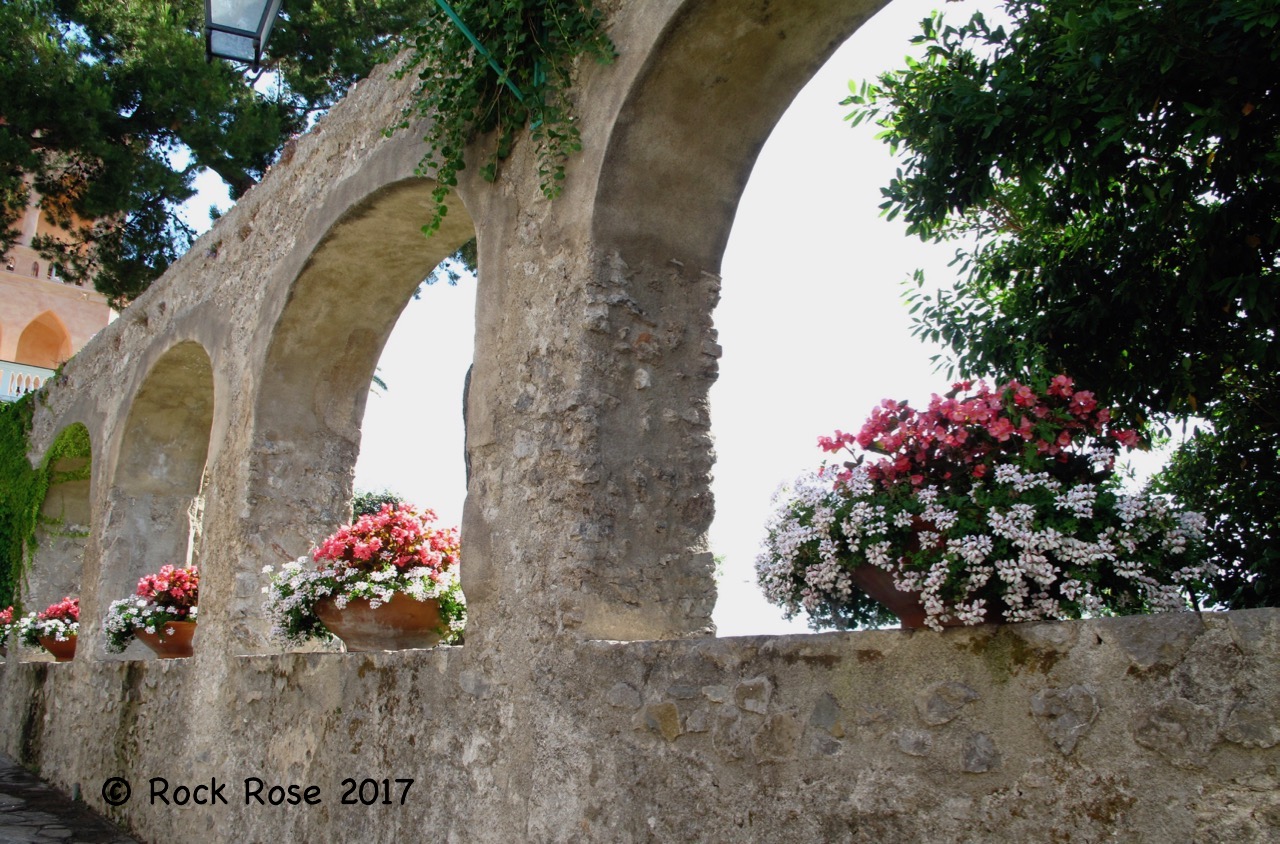


Tomorrow the Villa Cimbrone.

It's quite a hike up to the Villa Cimbrone and I can only imagine that those who visited came on horseback. There is a long walkway lined with olive jars before entering the large wooden gates into the estate.

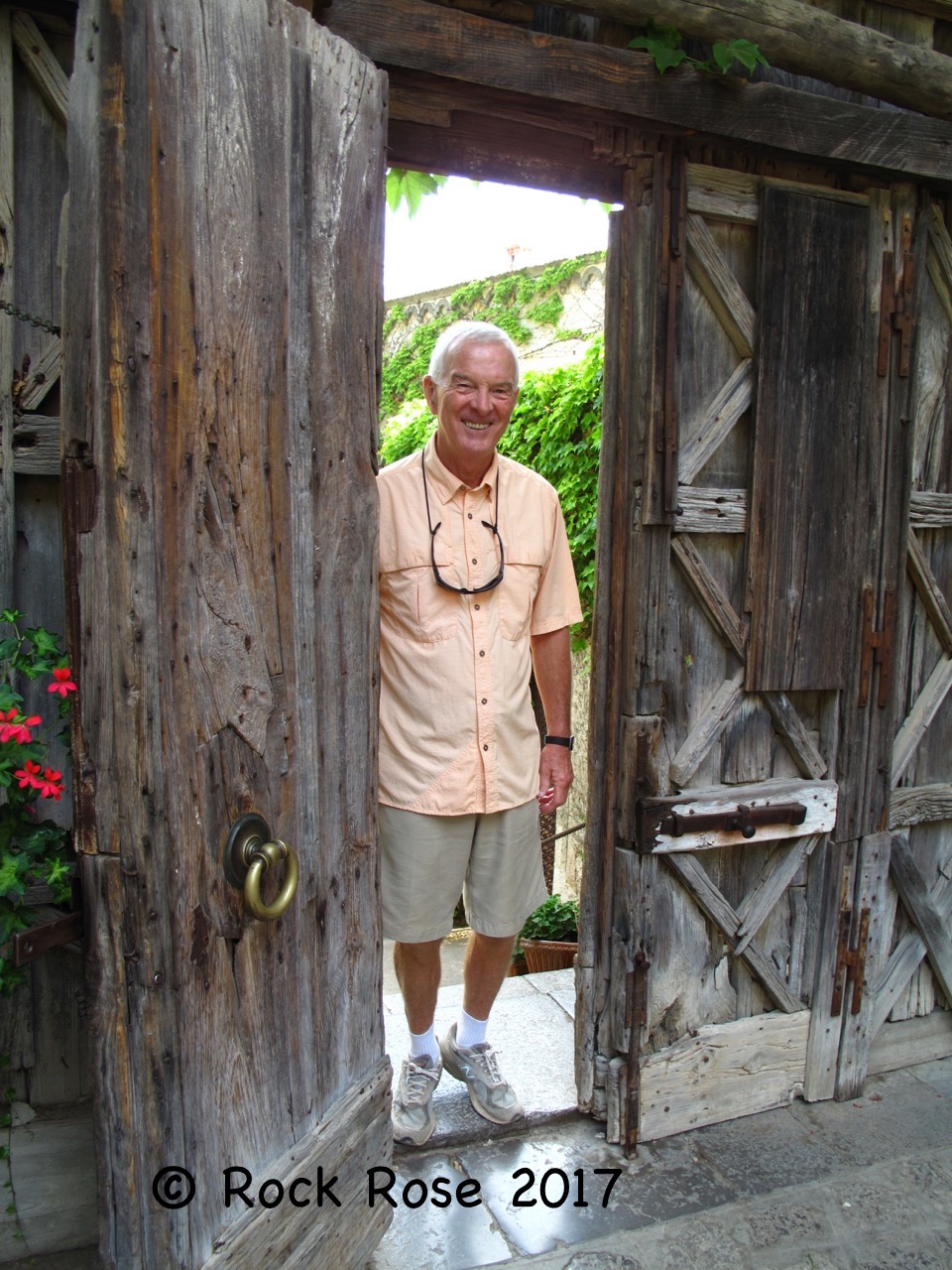

16th Century doorway

 Dating back to Roman times the 'cimbronium' was a vast estate producing timber. Unusual in the rugged area of the Amalfi this vast plateau was valuable for farming and changed hands many times until it fell into decay. The estate and garden, as it is today, was restored by Ernest William Beckett,  Lord Grimthorpe, after he bought the derelict property in 1904. The story is that Lord Grimthorpe came to this place when recovering from a severe depression brought on by the loss of his wife. He bought the estate for £200 (good grief) and determined to make it "the finest place in the word" I think he achieved his dream although I felt a great sadness as we walked around the property. I recently learnt from watching a visit by Monty Don's to the villa that he was a gambler, losing all his money, and quite a womanizer, which didn't seem to fit with the villa's portrayal of him.  I really felt I had to research more about Lord Grimthorpe to get to the bottom of the story. To learn the full story I need to read a book by Michael Holroyd called A Book of Secrets; Illegitimate Daughters, Absent Fathers. It's on my to buy list.

But whatever his failings in life he did restore a very fine property and one that is worthy of the entrance fee. He may have squandered the inheritance from his father but he was to inherit both money and title from his uncle and it would seem he spent his uncle's inheritance more wisely.
The doorway opens into the cloister and courtyard with Arabian, Sicilian and Norman features. The two boars heads above archway recall the crest of the Grimthorpe family.
Could anything be more romantic in a garden than these stone archways and buildings?


A garden roller repurposed from a Roman stone pillar.


The Avenue of Immensity


The Terrace of Infinity, a natural balcony adorned with marble busts and with views across the Amalfi coast.


Looking down to the trail we had taken two days before. That's a long way down and around the corner to the town of Amalfi.


Continuing down the steep lane we arrived at the seat of Mercury with a bronze statue of Hermes, a copy of the one on display in the museum in Naples.


To one side a seat with an inscription mistakenly attributed to DH Lawrence who visited Ravello and stayed in the hotel in which we were staying. I don't think it was a hotel at the time but rather a private house.


And finally to the resting place of Lord Grimthorpe, his ashes buried  beneath the plinth on which stands a bronze statue of a satyr supporting Bacchus with his bunches of grapes.


The Temple of Bacchus


I suppose it was the latin inscription on the temple that gave a melancholy air to the garden. Translated it reads.... what is finer, when work is done, with a mind free of every worry and tired from the effort on behalf of others, than when we return to our homes and lie down to rest on the bed we so desired. This was his resting place.
We continued on down the hill until we arrived at a small grotto in which was a marble statue of Eve by the Bolognese sculptor Adamo Tadolini (1788-1868) It was impossible to photo because there was a perspex screen protecting it... from what I don't know, maybe the sun. The grotto was behind bars.
We now began a steady climb back up the hill where more statues awaited.

The statue of David with the head of Goliath at his feet. An imitation of the one in the national museum in Florence.


He has clearly had his nose rubbed quite a lot.


And up onto the Rose Terrace with its arabesque balustrade, the gardens planted with scented French and English roses and the whole garden surrounded by the goddess Flora and Leda with her swan, and two wrestlers Damosseno and Greucante. What's an Italian garden without all its statuary.


And the stone seat bearing this inscription. Is it any wonder I felt a little melancholy.


The Tea room, seen here at the end of another garden planted with roses, is an open pavilion


Standing in front a 4 decorated Roman columns a stone well, probably of English origin and recently dated to X11th Century.


And finally behind the pavilion the Hortensia Avenue.


We had come full circle and it was time to leave Villa Cimbrone, head back down the hill and bid farewell to the beautiful town of Ravello with its delightful Doumo square, elegant villas and hotels, gorgeous umbrella pines and flowers everywhere, load up the car and negotiate that archway. We were on our way to Tivoli, outside Rome. We would be spending one night there visiting the Villa Adriana( Hadrian's Villa) and Villa D'Este.


Friday, September 29, 2017

MY WORST ENEMY HAS ARRIVED

It was just a matter of time before we were finally blessed with a good rainfall. In all a total of 3.8" fell over a period of two days. I'm expecting the arrival of plenty of weed seedlings as well as bluebonnets and other spring annuals over the next week. But the one thing I have been dreading is the awakening of the snails after their long summer nap. They have arrived and they are hungry, and not for brown vegetation. They want fresh greens. How perfect was their timing to coincide with the young tender chard and kale leaves, as well as emerging seedlings.
Maybe other gardeners don't bother much about the slugs and snails in their garden. It depends mainly on what you are growing as to whether you will notice their feeding habits. They love vegetables, so those tender seedlings are first and foremost on their menu. But they also love the flowers of the blackfoot daisies as well as seedlings of larkspur and many other annuals-but not nigella (love-in-a-mist). If I sow some seeds directly in the ground I will never see a single plant, so if you ever wonder why a packet of seeds never germinates the snail may be your culprit. The only defense is to cull their numbers dramatically.


I have been out hand picking and have already done away with hundreds. It worries me a little that a new snail has appeared this year... this tiny round one. I am not sure yet if they are just babies but they are more difficult to spot in the gravel and I am not going to let them multiply into great numbers.
The more common ones for me are the decollate snails. When they first appear their shells are complete but wear and tear breaks off the tip.


In the gravel they try to bury themselves but that broken off tips is easy to spot.

 
They gather in large numbers underneath the blackfoot daisies and can shred the flowers overnight.


There are many suggestions for dealing with slugs and snails. Hand picking takes time but is well rewarded. Small containers of beer partly buried in the ground works well. Empty grapefruit halves turned upside down and left overnight will bring them running as well as the pill bugs. Carrot peelings placed under the shelter of a plant will attract them but you have to remember to remove the snails in the early morning before they return to their shelter.
Using baits is the easy way. Sluggo or Sluggo Plus, both certified for use in organic gardens, work really well. The Plus formula also eliminates other pests such as earwigs, pill bugs, army worms and cutworms. But I prefer not to wipe out everything in the garden just to control their numbers we have a reasonable balance.
On to the next pest of the moment. Caterpillars on my vegetables. These little devils have been making lacework out of my curly kale. I have been feeding them to the little fish in my stock tank pond. Talk about piraña activity when I drop them in.


I could spray with Bt but that involves making it up. Just easier to pick them off.


I didn't even notice the nymphs of the leaf footed bugs on the peppers until I looked at the photograph. You can just see them on the largest pepper. I thought they left with the tomatoes.


Friday, September 22, 2017

I'M A CREATURE OF HABIT

For years my morning routine had been to get up, check the weather, email etc. until 7:00am, when I would take a tray of tea to the bedroom and switch on the TV. We would watch the morning news while drinking our two mugs of tea, each, and then proceed with the day. David would make the breakfast while I emptied the AC buckets and did a little general watering, we would eat breakfast together and then I would go out into the garden and start my garden work while he washed up (what an angel).That is, until a few months ago when I decided I no longer wanted to watch THAT depressing news, anymore. So no more lounging around in bed with cups of tea. Plus summer mornings are not to be squandered.


Once this habit was broken it was quite easy to move on and break that new habit. This past week my routine has changed completely and I am loving it. Of course there is no breaking the tea habit, that is a must and I can say that wherever I am in the world tea goes with me and sometimes even my teapot! So the new regime this week is to head out the door as soon as there is good light and take a 3 miles walk. The walk is uphill all the way from Lost Creek to Southwest parkway through a private neighborhood so there is no worry about early morning commuter traffic. The houses are pleasantly landscaped but rather boring so I am accompanied by my phone and a podcast. And you can probably guess the subject matter. Gardening, of course.
I have always listened to The British podcasts, Gardeners' Question Time and the RHS Gardening Podcast as well as Gardens Illustrated Magazine, but they are certainly not enough to feed my new hour long daily walk. GQT is once weekly and GI seems to have fallen by the wayside. ( I love listening to Sarah Raven one about cut flowers). I needed a new source. Enter the Still Growing-a weekly garden podcast. I think I may have listened to one segment some time ago when Pam Penick was interviewed.  I very quickly got used to listening to the Minnesota accent of Jennifer Eberling and absolutely love every bit of her program content. If only I could keep in my head all the information she shares. It has given me even more incentive to take that early morning  exercise.
I really like my new habit.

Sunday, September 17, 2017

THE SEPTEMBER GARDEN

When hurricane Harvey slammed into the Texas coast, 200 miles away, it brought some much needed rain to Central Texas. Along with that we saw a significant drop in daytime temperatures but more importantly night time temperatures in the low 60s. Warm days and cool nights. For a few days it was like being in California. The plants showed an immediate response; the sickly yellow leaves greened up and the flowers colors brightened. It was glorious but not to last. Still, for those brief few days I enjoyed every moment in the garden.
Sometimes I think fall is better than spring. Everything in the garden has become more blousy. There is barely a scrap of earth or gravel to be seen.


I never know from one year to the next how this will look or which flowers will be present-except there will always be plenty of rock roses.


The Salvia leucantha I have been planning to move for years is still there. The hummingbirds are very adept at flying in through the window in the high wall that separates the gardens.


A week ago there was but one bloom on the butterfly pea, Clitoria ternatea. Now there are many. The blackfoot daisy, Melampodium leucanthum, continues to spread across the step.


Ruby crystal grass, Melinis nerviglumis, is flowering. There will be plenty of those again next year.


  Globe amaranth, Gomphrena haggeana, 'Strawberry fields' is everywhere.


As are the purple and pink varieties growing in the pathway of the vegetable garden.


The spider zinnia will eventually be evicted from its home in the vegetable bed but I will save the seeds for next year.


In the sunken garden it grew where the white California poppy once grew.


In the sunken garden there are gomhrena, pink and purple skullcaps, aura, mealy blue sage, white Salvia greggii, and an errant member of the cucumber family which came in on the compost.


As well as zexmenia, Wedelia texana,  chocolate daisy, Berlandiera lyrata,  and returning alyssum.


But the absolute show stoppers of the moment are the liatris in the front courtyard. Purple is definitely the color of the moment.


Last year I removed many of the bulbs and planted them outside the walls. It seems that every seed germinates but they are silent all summer until their bloom time in the fall.


Phlox paniculata John Fanick, After the first flowering I pruned it back and here it is again. Smells wonderful.


Trailing Snapdragon vine, Asarina procumbens is a native of Mexico but seems to do well here as an annual.


Tradescantia sillamontana with its cobweb leaves and pretty pink flowers, easily grown from cuttings.


In the spring I bought a hanging basket because it looked simply gorgeous. I repotted it into a larger basket with baby diapers in the bottom. It was an impulse buy. It has been watered all summer on a drip system twice a day, and received an occasional fertilize. I have cut it back completely about 3 times. It took a beating on one side during the hurricane but is recovering.


The mandevilla vine is into its second year. I cut it down and put it in the potting shed last winter. It dried out and went dormant but started to come back after a good spring soaking. I will try to keep it for another year.


It is wonderful to see so much color back in the garden and there is still the Philippine violet yet to bloom. Soon it will be fall and these icky-sticky days will be a thing of the past!

Sunday, September 10, 2017

IT'S THAT TIME OF YEAR

The garden never ceases to provide us with an endless list of jobs to be done. As the cooler temperatures arrive there are plenty of outdoor jobs to be done.  Suddenly I remember those indoor gardening jobs I planned to do when it was 100º Somehow they just never got done.
This week I made a start on some garden ornaments that I needed to protect from the elements before putting them outside. After finally managing to pry the lid off the can of varnish and locating a paintbrush I made a start. By the time I had finished there wasn't a single metal item that hadn't received a coat of protective varnish. I found a shady place to work and made a start.


It was a job worth doing because it gave a new lease on life to all of them. These butterflies and dragonflies I picked up at a garage sale for $1. They looked pretty shabby with flaking areas.


I inherited this piece of decorative wall art from a friend who was leaving town. It spruced up nicely and found a place to hang it. This one I can see from my kitchen window.


These plaques came from a garage sale in Denver when we were traveling in our trailer some years ago. Not sure where they are going to go yet.


Then on to the wooden items. The fish who sits in the side garden pond as well as the wooden plaque above the side entrance.


Then I ventured to the outside to protect several metal wall hangings. It's quite amazing how it changed their appearance.


The bird houses were next. One of the owl houses needed a new floor, which David worked on. After which I shingled the roof.


The tree is turning into a shrine to owls. Surely this year the screech owl will come.


With plenty of bark left over I shingled another bird house. Outdoor things need all the protection they can get.


There! I ticked off quite a few items this week. Now to go and walk around the garden and see what needs doing.


Sunday, September 3, 2017

THERE'S A LION IN THE GARDEN

Walk in through the gate into the front courtyard and you may be greeted by a roar from my recently acquired lion. I have named him Harvey, because he came into my life on Saturday, the day that hurricane Harvey crossed the Texas coastline and to begin its devastation.


On that day we happened to be 1500 miles away, having flown up to Canada to attend a Golden Wedding celebration in Hamilton, Ontario. The day after the celebration we drove along the Lakeshore Rd as far as Oakville, where we lived in the mid 70s. The lakeshore has some beautiful houses and outside one we saw the inevitable Saturday sign 'Garage Sale'. How could we resist?

When I saw the lion I knew immediately he would look perfect among the grasses in the front garden. But then thought about the fact we were not checking baggage. David felt sure we could carry the lion on the plane, one way or another. I wondered if security might be a problem. He's quite heavy, being cast from some kind of metal and his patina needs a little touch up. But we had no problems and no-one even queried the lion as it went though the scanner.


But that wasn't the only critter I found. A sweet little ceramic gecko reminded me of the one in our Air B&B house in France. All I need is a piece of driftwood.

French gecko
I might even let him stay in the house which is where geckos like to live, if the number of ones in our house is anything to go by. I am always shooing them outside but they always come back.


To round out our shopping experience a nice ceramic owl hanging and two lovely Indian scarves. The total came to $10. Now, that's what I call real garage sale prices.

Friday, September 1, 2017

AFTER THE RAIN

It has taken me a few days to even think about mentioning the damage my garden sustained. It's all minor compared with what Houstonians and those along the coast are facing and will face for years to come. With Austin 200 miles away from the coast our rainfall didn't come anywhere close to that at the coast and while the winds did some damage none of it was catastrophic. We didn't lose any big trees and are forever grateful that we don't have trees overhanging the house, having lost those 5 large oaks several years ago. I'm glad we got those down immediately. We had lots of twigs and leaves scattered all over the place and in the plants. My poor oaks are not in very good shape and now they lost more leaves.
But the rain has gone and the sun shines again and the garden couldn't be happier. In less than a week the oxblood lilies, Rhodofiala bifida. began to bloom. Sometimes known by the name naked ladies because the flowers come before the foliage, they appear overnight, a signal that cooler weather is on the way.


A new crop of the pink rain lilies.


Everything in the garden is refreshed. Wafts of almond fragrance from the blackfoot daisies, Melampodium leucanthum. I wish they were a little more generous in spreading their seed. But this one found a perfect home in the English garden among the stone steps.


More seeded among the grasses in the front courtyard garden.


There's nothing a seed likes better than to find itself in a gravel bed. No fertilizing or watering needed here.


Across the garden the flowers on Rosa Felicia are beginning to show a deeper pink color. Sometimes, even on the hottest day her fragrance wafts through the arch.


The first blooms of liatris hang over the low dry stone wall in the English garden.


I can almost hear the plants saying, 'We made it through the summer and now we have fall to look forward to.' I hope this is the case. Those cooler mornings do make all the difference.