My Blog List

Monday, September 3, 2018

THE NEXT 750 MILES. PHOENIX TO PARSHALL COLORADO

Our stay in Phoenix was a brief one. Just enough time to catch up with our son Nick and family, attend the Junior Olympic State swim trials in which our 9 year old granddaughter was participating, and load up the trailer for the next leg of our journey. We needed to get to Parshall by July 22nd (You are going to hear a lot more about that in a subsequent post.)


Her events had been marked on her arm so she knew when to appear on the blocks.


Well done, Holland. You're a great little swimmer and we are glad you like all that swim practice and all those laps you do. There were many times when I felt like jumping in the pool myself. Yikes! That Arizona heat is something else.

Mmm! I wonder what this plant is growing outside the pool. But with 5 weeks of travel ahead of me I didn't feel like snipping a little piece. Maybe on the way back. I spent 15 minutes trying to get an id on this plant last night, to no avail, so please enlighten me if you know it. It seemed to be everywhere.


After a stop at the shops to load up with food for the weeks ahead, Nick and David hitched up the trailer. We were ready to head off towards on the next leg of our trip. About 5 years ago, after our marathon Canada trip, David decided he had had enough of trailer travel life. We gave the rig to Nick, who has a convenient place to store down the side of his house. But in view of our summer plans this year he agreed for us to take the trailer again. If we were going to drive to Colorado then we might as well extend the trip for a few more weeks.


Our first night was at the Sunset Crater National Monument, just north of Flagstaff. The campground is not actually in the park but adjacent and within 100' of the park entrance and visitor center. By the way we always make full use of our National Park pass which we purchased for $10 when we were 62 and which has gained us free access into all the National Parks, Monuments as well as 1/2 price off the cost of the campsites in all the National Parks and National Forest campgrounds. There is no greater perk for aging than this.
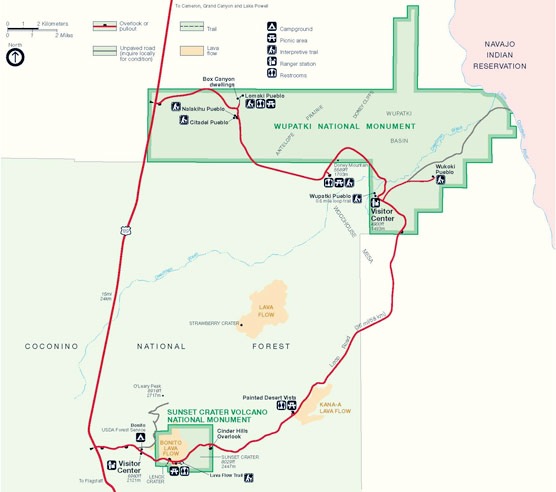

We had no trouble finding a good site where we didn't have to unhitch. Always a blessing when you are on the road. It's a nice campsite under pine trees and cool enough to survive without AC. We had stayed there once before but never had chance to do some of the trails.  D studied the map plotting our next day's route.


You can see that the road through the monument drives through lava country with several stops for hikes and roadside information. To think that shortly after the Norman invasion of Britain in 1066 ( a date that every English school child once had drilled in their head) around 1085, the magma started spewing out of the ground building up the great cinder cone that is Sunset Crater. All along the road were loose cinders and larger chunks of rough basalt that had bubbled up through the earth's crust.


It's an unforgiving landscape but even here Apache plume blooms and sets seed.


We stopped at the Wupatki pueblo ruins, once inhabited by the ancestors of Hopi, Zuni and Navajo people of today. The pueblos were built of flat plates of Moenkopi sandstone, hence the bright orange color. After the pueblans left, the place was inhabited by others who followed and changed the buildings, sometimes adding tin roofs. The park service is busy restoring the site to its original building with the help of volunteers. The site is so open and exposed that I was glad I had purchased my sunscreen umbrella before leaving home. One lady even stopped to ask me about it.


 The day became hotter as we moved further into the desert areas, first passing Chimney Rock and then a brief stop at the Teec Nos Pos trading post. We stopped there once in in early 80s when traveling with our three boys in our VW camper which had no AC. We were younger then! A brief visit into their rug room where there were some gorgeous but very expensive rugs. On that trip years ago I think we may have bought a Two Grey Hills rug.


A night with a full hook up was in order so we headed to the KOA in Cortez. Electricity, running water, sewer and showers. All the home comforts! It's nice not to have to worry about the black tank and batteries.


KOA campsites also have cabins but this one had tepees and cabins. What I didn't know was that you had to take your own linens if you want to use one of these, so be prepared. We thad several dry camping nights coming up.


We continued on our way with a plan to stop somewhere near Telluride. We favor National Forest campgrounds so I was busy checking out the possible sites in the area. As we saw the sign to one we pulled in. Our concern is always whether we can turn around so we waited for another rig coming out and stopped to ask them about the camping and turnarounds. No problem they told us but what site number do you have? We are used to first come camping so this came as a surprise that you could book ahead.


Nevertheless we drove on in and were lucky to find a site that had 2 unbooked nights. These camps sites are almost always booked up for the weekend which is always a watch out.


The site was right on the river.


This campground had a couple of drawbacks. First, the flies. I don't know what the attraction is in the area but the flies were worse than annoying. You couldn't get away from them. Then possibly the worst host on the site we have ever experienced. In fact he was no host at all. We saw him for a few minutes the first day fixing a lawn mower and then he disappeared for the rest of our stay. Usually the host drives around in a golf cart with a cheerful welcome and to check you have signed in and paid.  David and I ended up picking up bags of garbage that were strewn around the trash bins. Whoever was maintaining this camp site for the forest service was not doing a good job.
We had never been to Telluride, which was not far away, and drove in there. The main street was very attractive with the usual gift shops and we drove up to view the ski areas which were almost deserted.


The second day we took a hike from our campground. It was basically up a gravel road with some nice views and lots of wildflowers.

Wild roses

Castelleja miniata

Castelleja sulphurea
Twin Berry Lonicera involucrata
But, about an hour into the hike just as we reached this dry lake the sole departed my right shoe and was followed almost immediately by the left one. Nothing to be done but return to camp with stones poking though what was left of the material between the upper and sole. Thank goodness there was some. This was the second pair of Asolos this had happened to. Such a pity because the leather uppers were in perfect condition. I will miss them.


The following day we left the site and as we pulled up to the main road an elderly lady came walking towards us. She had a flat tire and had no idea what to do. No cell phone service out there and she didn't even know if she had a spare. David got her to drive off the road onto a flat area, found her spare and jack and fixed the flat. It was a good lesson for both the lady and myself on how to change a tire. An hour delayed we were on our way with a plan to spend the night in Montrose. It's been a few years since we were there before and that town has grown. Next morning, before heading off, we visited the Montrose Botanic Garden.
I am disappointed in myself that I didn't really take any good photographs of the garden because it certainly deserved better representation from me. I'll blame that on the sun and my holding an umbrella to shade myself. The garden is open to the public-donation box at the entry- and serves to encourage those who live in this high desert region to use xeriscape gardening techniques and plantings. A series of signs at each stop serve to cover all the principles of xeriscaping.


It's a small garden but manages to incorporate several types of garden areas although all the plants are suitable for dry summers and cold winters. At the same time it was an introduction to me to crevice gardening of which I was to see a lot more and which convinced me that this was the next major project on my gardening schedule.


Good signage is important when you are trying to encourage people to make major changes to the landscape. They need to see the plants and know their names. Here's one I grow although it has never looked quite this good.


I wonder if it is the same cultivar?


For the who simply have to have a lawn then there are various selections of low water-use grasses.


It was an enjoyable visit and there were signs that greater things in their future.

We had one last stop for the night in Craig and then it was on to our destination in Parshall. We arrived around noon, David dropping me off, parking and unhitching the trailer off site, and then turning around and driving down to Denver to pick up our son Andrew and family. We had booked a week on the Bar Lazy J Dude Ranch. The final celebration of our 50th Wedding Anniversary.


I had no idea what to expect!

Saturday, September 1, 2018

GOMPHRENA

Keeping color in the garden through a long, hot dry summer is not easy. All those spring flowering beauties, which in cooler climates are summer flowers, vanished long ago, their spent stems consigned to the compost pile. In my garden some of the best colorful summer bloomers are the annual gomphrenas and one of my favorites is the cultivar Gomphrena sp 'Fireworks'


You can see how it got its name. Instead of the globose flower head this one has clusters of bright pink starburst bracts with yellow stamens just peeping from the top.


The plant is very airy and open, and growing to several feet it would be well placed at the back of the border. If only it would be so disciplined. I can't remember when the first one arrived in my garden but for many year it has showed up every year. It seems to be more perennial than the globose varieties forming quite a large root which survives most winters. At the same time it seeds readily, rather too readily, but the seedlings are easy to pull or transplant.

I also have several other colors of the globose variety; pink and purple. They grow from seed left on the ground over the winter but since they require a very warm soil they don't germinate until early May.


 Gomphrena globosa 'strawberry fields' has bright red bracts.


While all the above grow to several feet, this year I found a shorter variety Gomphrena sp 'Buddy Purple' which seems to be performing well. I will save the seeds of this variety to plant next year as I am always in need of shorter growing plants.


And Gomphrena sp 'Pin Ball Snow tip Lavender' which I understand does not grow true from seed. Do I have to take cuttings?


All the larger gomphrenas can be cut back to limit their growth and the flowers dry well. Just cut before the lower bracts begin to lose their color and hang upside down in a cool dry place. But remember to leave a few for the goldfinches and next years seedbank.

Monday, August 27, 2018

SUMMER'S BRIGHTEST STAR

A few years ago a seed germinated in my garden. I wasn't totally sure what it was at the time but I was hoping that it might be what it turned out to be, Pride of Barbados, Casaelpinia pulcherrima. The tiny bipinnate leaves and stem had small spines and that was what made me think it was the Pride of Barbados.


I have no idea how it got there. Maybe I cast out a handful of unknown seeds and this was among them. That winter the small plant died back to the ground. When I searched for it in the spring it was nowhere to be seen. I forgot about it and then one day in early summer, when the ground was truly warm, it began to grow again. That's how it goes every year-me looking for it and not seeing it, and finally thinking it has died, and then weeks later here it comes to brighten the summer garden. Since then it has flowered every summer putting out more side branches until it is now overhanging the pool. I might have to do a little pruning.


This is a plant that you see growing in desert gardens so not surprising it does well here. In warmer climates it is evergreen and can grow to enormous size so I am happy that it dies to the ground in winter. Just having one in the pool garden is enough for me, although I did try to transplant a seedling this spring. It died. And the 3 plants I grew from seed and planted in the front garden also died, probably from lack of water during my absence. I do have one growing out at the front which is even slower to come back. It just started blooming but is quite spindly compared with the one in the back. A little rain might help.


I often turn my head, to look out of the window and across the garden, at this flowering wonder. At least one plant likes endless 100ยบ days.

Friday, August 24, 2018

THE FIRST THOUSAND MILES- AUSTIN TO PHOENIX.

To stay I am addicted to gardening would be an understatement. I garden, I read books and magazines about gardens, I visit gardens, I visit nurseries everywhere. I search them out when I visit foreign countries, although I know I can't take any of those plants home, and I listen to podcasts about gardening,  When I leave my garden I do all of those things except the gardening part, although there have been times when I have taken plants with me. When we drive out west my eyes are constantly searching the roadsides for plants and even rocks!
The drive from Austin to Phoenix takes us through some interesting country; from the rolling Hill Country of the Edwards Plateau, into Chihuahuan desert areas of west Texas and New Mexico and finally the Sonoran desert in Arizona.
Our timing happened to coincide with monsoon rains so I was pleasantly surprised to see wildflowers on the Air B&B ranch, in Alpine, where we spent our first night. It was raining when we arrived so there was no chance to look around that evening but in the morning the air was clear.


We ate breakfast outside and then I walked around the area by our cabin. There was no garden just the scrubby ground you see here but the wildflowers growing there were amazing.

How exciting to see chocolate flowers, Berlandiera lyrata, growing in their native habitat. I grow this
plant with great success in my garden. One plant, growing in the sunken garden is more than 12 years old. There is no irrigation in the spot although I do occasionally pass the hose over the area. It has never reseeded in this area although that could be because I cut it back several times a year to prevent it getting too straggly.


Although I have never grown this plant I believe this is snake herb Dyschoriste linearis. I remember seeing it in an Austin garden once but can't recall seeing it in the nurseries. I like its compact nature and clearly this would be another good plant for the rock garden.


Here's another native I have never had in my garden and would love to have. Scarlet musk flower,  Nyctaginia capitata. Another native missing from our nurseries.


I had to call on Texas Flora on Facebook for an id on this plant. What a great resource for identifying unknown plants growing in Texas, although it is not exclusively for native plants. This is the Woolly paper flower, Psilotrope tagetina. According to my research it does grow on the Edwards Plateau and would make another good low-growing plant for my rock garden....if I could find it.


And wild gaura was plentiful.


Our second night was spent in Mesilla, New Mexico, in a delightful adobe casita.


The owners had built the small casita with traditional adobe bricks and lived in it while renovating the original adobe house that was on the property. That was where we spent the night.  Between the two was a shady courtyard where we sat in the evening to have a glass of wine.


I was rather left wishing we had a similar tree under which we could sit on summer evenings, although I know they are rather messy trees.

Continuing on our way we stopped at a rest area and I hopped out of the truck to take this photo of, what I thought was, a lovely tree. Great structure with gnarled bark and hanging purple blooms. I later learnt that it was the tamarisk, an invasive tree with a long tap root which enables it to live in these desert conditions. There have been ongoing attempts to eradicate this tree using a bark beetle and herbicides.


Then on to stop again at Texas Canyon, actually in Arizona, an area of precariously balanced rocks formed 50 million years ago when magma pushed up but didn't quite break through the earth's crust. Eventually both weather and chemical weathering produced the scene we see today.


And on into the Sonoran desert with the appearance of ocotillo, fully in leaf, and stately saguaro. Then we pulled off into the foothills of Tucson to visit my friend, Syd Teague, who had just relocated to Tucson last year. Syd created a beautiful garden in Austin in which it was abundantly clear to see she was a lover of desert plants. Over the past year she has created a new desert garden in the desert. While she may not need to worry about freezing temperatures and excessive rain gardening in the desert does not come without its challenges. For one many plants would not survive without some additional irrigation and then there are the desert critters.


Syd is holding a saguaro 'boot', a thick cork-like callus that forms within the flesh of the saguaro after the Gila woodpecker or flicker have excavated a nest. The 'boot' is so sturdy that it will survive on the ground long after the saguaro has rotted away to dust.


Although the property came with some trees and cactus Syd has added hundreds more as well as bringing in tons of rock and sculpting the land to form berms.


One large addition was this Texas ebony tree, Ebenopsis ebano. The tree is native to south Texas but I wonder how it would do here-or have I ever seen it at the nursery.


In a side courtyard area a familiar face soon to be cloaked in bougainvillea rather than fig ivy!


and the lovely green man I remember from her old garden. I wonder what he thinks about his new desert home.


The property backs to the golf course and makes full use of a borrowed landscape with a backdrop of mountains and green spaces.  Let someone else water and mow the grass!


If you look closely you will see that those tall cactus are not cactus at all but stone disappearing fountains. The tell-tale area of wetness on the rocks below is the only indication that they are not the real thing. There are three in all. Shortly after we left Syd sent me a photo of a bobcat drinking from one of them. It doesn't take wild life long to catch on. Just as long as they don't attract the javelinas!!


And finally a row of pots I remember from her Austin garden.


Thanks Syd for a wonderful visit to your new garden and for lunch. We needed to press on to our final destination of the day; our son and family in Phoenix. We had completed 1000 miles of a summer that would put 5000 miles on the clock!

Thursday, August 23, 2018

JUST THE WORDS I NEEDED TO READ

Do you ever find that you just need a little push to get something done? I'm not so much talking about  starting a job, although that is true also, as making that final decision to get rid of a something. I would say it has taken me at least 4 years to finally decide that my Zephirine Drouhin rose must go. This will be the last photgraph I take of a much faded and dried up flower on the climbing rose I have had for 15 years.


There was a supplement in this month's English Garden magazine the Romance of the Rose. One of the articles was an interview with Michael Marriott, technical manager and rosarian at David Austin Roses. Here is what he had to say. "You need to be critical of your plants to be sure they are paying their way" And then, on the subject of antique roses, " 'Zรฉphirine Drouihan' gets every disease going, it's the epitome of what a rose should not be like." There he gave me the much needed push. Sometime very soon I will head out with my loppers and pick axe and the rose will be no more. This lady has underperformed for so many years that even I, who will hang on to plants until they take their dying breath, knew she had to go. I have added compost and fertilizer and even given her new wall supports all to no avail.


I am on the look out for a replacement. A repeat bloomer would be nice and as the wall is only 5' high it must be of suitable size. I will have to remove soil and probably plant the new rose in a cardboard box to prevent rose-replant disease. Ideas welcome.

Tuesday, August 21, 2018

" AND NOW, IT'S BACK TO THE WEEDING"

Every week I listen to Gardeners' Question Time on BBC Radio 4 and hear those words spoken at the end of the show. So, after 6 weeks absence from my garden those words are ringing in my ears. Despite the lack of rainfall, only .2" in the whole six weeks, things had run amok. The absolute worst offender is one variety of ruellia. Generally, I like the ruellias because they seem to tolerate the worst heat and drought, sending out new flowers every day. They are stalwart performers in the rocky gravel.


Pretty when in flower but once gone to seed becomes quite ugly.


It was to this plant that I turned my attention first. Removing massive numbers from the areas around the sunken garden;  a total of 2 bins of gone-to-seed plants, in all.


The next plan will be to tackle the blanket flowers. Some have died and some require a good prune back so they will flower again in the fall. They are mainly smothering the stones in the lower part of the garden, making it impossible to walk down there.
Ruellia had taken over this area along the walkway and I had just laid these rocks a couple of months ago, planting with narrow leaf zinnias and skullcaps. A tall ruellia I had missed can be seen at the front of the photo.


This area is under drip irrigation from small spray heads but I think I may be too generous with the supply.

One of my big problems which I have been unable to solve has been in the vegetable garden. The water will just not stay in the beds seeping down to the bottom and into the pathways. (I have 1/2" line with emitters staggered every foot.) Plants grow better there than in the beds. I have made a start at removing all the gomphrenas that have seeded there. I just need to bite the bullet and remove them all to save my own sanity. Maybe by the end of the week. And as there is nothing much left in the vegetable beds I am going to cut off the water.


Not much work is needed in the front garden although there have been some losses. A few of the grasses need pulling and skullcaps cutting back. As there is no irrigation here I may have to water by hand if we don't get some rain soon. I would hate to miss the flowering of the liatris and sennas.


The brugmansia in the corner must have lost all of its leaves because there seem to be just a few tiny ones starting to regrow. I think a boost of liquid seaweed may be in order.

The Brugmansia looking very sad
The trough of paddle plants is looking really sad. The hard veins have become very prominent as water was lost from the leaf. Hopefully they will recover and I hope all my shrunken cactus will find a new lease on life now that I have watered them.


I need to get the garden back in shape as soon as possible as I have returned home with many garden ideas which I am excited to try.