My Blog List

Saturday, March 2, 2019

THE WORST THING THAT COULD HAPPEN

In my early gardening years in this garden I had the Newcomer's Garden club visit. It was the first of many garden groups that have visited my garden. I remember standing out in the front courtyard and telling them that my worst fear was that deer would get into the garden and eat everything down to a nub. Of course that was before the next worse gardening event,  the horrendous hail storm we had in April 4 years ago, which took 90% off the leaves of the trees, flattened everything in sight and left such bark damage on so many woody plants that they never recovered. Among others I lost a gorgeous Zephirine drouhin rose to that event. But the garden and I got over that.

Now here comes another 'worst things that could happen' but this time there is warning of what is to come. I am doing my best to make preparations. Inevitably there will be damage.

A strong Arctic cold front will blow in on Sunday during the day and the lowest high temperature of the day, recorded in Austin for this day, is likely on Monday. The temperature will barely rise above freezing all day and we will have three nights of temperatures in the mid 20s. Plus those strong gusty winds. The garden has already had a low in the mid 20s this winter but this one will be different. A milder than normal winter has most of our plants a month ahead in their growth cycle. My garden has benefitted from this with a fabulous blooming of the Texas Mountain Laurel, Sophia secundiflora.


Often the buds are blasted by a frost at the wrong time. This one is in my front courtyard, a seedling from the original tree I planted and removed because it grew too large for the space. It  is a more erect tree so may get to stay for longer.

But what of my other Mountain laurels outside the walls. They don't enjoy quite the favorable conditions of inside the garden. Their flowers are only just in bud. Will their petals be protected by that enclosing bract?


The mallows, Sphaeralcea ambigua, are in flower too with lots of new buds waiting to open. I don't hold out much hope for them. Just because they are natives doesn't necessarily afford them special protection.


And when the sun finally comes out again will the bees be disappointed too find the flowers on the agarita, Mahonia trifoliata,  blasted.


The first of the species tulips are blooming. This one Tulipa clusiana Lady Jane.


And these gorgeous deep purple iris. Only two blooms last year but already at least 5 on this plants and more around the bird bath in the English Garden.


And the freesias. Shedding a tear.


So what's a gardener to do. First, I have a lot of plants that I will simply move inside, some into the house and some back into the greenhouse, some into the potting shed and some into the garage. I was premature in taking some things outside. The citrus are much easier to move as I have them on carts which I can just wheel in and out of the garage.


I also made a final picking of peas. It has been a wonderful year with pounds of peas but I don't plan to protect the plants. I also picked some of the kale that was starting to go to seed and the last few spears of broccoli.


I'll put row covers on the rest of the winter vegs. to give them some protection and I will be using a lot of blankets, plankets and sheets to protect my tender agaves, iris and freesias. And will keep my fingers crossed that all will survive as I have an early garden tour at the end of March.
But one thing is for sure. Just like all the other 'worst events' I will not be discouraged from gardening.

Monday, February 18, 2019

A FLOWER FROM MY SCHOOL DAYS

Do you have a flower that has a strong memory link to your past? I do. Mine is the anemone.


It is rather a strange memory. It was my last year in high school and I was taking the A level botany exam. As part of the practical exam we had to identify a flower using the Flora. I don't know if they still have floras today but this was book in which you could trace the identity of a plant by identifying all the parts of the flower. Each identifying feature would take you to another page and more choices. Eventually you arrived at what you hoped was the correct ID. We were all rather fearful of what we would get, having just been presented the cross section of an elephants trunk and a dormouse in the previous Zoology practical exam.

The good news was there was a flower I immediately recognized at each place, the anemone. I still had to trace the id but at least I would know if I had done it correctly. I even remember my flower was purple.

The flower above is from a bag tubers I planted in pots in the fall. Not the prettiest of colors but still the first bloom to open and to once again trigger that 56 year old  memory.

Here in Texas the first flowers of the New Year are almost always the native Texas anemones, Anemone berlandieri, more commonly called windflowers because they open on windy days. They usually arrive singly and are white or shades of pink and purple. This was the first time I had seen clump. Those would be perfect in my rock garden if only I could get them to clump.

Anemone berlandieri
Of course the prettiest are the purples and pinks although it is not the petals that have color but the sepals.


These flower will enjoy center stage for a few weeks. As the flowers fade the center cone grows upwards into a thimble shape until the fluffy seeds mature and are blown away on the wind.

Saturday, February 9, 2019

INDOOR GARDENING

Since moving to Texas, with barely any down time for gardening outdoors, indoor gardening has slipped to a minimum, too difficult to take care of during long periods of travel. But as I look around the house on this rather miserable, chilly day I am surprised by how many plants I do have. Of course they are plants brought inside for the winter but the bonus is many are flowering.

This cane begonia, Begonia 'Matchmaker' is a cutting from a plant that Gardeners' Supply used when filming here two years ago.


I asked them if I could have a leaf from the plant and they generously left me the whole plant. The mother plant is in a large pot which I will prune well when safe enough to leave outside for the summer. I took two stem cuttings from the plant last year and rooted them in water. This is the first one to flower.


The leaves have this characteristic speckled appearance as well as the angel wing shape and their stem resembles bamboo, hence classified as a cane begonia.


Another begonia is Begonia erythrophylla, more commonly named beefsteak. A passalong from Julie Marcus at the Wildflower Center.


By contrast its towers are more delicate. The fallen petals lying on the ground are not unlike the wintry mix we have experienced over the last two days.


On Friday I received another passalong, this Euphorbia milii var. Splendens, Crown of Thorns, from a garden friend who is leaving town. The plant comes from Madagascar.


Like its cousins, the poinsettias, the plant requires a certain amount of dark nights in order to flower.
The flowers are easily recognized as those found on many euphorbias.


The stems are thorny, being adapted for water storage, with the leaves dropping as they age.


The plant requires little care as long as it receives a good amount of sun and sparce rainfall. Sounds like a perfect plant to put outside in a rain-sheltered position in my summer garden.

Thursday, January 31, 2019

THE PASSING

Last year the inevitable happened. The mother Confederate Rose agave, in the herb garden, flowered. I think things were getting rather crowded for her and she was making room for her offspring.


You know when you see this starting it means flowering.


The family lived in a hypertufa pot that I had made specially for the pedestal in the herb garden. Not an easy life. For one thing the pot is very shallow, receives the full blast of summer sun and was often left to fend for itself during a brutal summer. I also recognize that I might have helped the group if I had pruned out some of the pups. Instead of which they grew together in a tightly packed group.
When the flowering was over I removed the dead agave( no easy matter) but despite adding one of the larger pups to the void in the center, things never looked good. I decided to remove everything and start over. Sad to say the plants have remained in the greenhouse throughout the winter, waiting for my attention.
I turned my sights to a replacement planting. Something easy care, no water. In my current phase of crevice gardening an idea spring to mind. I took some of the smaller rocks I had gathered for the large crevice garden I had planned and et voilĂ .


I have just added a couple of small sedums, Sedum lineare 'Variegatum',


and Sedum makinoi 'Ogon' and a couple of seedlings of alyssum. When winter is over I may add couple of succulents. It will be about experimentation.


I am pleased with the result and I think it is worthy of a little limelight.


Monday, January 21, 2019

MAKING A CREVICE GARDEN

We have been blessed in our current garden with what we like to call a 'quarry' at the back of the lot. We had no idea when we bought the land that it would turn up such a wealth of rocks, and we do look at it that way. A wealth. It opened up a whole new style of gardening. We have used those rocks for making raised beds, patios, pathways and retaining walls as well as rock gardens. I am forever finding a new part of the garden in need of more rocks.

January 2019
Inspired by travel in the Western States of Colorado and Idaho I am venturing on a new-to-me style of rock gardening called crevice gardening. Although when I delved into the subject I realized I had already embraced crevice gardening in a small way.


Quite often when I find a good rock it will break during transportation. That is not always a bad thing as these limestone rocks are very heavy and I can only manage a certain weight. But all is not lost. I marry the two pieces together leaving a crack large enough in which to plant a succulent or small grass.
Then again my sunken garden where, loose-laid over decomposed granite, Arizona sandstone pavers provide yet another example of crevice gardening. Between each paver plants survive with only the water that comes from the sky, moisture being preserved under the pavers as well as providing a cool root-run for the plants.


But I intend to spread my horizons having seen some very inspiring crevice gardens, created both by  man and nature, during last summer's travels. After all rock gardening tries to emulate nature.
The first crevice garden we saw was in the Montrose Botanic Garden, Montrose, Colorado. Their crevice garden was created by volunteers under the expert guidance of Mike Kintgen and Kenton Seth, both well known in the field of crevice gardening.


Bur the most impressive crevice gardens are those at the Denver Botanical Gardens.


While some are more true to what you might see in nature others are probably only suited to a large garden installation. I can't imagine the work that must have gone into cutting these stones to make the perfect curves.


Walk around the other side and you will see this one incorporates a water feature too.


But my favorite was in the Mordecai Childrens' Garden at the DBG.


You don't need to drive far from Denver to find a wealth of rocks suitable for crevice gardening. These slates and sandstones split easily along horizontal lines which make this kind of crevice gardening possible. That night we stayed on a campsite on a lake and I couldn't help wishing that we could take a few of these pieces home. However, one of the things I have learnt about rock gardening is that you must use materials that are compatible with the rocks you have and these just wouldn't look right in my garden. I must find a source closer to home and that means my own back garden.


We now headed on further up to Idaho and our favorite place to camp and hike. Just outside of Ketchum in the Sawtooth Recreation area. We spent a week hiking in the mountains where, with my eyes tuned into crevice gardening, I was able to see plenty of nature's handiwork.
Naturally it takes time for soil to accumulate between the rocks, enough to support plant life.


Once it does it isn't long before the flowers spread carpeting the ground.

Sawtooth Mountains

These plants are growing at 7-8 thousand feet so are considered to be alpine or sub-alpine plants which is one of the reasons people started emulating nature. So they could collect and grow these alpine plants.  Definitely not suitable for a garden in Austin.
The hunt is on to find low-growing plants which would work in these situations. Small, hardy cactus and succulents as well as thymes, skullcaps and erigeron daisies

Hike to Lost Lakes, Sawtooths
Since arriving home from that vacation there has been too much to do to start on the project I have in mind but I have begun collecting suitable rocks. It isn't so easy to find them as we used so many of them making the patio, but they are there and once the pile is big enough work will begin. Winter days are a good time to be searching.


There are simpler ways to make crevice gardens. They can be made in troughs or pots. Just a few stones tucked into the gravel of this trough and planted with a native blue-eyed grass and a dwarf iris, some seedlings of alyssum.


Succulents in trough made from polystyrene box.


Monday, January 7, 2019

LESS THAN 6 WEEKS TO GO

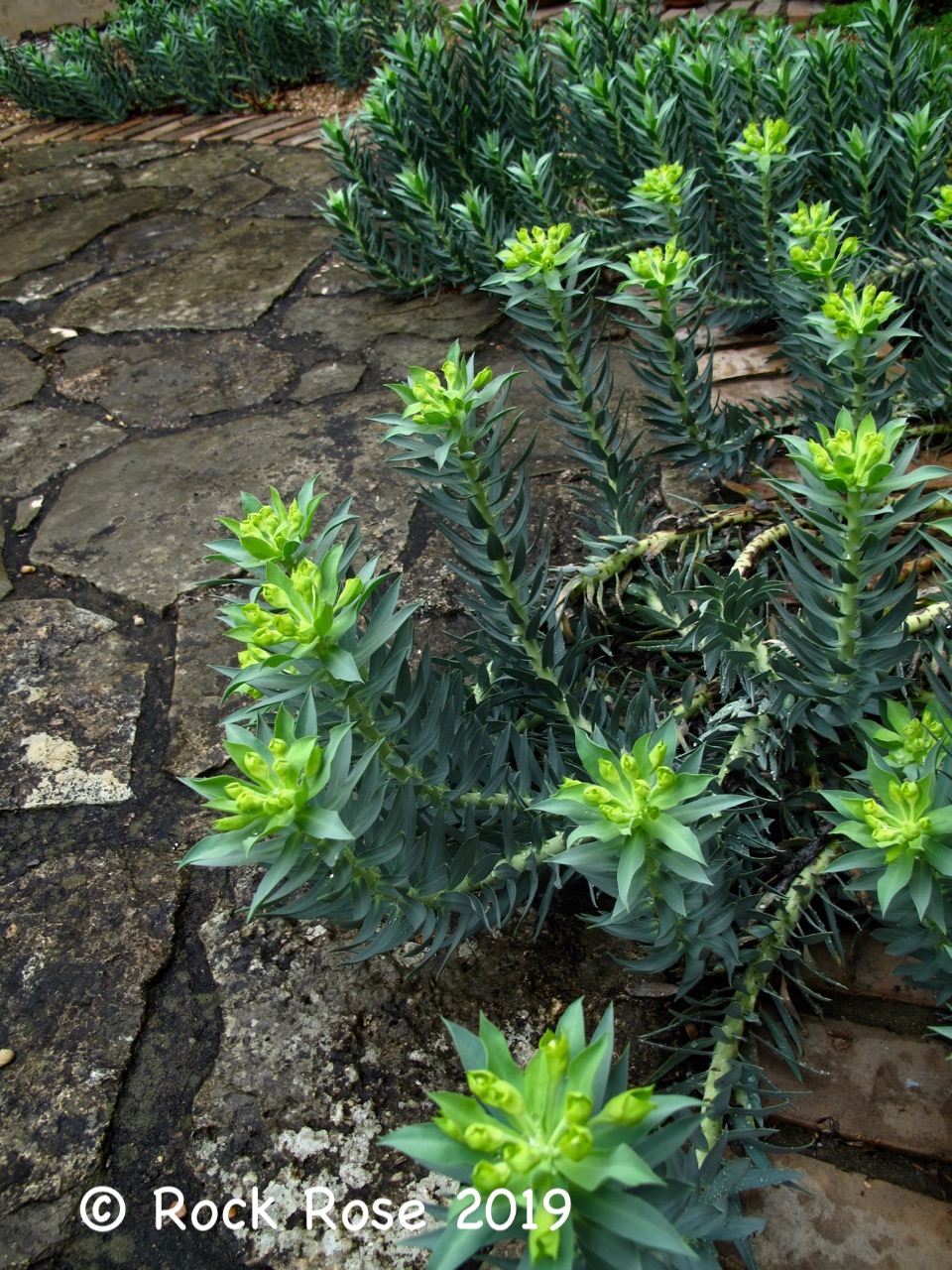
I was looking back through my photographs from last year to see when I can expect the Gopher plant, Euphorbia rigida,  to start flowering. Or at least looking better than it does now. These photos where taken the middle of February last year, just as they were coming into flower.


But the main reason I was looking back was because I am looking at my plants now and wondering if their life-span has come to an end. They are looking pretty wretched, long and lanky with masses of missing leaves along the length of the stem. Of course that always happens whether from drought in summer or excessive rain at other times. They certainly got a dose of both this year.
 In my opinion this plant has two good seasons. The season when it flowers and the season when the new leaves have reached about 12". Then they take off, snaking across the garden. The two good seasons follow each other.  First the flowers on the old stems and almost immediately the new growth.  If you don't want to collect the seeds after flowering then the stem can be cut back to tidy the plant.

If you are growing this plant for the first time don't be tempted to cut off those lanky stems because if you do you will be cutting off this year's flowers. There may be one or two stems that clearly are not productive but hold fast on the rest.

So what do mine look like now?


Long, lanky, twisted and scarred from a Texas year.


The stems are badly scarred and there are stumps from last years old stems which were not cut off down to the crown. Those can be tidied up by either pulling them or snipping at the base. That's all the new growth at the base and will plump up over the next month, growing longer over the summer until they flower next February.

I am asking myself if I can live with this mess. For the time being I will give the plant the benefit of the doubt and see how it performs this spring. Then it may be a case of starting over again or planting something less untidy for much of the year. We shall see.