My Blog List

Tuesday, March 9, 2021

IT DOESN'T TAKE MUCH

It doesn't take much for me to get my gardening mojo back. I have already been hard at work cleaning up following the inclement weather two weeks ago, that wreaked havoc on my Texas garden. Whereas I must wait several more weeks on the woody perennials there are many things that can be done. I felt my first and pressing job was to clean up the vegetable garden. Almost all the winter crop is gone except for the kale, a few Napa cabbage and the multiplying onions. Red onions don't seem to have moved since I planted them but are still alive.
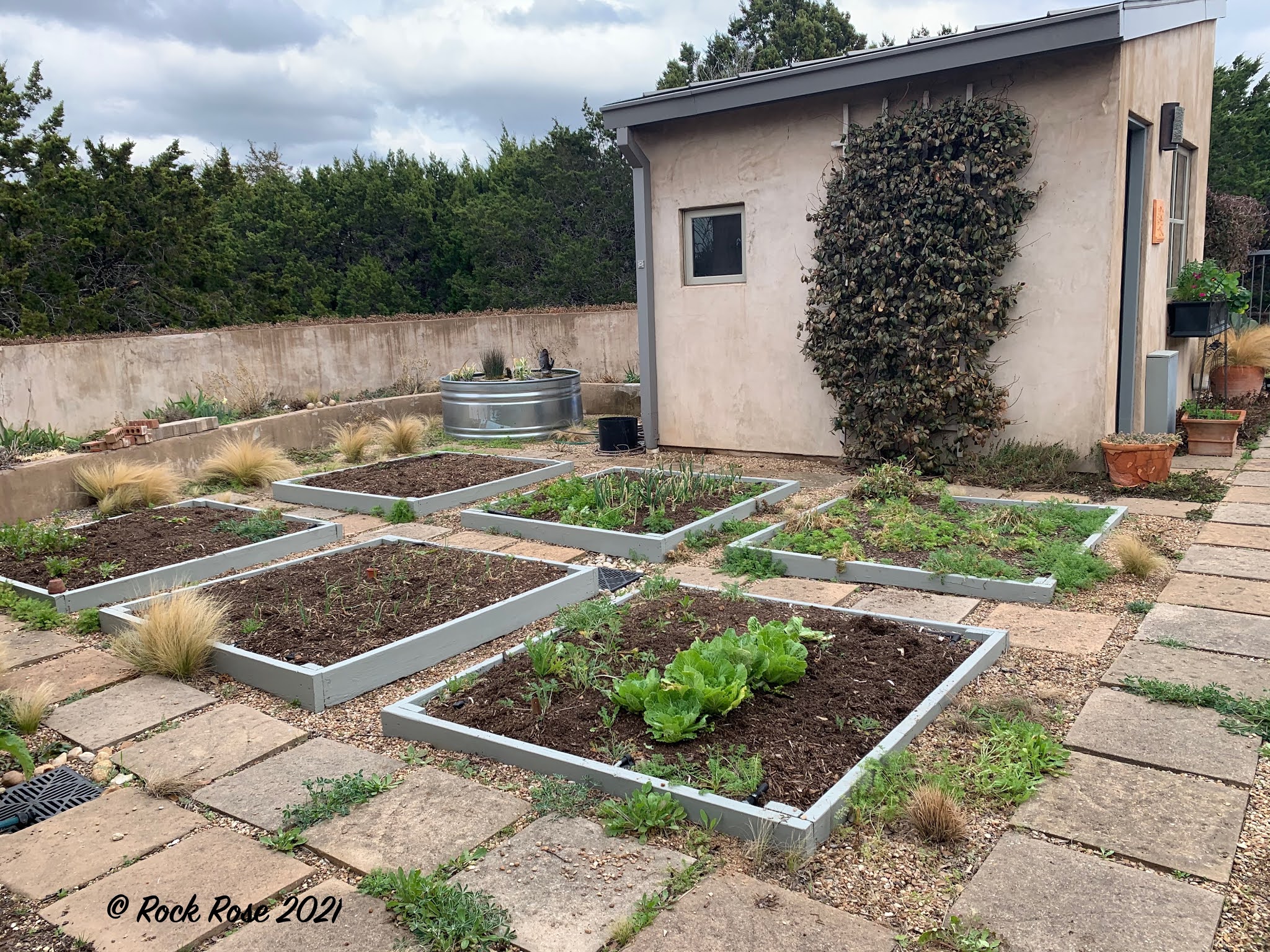
As usual, the beds have their interlopers and they seem to be untouched by the weather. Larkspurs, Love-in-a-mist and some poppies. One or two California poppies were quite far along and much of their foliage was browned-off . I tidied them up hoping they would give me a little color until it comes time to plant the summer crop. I'm finding the lower plants were to the ground the better they have survived.

Lemon grass in late summer.

The next job was to remove the large lemon grass at the corner of the potting shed. It always dies back every winter and it is no mean task removing it. It had lost its shape growing out towards the beds having only been cut back for 2 years. I took some roots in the fall so I have a replacement. It is a lovely grass but grows incredibly vigorously even without irrigation. Extras plants that I put outside the walls but have not checked yet to see if they have survived.

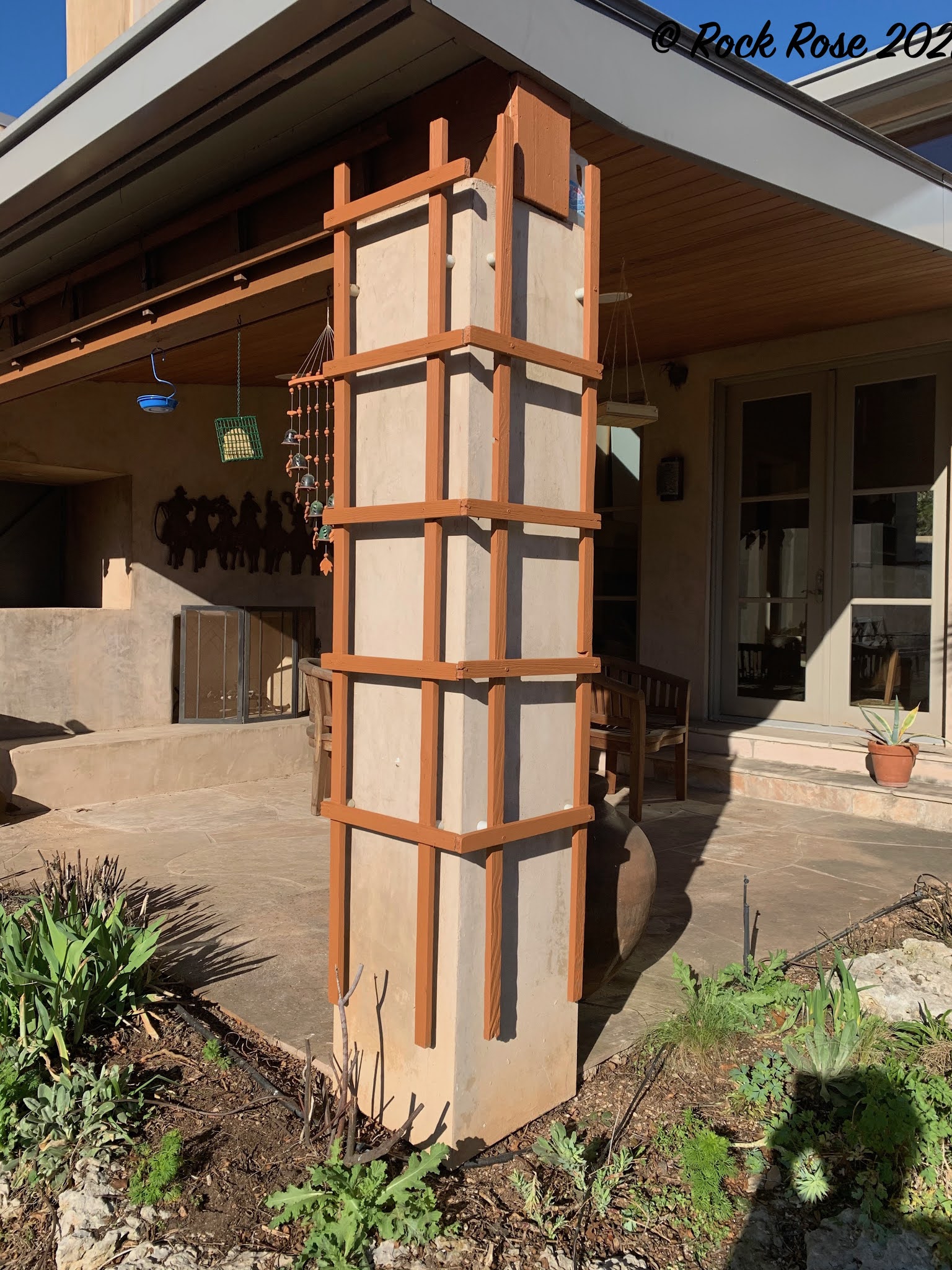
The Confederate jasmine, Trachelospermum jasminoides, on the trellis may not have survived as it is only hardy to 10-15° and we did go below that for at least 2 nights. It will be a big loss but I will replace it because it is an evergreen vine and its fragrance is wonderful. For now I wait and see.

Confederate jasmine spring.

It feels good to have made one area look presentable. There are so many dead agave to pull out, and their removal is pressing because they are starting to rot. But, it is a dispiriting job and has to be interspersed with other more cheerful tasks. One of those came unexpectedly 10 days ago. Instead of our Sunday morning walk at the Wildflower Center we decided to walk around Ladybird Lake for the first time in 18months. Then we stopped by The Great Outdoors. They have been busy during the pandemic making some remarkable changes and with fresh plants in perfect condition I was very tempted. 


I purchased two Hesperaloe parviflora, commonly called red yucca. They are tough as nails and also act as a structural plants during winter. They will replace the A. desmetiana in the front courtyard. The area was once shaded by a lady banks rose which we removed in the fall, where there us now plenty of sun for the expected blooms. My first job was to remove the agave-with a pick axe. Then the rain started and a cold wind from the north drove me inside.

Another job I started was the removal of the Carolina jessamine, Gelsemium sempervirens, in the sunken garden. It was a tangle of separated bark, a sure sign of a dead stems. The trellis needs staining and as yet I am undecided as to whether to remove the root ball or hope it has survived. I also bought a replacement plant just in case. 

A third vine the pink jasmine, Jasminum polyanthum, in the English garden is also only hardy to 10-25 degrees. so is probably lost, although its location in the corner of the English garden and protected from the north wind may have saved it. It was ready to flower.

David has been busy on my behalf. He has sanded and stained the trellis so it is all ready for the new vine which I had purchased at the nursery.
A week later and still no end in sight to the removal of agaves. But from time to time to keep my spirits up I try to work on making at least one are look presentable. This upper part of the sunken garden, surrounding the Y. rostrata needed some work. I cut back the shrimp plant removing some stems that had layered. If the main plant dies then I will at least have some replacements. They had fairly healthy root systems so I am hopeful. I don't think the Philippine violet will have made it but will not be pulling it out until I am sure. I planted a couple of foxgloves I have been growing over the winter. 

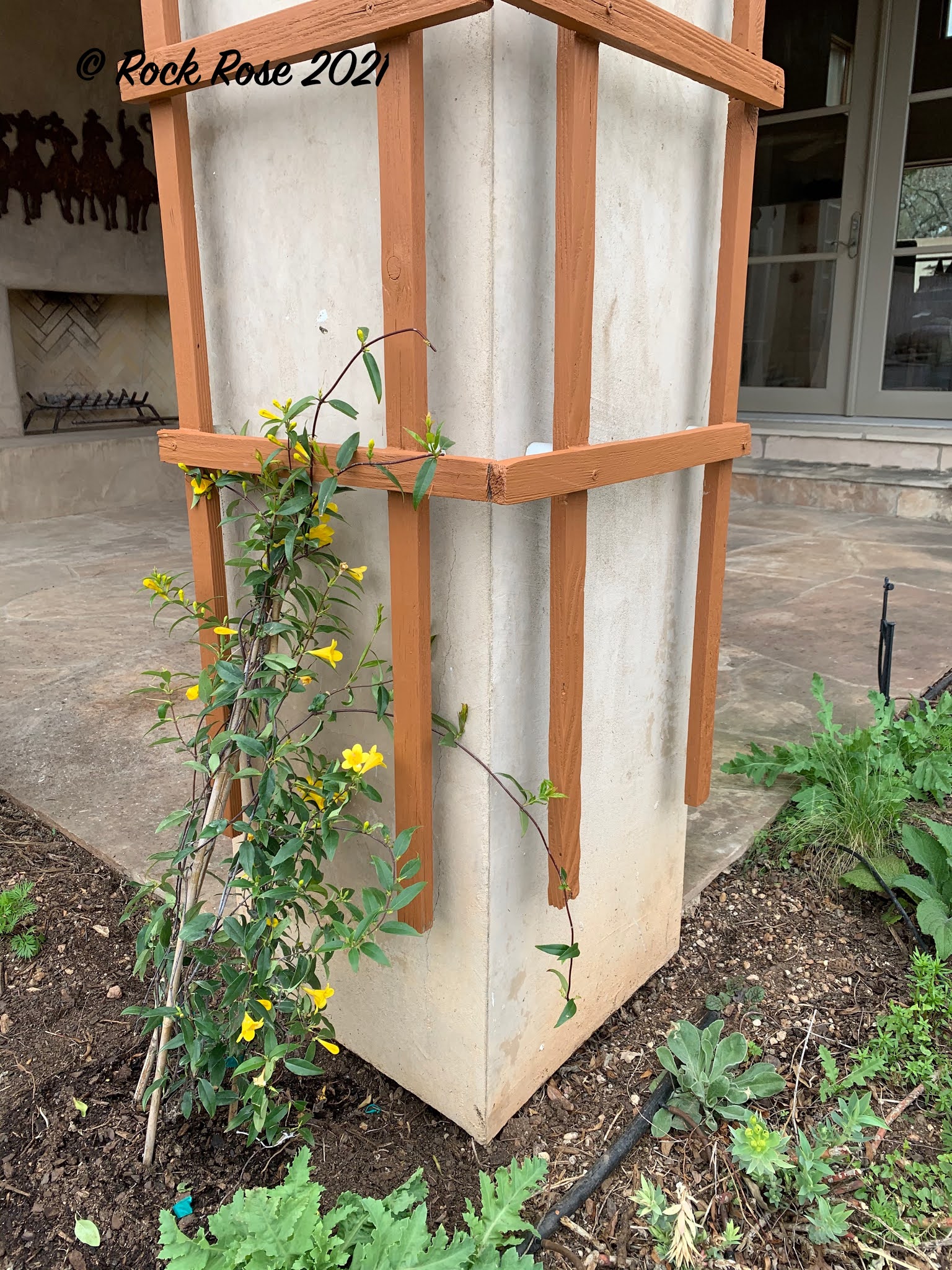
And I finally got around to planting the Carolina jessamine, Gelsemium sempervirum. The old vine appeared to have some new growth at the base but it seemed like a good time to amend the tired and dry soil. It's a fast growing vine and I will try to train it around both sides of the pillar. David spent the afternoon power washing the patio floor and his next job is to clean up the teak furniture and oil it. Although not the most comfortable seating they have certainly lasted 20 years and look as good as new when cleaned up.
Of course, these jobs were on my list of spring clean-ups anyway and there are plenty of those to do as well as removal of dead material.

Work continues in the front courtyard removing damaged agave and outside the walls where the job is quite daunting. There is so much dead and rotting material and disposal is not easy. We tip the garbage men every week to take some of the extras away. It will takes weeks of work to remove and dispose of them all. I did pull out a couple before the big freeze and hopefully they will soon start pupping.

The oak trees started dropping their leaves prematurely resulting in a massive amount of dead leaves. At least those can be disposed of on our property as mulch. But then the gutters needed cleaning out so David has been enormously busy doing those jobs. 

I feel a little fortunate in having a number of native plants that will brighten the upcoming days. The list is quite long of low-growing plants that survived. Already the golden groundsel, Packera obovata, is blooming. I think I will try to bring some of the small plants into the back garden next year.

 There are good stands of Barbara's buttons, Marshallia caespitosa, which are spreading quite well in the front courtyard. And the species tulips, Tulipa clusiana, will be blooming among the bluebonnets in the next month. Of the hardy natives is the chocolate daisy, Berlandiera lyrata, Heart leaf skullcap, Scutellaria ovata, and lyre leaf sage, Salvia lyrata all did well and are growing rapidly. Columbines, Aquilegia chrysantha, var. hinkleyana  is starting to grow new leaves. Of course the bearded iris are fine. 

I removed the A. desmetiana from the pot outside the front window and was fortunate enough to already have the plant that will replace it. 

This Agave striata, which has languished in a pot for years, in the outer parts of the garden where it has neither been watered nor fertilized.  It has now found a pride of place in the front courtyard. My first thought were to leave it in its plastic pot but this afternoon I planted it in the soil that was already in the pot. I am looking on it with renewed admiration after it survived our recent winter weather. Native of northern Mexico it is reported to be hardy to 0°F. I think it just proved its case. And I have a second one, also in a pot. It is a plant that needs to be tucked out of the way as its knitting needle-like leaves show no mercy. 

 A. striata is on of only 2 century plants that does not die after flowering.

The progressive deterioration of the A. parryi over the last two weeks has left me with no choice but to remove it. 
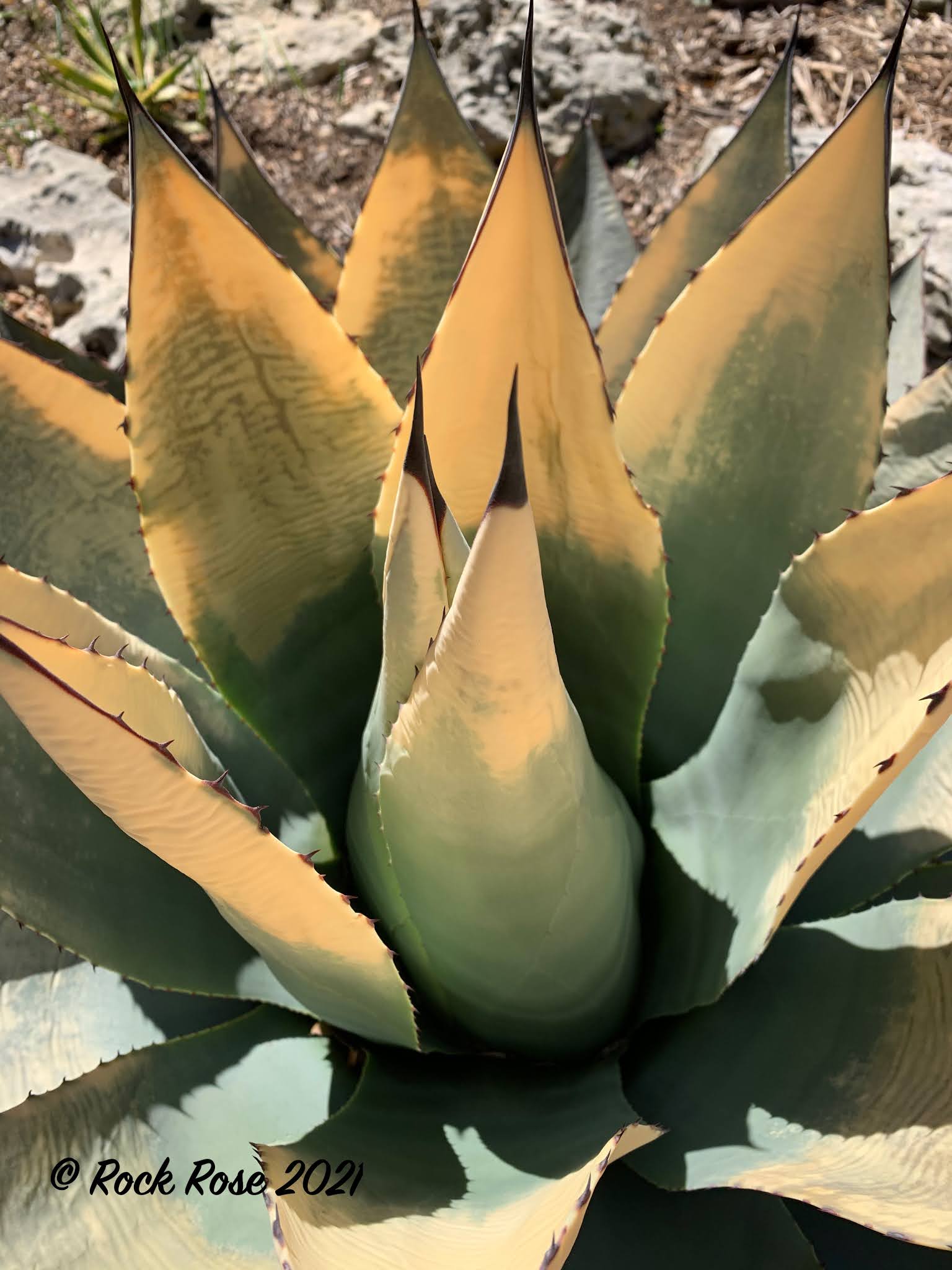
 

Yesterday David removed most of the leaves but neither of us could live with it so today it was time to remove.

It was such a beauty and took years to grow to this size. And all the A.lophantha had to be removed too. 


So, so sad.

But to finish on a brighter note. The window box I planted some months ago was protected from the freeze in the potting shed. I decided to put it up just to bring a little cheer to the garden.


 If your garden suffered badly during the freeze I hope you will be able to find a way forward to a new and better garden.

Friday, February 26, 2021

PICKING UP THE PIECES

When my boys were little I used to read from a Hilda Boswell book of poems, nursery rhymes and stories. To this day I know many of them off by heart. One such rhyme..

On rainy days we stay inside, we have a lot of fun, but there is so much work to do when rainy days are done.

Let us substitute ice, snow, frigid temperatures for rain, although I am not sure about how much fun we had.


Having prepared my greenhouse, potting shed and garage for in influx of plants during the winter, snug and warm with 2 portable heaters, the last thing on my mind was a total failure in our electrical supply. So when the power went out at 4am and and there was news that it was not going to return and the temperatures over the next 2 nights were going to dip into the single digits there was no choice but to bring the greenhouse into the house. Here it is and here it will stay for a while.

With David's help we dug out a few small Agave weberi knowing they might not survive such low temperatures. We covered many things but the hardiest of plants, which included the whales tongue agave, Agave ovatifolia, the A. parryi, A. Lophantha quadricolor and the large A. weberi all of which have been in the garden for more than 15 years, we did not. That was a mistake. Two hanging baskets found a home in our closet and flats of annuals on the floor in what is normally a sunny spot...but there was to be no sun for days. 

As to ourselves we had no heat in the house but a little warmth from the gas logs we had put in this winter and we were lucky enough to have a gas cook-top so food was not a problem. We put the contents of the fridge and freezer outside, filled the bird feeder constantly and boiled water to keep a dish of water for them from freezing. The water pressure dropped and I began to save water in jugs and I trickled water into the bath. I was glad I had as eventually it stopped. We were still boiling water after 6 days but at least it returned after 3 days. Some were not so lucky.


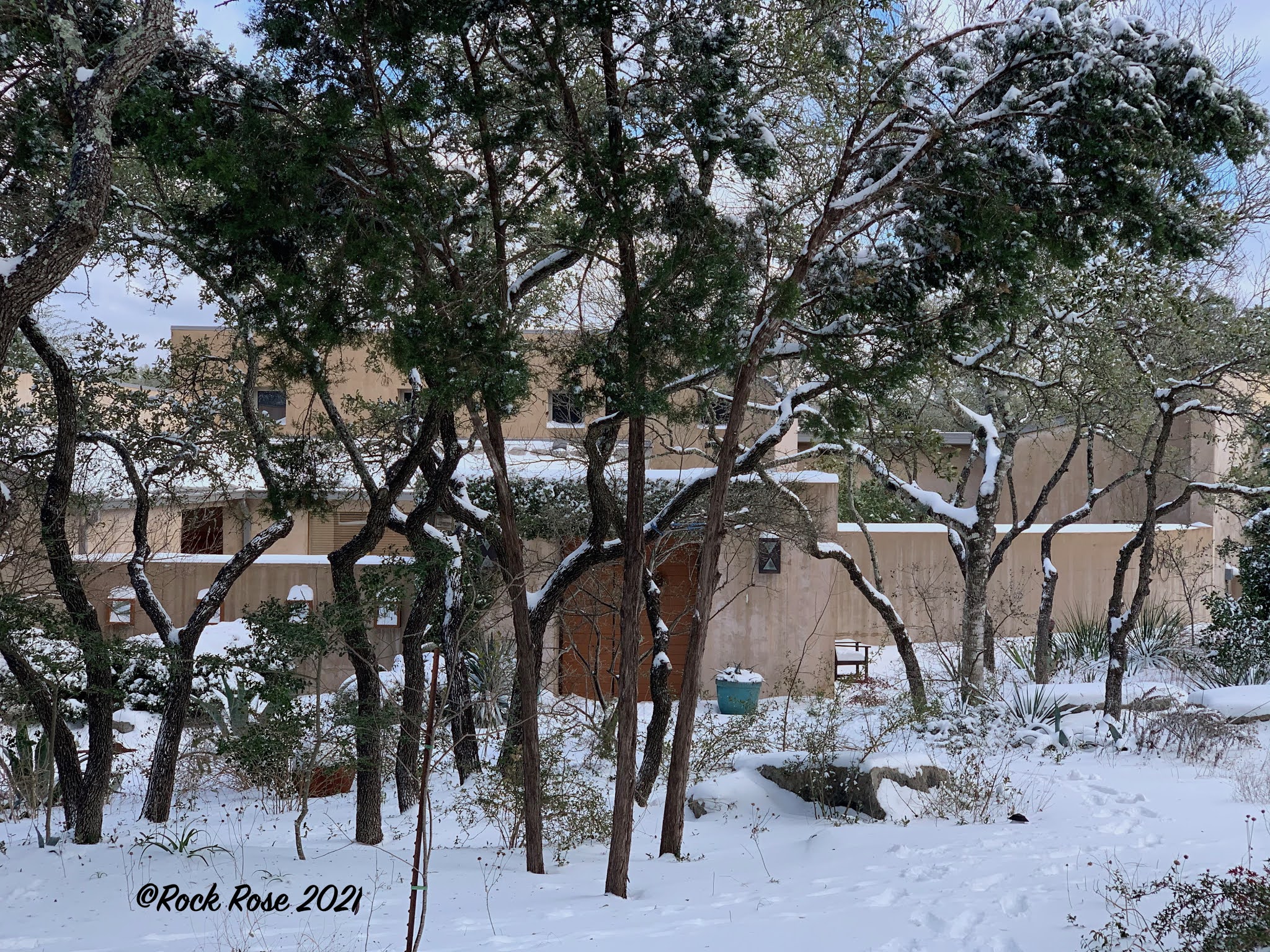
Our first venture out into a snowy world after 3 days. It was safe to walk as long as snow covered the layer of ice. Little did we know how this scene would change.

But that is behind us now. The sun is shining, the snow has thawed, we have surveyed the damage and it is enormous. The first day day I tried not to dwell on that, looking only to the things that appear to have survived.

The blue eyed grass, Sisyrinchium sp. hesperaloe, iris, species tulips, small plants of blanket flowers, some bluebonnets. It depended on where they were located. In the vegetable garden the kale I covered survived the best. Most other vegetables have turned to mush including the Swiss chard.  That isn't a surprise because we already had a freeze which knocked them back. They had just recovered and were producing when this happened. Fortunately I dug up some small plants that I had started from seed, saving them in the potting shed, and replanting today. Many herbs are gone including sage and oregano I have had for years.

Blue-eyed grass


Chocolate daisy

Bee balm


 Trailing wine cups

Gulf coast penstemon,

This spiky aloe has survived in a pot and I think will go in the ground next year in a safe place.


 Windflowers. Anemone berlandieri.

The worst place is in the front garden where it looks as though all the Agaves are lost. Also the front courtyard garden where I found that the A. parryi were severely damaged  being wrinkled with white patches of frost burn. They grow so slowly that I don't think there is any hope to see them rebound. The same with the A. lophantha. Time will tell with them but their cells seem to be very soft. It was harkening to see the species tulip, Tulipa clusiana, weathered the storm but they are used to the mountains of Iran. There is hope for a spring bloom from them and bluebonnets and of course there are plenty of windflower leaves that look healthy. 

Agave parryi 

The agave in the front courtyard and outside the walls are a major loss. They were my structural plants. Even the hardiest did not survive these temperatures. With every passing day they tell me it is the end. And to think in the past the things I worried about were hail damage, the agave weevil and whether they might flower. Loss from cold had never entered my mind. 

Damage has progressed from this.......


 To this.

Every one needs to come out and it is a major job to do as well as disposal. It looks ghastly on this dull morning. For now we are sawing off the soggy stems and piling them up in the hope that their weight will be reduced over the next few weeks. The cores are a different matter.

Nature did an imperfect job of pruning my prickly pear cactus in all parts of the garden. The weight of ice and snow was just too great for them. I believe they will survive although I will have to put my imperfect pruning skills to the test. Or maybe I will just start them anew.


 It will be wait and see with most of my plants and I fear will be a disappointing spring. It is probably time to rethink my gardening strategy and garden with less. If I was planning to have fewer things in pots I shall think again as right now that is where my garden is for this year. 

Already my Austin garden friends are offering  extras of plants that have survived. 

Yes, there is so much work to do now icy days are gone.


Wednesday, February 10, 2021

A M0RNING IN THE GREENHOUSE

 "I'll just spend a little time in the greenhouse this morning while it is still cold outside" 

That little time turned into a whole day. If only I hadn't let it get so out of hand. I had good intentions when I started to take things inside last fall promising myself that I would keep plenty of space between each pot and nothing on the ground. Suddenly every bit of shelf space was filled, above and below and then the floor started to get crowded out. That pot of dwarf papyrus, the two branches of plumeria, a box of agaves which I had planned to take to Phoenix at Christmas, a bird of paradise I dug out from the edge of the path. Empty pots, pots of soil. No room to move in there. The first job was to move everything outside so I could work on the shelves.

Next was to organize the shelves moving a few things around. There is shade cloth and a cross vine growing over the greenhouse so the only really good sun is at the end. That is where I need to have my winter blooming cactus. Some have already started blooming and some are now making buds. I think they are going to be earlier this year than any before. 


I have several pots of lady finger cactus, Echinocereus pentalophus. All are beginning to make buds. If you aren't familiar with this plant the flowers are the most wonderful Thai-silk pink. But it will be a few weeks yet.

And more and more mammilarias.

I moved this plant up from the lower level and into a more sunny spot when I saw this bloom stalk.

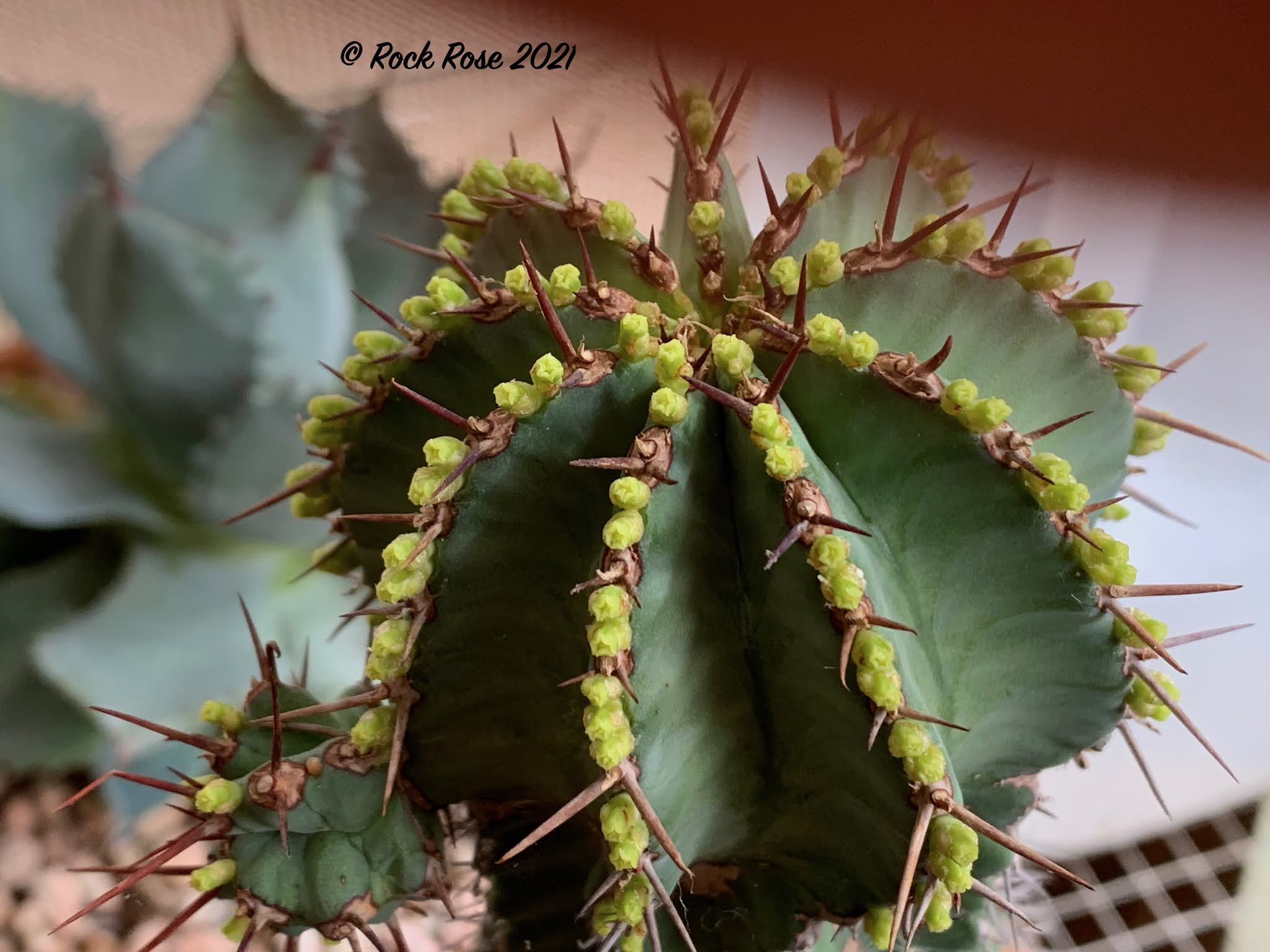
And a euphorbia blooming. You know how tiny their flowers are and if it weren't for the fact that they are yellow you might even miss them.


Finding more scale on some cactus I broke off tidying and got the paint brush and alcohol out. I was not expecting to do that but it seemed like a priority.

I was sad to see I had almost missed these sprays for flowers on the copper Sedum nussbaumerianum. I felt rather badly that they had been under appreciated being on the lower shelf. The plant is rather straggly and needs a complete pruning. Not a job for today.

When I got down to moving the last pot which was on the floor by the door I discovered that the ants had come up through the bricks and into the pot. What next! It was the newly potted bird of paradise which I quickly removed and took outside far away from the garden. Then I put the kettle on to boil. I'll make their life unpleasant. 

I only have 3 orchids left and they are in much need of attention. I heard on a gardening program that an orchid needs at least 4 good strong leaves in order to bloom so there is a good chance that this one will soon send out a bloom stalk. One has a small stalk and the other only 3 leaves. Some nurturing is needed. I knew that orchids like to grow in clear pots. Don't they all come that way from the nursery. Their roots like light as they photosynthesize through them. I don't know why I was anxious to put the other two in clay pots even though they were so-called orchid pots. From now on its clear pots for my orchids. 


I have a couple of hanging baskets. The first is the Huernia schneideriana, which spent the summer hanging in the live oak tree, totally under appreciated. It will probably go back there again next year but will need some trimming as eventually the longer stems start to fail. In Arizona I saw this plant creeping along the ground and it will set down roots easily along the length of the stems.  


Finally a quick wash down hoping to make the ants more miserable and the greenhouse is ready to receive many plants that will have to come in during the upcoming inclement weather. 

Now a week later we begin to feel the start of the weather. It is 43° out there and for us bone chilling and damp. Tonight will probably be the first night of 7 nights of freezing temperature with some possibly in the single digits. Freezing rain is also in the forecast followed by snow next week. The heaters are on in the greenhouse and I have brought even the foxgloves inside. I have been nurturing these since they were 4" pots. You can't take the English out of the girl. She has to have her foxgloves. 


It will not be good as the garden is so far ahead. I have already picked daffodils and many of my vegetables that will not take even those low temperatures. Shiver , Shiver! I don't want to think about the possibility of a power failure due to this unusual weather. 

Thursday, January 28, 2021

WINTER FLOWERS THAT BRING JOY

We send flowers to friends in hospital, on their birthday, Valentine's Day, when they lose someone dear and we celebrate weddings with flowers, the bride carrying her favorite flowers in her wedding bouquet. Flowers bring joy to everyone. These days we can enjoy flowers year round with winter no longer a problem because flowers can be grown in glass houses and from there transported to flower shops and grocery stores. 

For the gardener flowers that bloom during the winter season are special. Yesterday when I went into my greenhouse I was thrilled to see flowers blooming on the Mammillaria compressa. This is the best flowering I have seen in many years.


The original plant was bought many years ago at the Austin Cactus show, a gift from friends who were staying with us. It was cluster of about 7 growing closely together. When I tried to repot into a larger pot the individual plants, which had been growing very close together collapsed. They never regained their original form.

There was only one thing to do and that was to cut off the individual plants, let the cut dry and pot up in some really good succulent mix. The only one I have found, which in my opinion is the best, is from East Side Succulents and is called Cactus Gold. I made up several pots, this one with three and several singles. This time I would really take care of them. As you can see I was rewarded. 

Over the late fall and early winter tufts of white fiber began to fill the spaces between the tubercles and it was from these that the flowers burst. Furthermore new branches have begun to sprout from the sides which means that it will eventually make another clump. It is for this reason that it has often been called Mother of Hundreds. This cactus comes from Central Mexico and is supposed to be hardy down to -5°C or 23°F if kept dry.


Other mammillarias are flowering too. This pink flowered variety.


And recently a much larger one which is also starting to make off-sets. This one blooms multiple times throughout the year.

They seem to favor having a cold dry spell during the winter and although in my greenhouse they are not in full sun. A sunny window ledge in the house might suffice.

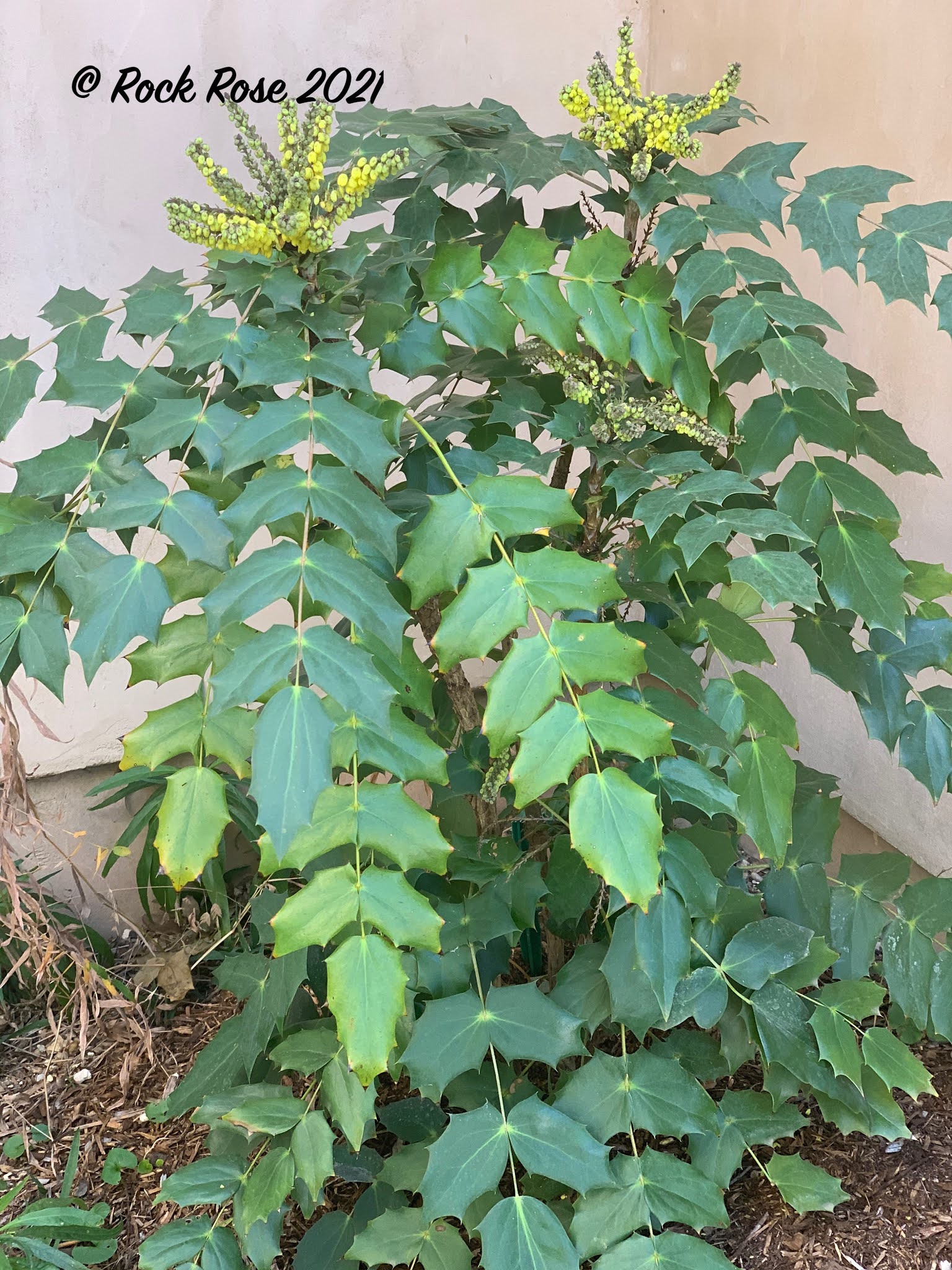
In the garden there are a few early bloomers. The Mahonia is one.


 It grows in the shadiest spot I have in the garden never receiving any sun. For this reason it blooms later than most in the area.

Yesterday I was thrilled to see several bees had managed to find the flowers.

And sweet alyssum, Lobularia maritima, is of the early bloomers. It re-seeds around the garden and is  loved by bees.


Plant it now and you will never have to plant it again and at the same time you will enjoy its sweet honey fragrance for months.