My Blog List

Saturday, April 27, 2024

THE NARROW SIDE GARDEN

I have thought about changing my blog name to Gardening on the Edge, which is exactly how I am gardening these days. Each of my gardening spaces follow the footprint of the house. The edge that needed attention was at the side of the house leading up to the side garage door. I get the feeling that the previous owners never walked around there because there were several bushes whose branches would grow at odd angles and grab you as you walked by. We use this way frequently and were tracking dirt intot he house. First step was to remove them leaving only the photinia and the Texas olive at the front and at the back a beautiful Anacacho orchid tree. 

In the spring the arching branches hang over the walkway and are reminiscent of times when I had apple and crabapple trees in my garden.  The fragrance isn't quite the same but not unpleasant and the bees love the flowers which give them black pollen.

This narrow 7' space is bounded by a low wall with fence on the left had side. On the right the garage wall. There are two scuppers coming off the roof. They carry water of the flat roof which drained away along the bare ground. The first job was to create a place on which the water could land before passing into a proposed wet weather channel.  And make it possible to walk past without getting muddy feet.


I marked out a winding channel which David lowered a few inches so water would flow out towards a drain at the front of the house. I knew we did the right thing bringing our pick axes with us.

This is a budget project using rocks abandoned by builders in the area and some taken from areas of our lot where we created more garden space.  To add more interest I found a couple of large ones and then filled in with smaller stones.


 I wish I had some larger rocks to create a rock garden but as my mother used to say " beggars can't be choosers" This is what I had to work with.


There will only be planting along the left side. I already have some native plants growing from seed( thanks to a gift from Syd Teague)  and hopefully they will soften the jagged rocks that I am making do with. By late April native Desert marigold, Bailey multiradiata, and Goodings verbena, Verbena gooddingii, are already flowering. They are short-lived plants but reseed easily. I['m also saving seeds from my very successful damianita and chocolate flower.


I have also added a few pups of Octopus agave. I really don't have a big enough garden for this large agave but they will stay until I find substitutes or they grow too large. 
As I mentioned this is a shoestring garden of native plants that are not attractive to the javelina. We finished off the walking area bu adding a small clean gravel. Most of them were bought at the 50% off bin at HD where they put their opened bags.

Tuesday, April 9, 2024

THE DESERT BLOOMS

When it rains in the desert at just the right time, the desert becomes a carpet of flowers. These are plants that rely on rainfall to grow, bloom and set seed in a very short period of time before the summer heat arrives.. It doesn't happen every year but this year was a particularly good one and we made the most of it by visiting the places where wildflowers were blooming. We took trips to the Anza Borrego Desert, the Boyce Thompson Arboretum and surrounding areas of Superior and our nearby Catalina State Park and Pima Canyon. We have hiked there multiple times this spring awaiting the desert bloom.

 The Mexican poppy or Gold poppy, Eschscholzia californica ssp mexicana is the most prolific of the annual desert flowers in our area. It is similar to the California poppy except for missing the small green sepal underneath the flowers.


 It appears in shades of gold and yellow and seen here with owl's clover, Castilleja exerta..

 The first time I saw it I thought how much it reminded me of Indian paintbrush and I was correct. It is in the same family.


Cream cups, Platystemum californicus, also blooming alongside the poppies and as the poppy prefers the open, hillside meadow area. Where it finds a happy place it blooms in large swathes opening its petals once the sun shines but remaining closed on cloudy days.

The desert zinnia, Zinnia acerosa, is on my list of seeds to buy. I hope to find a small patch of my garden to plant a wildflower patch. 

This hike is is one of my favorite hikes, the wildflowers just adding an extra layer of joy. The scenery is superb and at this time of the year there is water trickling down the mountain into pools known as bathtub tanks.

Another wildflower blooming prolifically is the scorpion weed, Phacelia distans. It is very showy when found in large numbers.


 Some flowers are prolific along the roadisdes including the Arizona lupin,  mallows and penstemons where they receive just a little more rain. They are different from the Texas bluebonnet in being a little taller, having finer leaves and smaller more upright flowers. 

                                                   Lupin, Lupinus arizonicus


                                                       Mallow  Sphaeralcea ambigua

Desert chicory, Rafinesquia neomexicana, is abundant in washes and on the hillsides and is particularly showy when found in a clump. 


 There are many more wildflowers blooming in the spring and every day when we are out hiking I feel fortunate when I find another new one to add to the list of the many flowers that bloom under the harsh conditions of the desert.

As the gold poppies fade the brittlebush, Encelia farinosa, comes into flower. It is a perennial shrub growing to about 3'. It seeds easily and I don't understand why it isn't used more frequently in the landscape. In our neighborhood of landscaper-tended gardens there is only one. The use of pre-emergent means it never gets to germinate. As you might imagine my garden has many blooming specimens with more showing up every year. It is so plentiful that I can be choosy about where it gets to grow.


But our visit to the Anza Borrego Desert yielded the most prolific of blooming carpets. It was a spur of the moment decision. We packed up the car for an over-nighter along with picnic supplies and headed west towards the Salton Sea. We had been only once before on a Thanksgiving trip in our VW camper in 1981. We had forgotten about the fact that it would be dark by 6 o'clock and with no campfires allowed and no other campers foolish enough to be out there. We ate and had the earliest night ever. And it was cold. We did enjoy hiking the next day and determioned to go back during a better time of the year. It had taken 43 years!

We knew exactly the spot to aim for. Henderson Canyon and were not disappointed.


It was incredibly windy and trying to get the flowers to sit still for a photo was almost impossible. The best spot was to find a larger growing creosote bush and hide behind. We planned to come back the next day.

I was on the lookout for the desert lily, Hesperocallis undulata. If someone on instagram had not mentioned he had found it I would not have known what or where to look, but as we drove along I had my eyes peeled for them. They are mostly found growing alone but I could spot the open lily from the car as we drove along. We had to stop and then walk back. The ones we saw were about 1' tall although I hear that in more favorable conditions they can reach as high as 3'

How could such beauty spring from this cracked earth?

We spent the night in Indio and returned the next morning. The wind had dropped and the fragrance from the field of flowers was incredible. Then we drove to look at the desert sculpture we had heard about stopping first at the Friday market in Borrego Springs. 

                                                                      The serpent or dragon

                                                                        The Spanish priest


                                                                    The gold miner

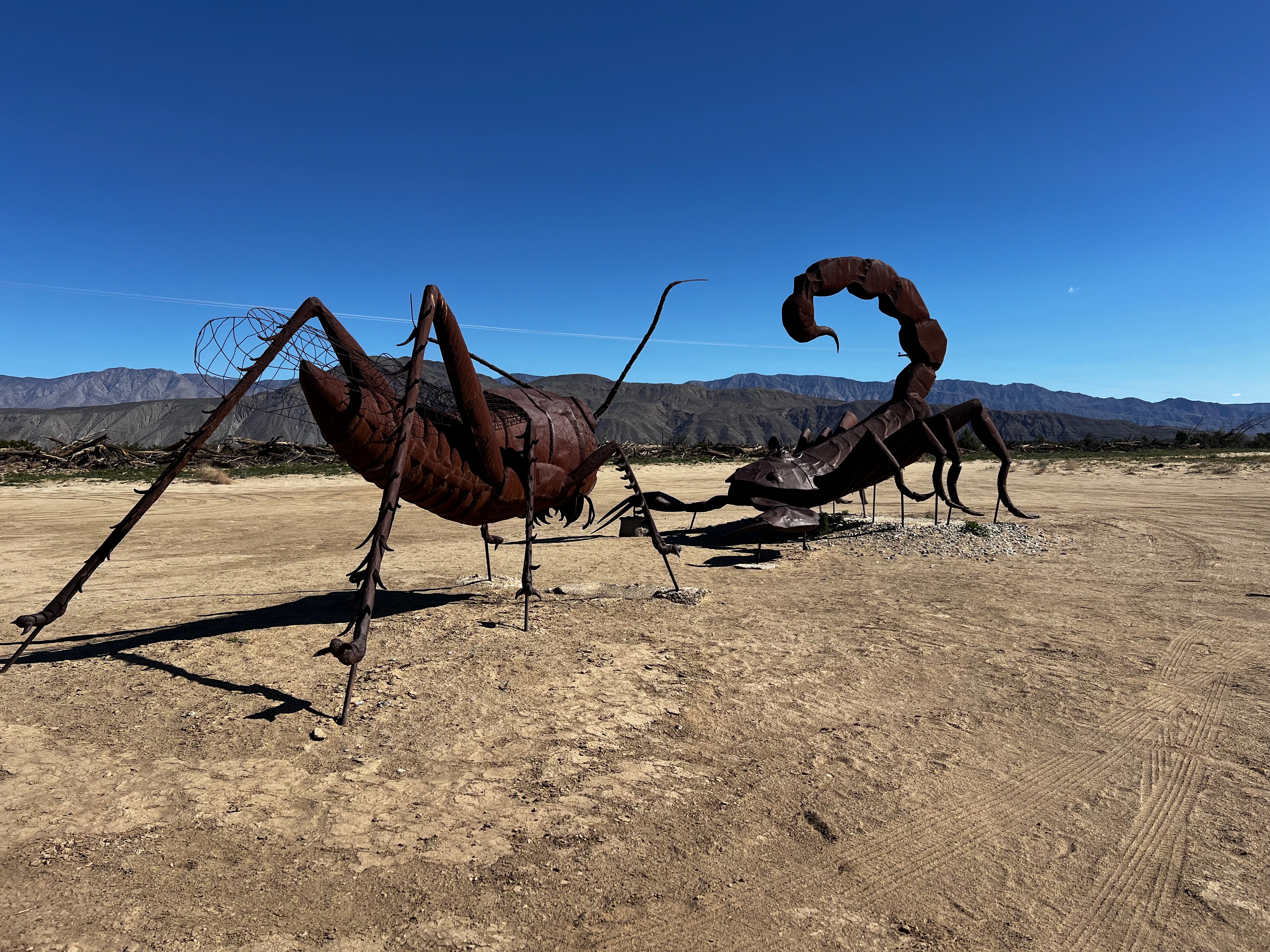
                                                The scorpion and the grasshopper

Over 100 pieces of metal sculpture created by Ricardo Breceda are spread over 1500 acres of undeveloped land. These are just a few of our favorite pieces. They were gifted to the town by the town's benefactor Dennis Avery. All manor of animals; camels, sloths tigers, pigs, sheep, tortoise and the dragon seen above. Also the Spanish explorer Juan Bautista de Anza. 

The Anza Borrego desert is surrounded by BLM land and camping is permitted in many areas. Most of the people who camp here have all terrain vehicles and derive enjoyment from driving the desert trails. Not our cup of tea but we are open to dry camping inside the park where there are one or two designated campsited. It is our plan to return next year and explore more of the hiking trails. 

Because we had a long 6 hour drive home we quickly went over to look at one of the hikes into a slot canyon. We had not planned to hike so had no boots or poles with us. We did a short distance but the going got tough and a 5' drop made us turn back. Next time!


All in all it was worth those long drives there and back.

Sunday, February 25, 2024

SURPRISE, SURPRISE

 I might have expected David to find something special for our 56th Wedding Anniversary, and he did. I walked into the guest bedroom and immediately spotted something new on the wall. A photograph, on canvas, that I had taken last summer while hiking in Idaho.  It is the elephant head, little red elephant, Pedicuaris groenlandica.


This sub-alpine plant blooms in mid summer and our timing for the hike was perfect. We had hiked the Norton-Big Lost Lakes loop many times. There are three sub-alpine lakes, Norton Lake, Big Lost Lake and Smoky Lake. It was at Smoky Lake where I wandered into the lakeside meadow filled with wildflowers  and where I found the plant. 


At first I thought it was an orchid  but then I saw the little heads and a light went on. I had seen it in my book, Idaho Mountain Wildflowers, A Scott Earle. It was the elephant head. Do you see his little face, two large ears and trunk? 

The location was just a described where other lovers of moist ground were blooming; the Explorer's gentian, Gentiana calycosa. Found between 9000'-10000' 


and the Elegant camas, or mountain death camas Anticlea elegansm. Also a lover of boggy ground and high places.


From the gorgeous flower-filled meadow the hike takes you down along side the creek which runs out of the lake. The sides filled with monkey flowers and all manner of stream side plants. It has to be one of my favorite hikes in Idaho for the wealth of wildflowers.


What a wonderful idea for an anniversary gift. Every time I walk into the room it will bring back memories of that wonderful hike and that wonderful find. We will be heading back there again this year and this time I will find the Steers head, Dicentra uniflora! 

It even got me blogging again!


Saturday, November 18, 2023

MY GREY WORLD

In 2021 we moved into a grey house. The previous owners loved grey both inside and out.


Somehow I had to try to make it work with the things we brought with us taking the emphasis off the grey. Inside was one thing outside another. It would have been a huge undertaking to change the color of the house not to mention getting permission from the HOA review board! All the terracotta pots of plants I brought with me didn't look right against the clean modern lines of the grey house. And so began the change. It also brought with it a simplification which was the reasoning behind moving here in the first place. Grey and black planters and square rather than round to complement the formidable, square patio pillars, softening the area. Away with all those tiny pots which dried out too quickly and maybe a new beginning with a coat of paint.


 I was lucky to find some square planters on sale at 50% of the price. With a little negotiation ( a few had dings) we managed a great deal. All the pot feet were pained black. Now for the plants. Drought tolerant plants which require little to no water when I am away from home. They must also tolerate vast swings in sun and shade as the sun moves across the sky from winter to summer. 


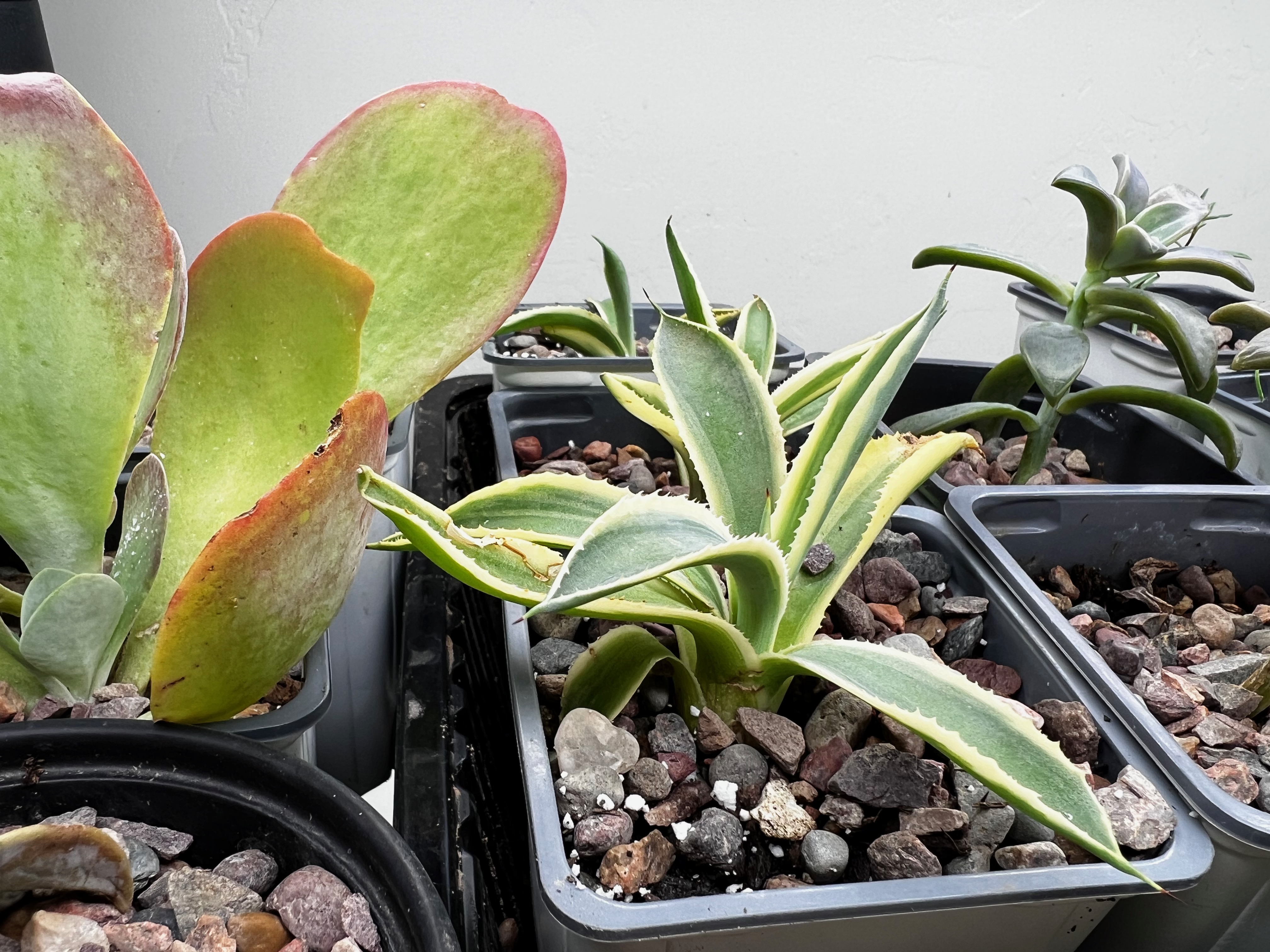
 Cactus and succulents and small agave  the obvious choice. Shout if you can identify this small agave.


I already had a few nice specimens and purchased several elephant food plants, Portulacaria afra, for the larger pots. Elephant food can be grown in full sun or part shade and is very drought tolerant. And there is a variegated version which I think I like even better. The stems are dark burgundy and look stunning against the pale foliage.


Elephant food roots easily from cuttings but will need to be protected from frost. A friend of mine who lives in S.Cal. uses this as a ground cover on his hillside and has a small 'nursery' of pots he has rooted to increase their spread. After the new year I will cut back one of the plants and start my own nursery. Growing in the ground would probably not work here as we have too many nocturnal visitors.

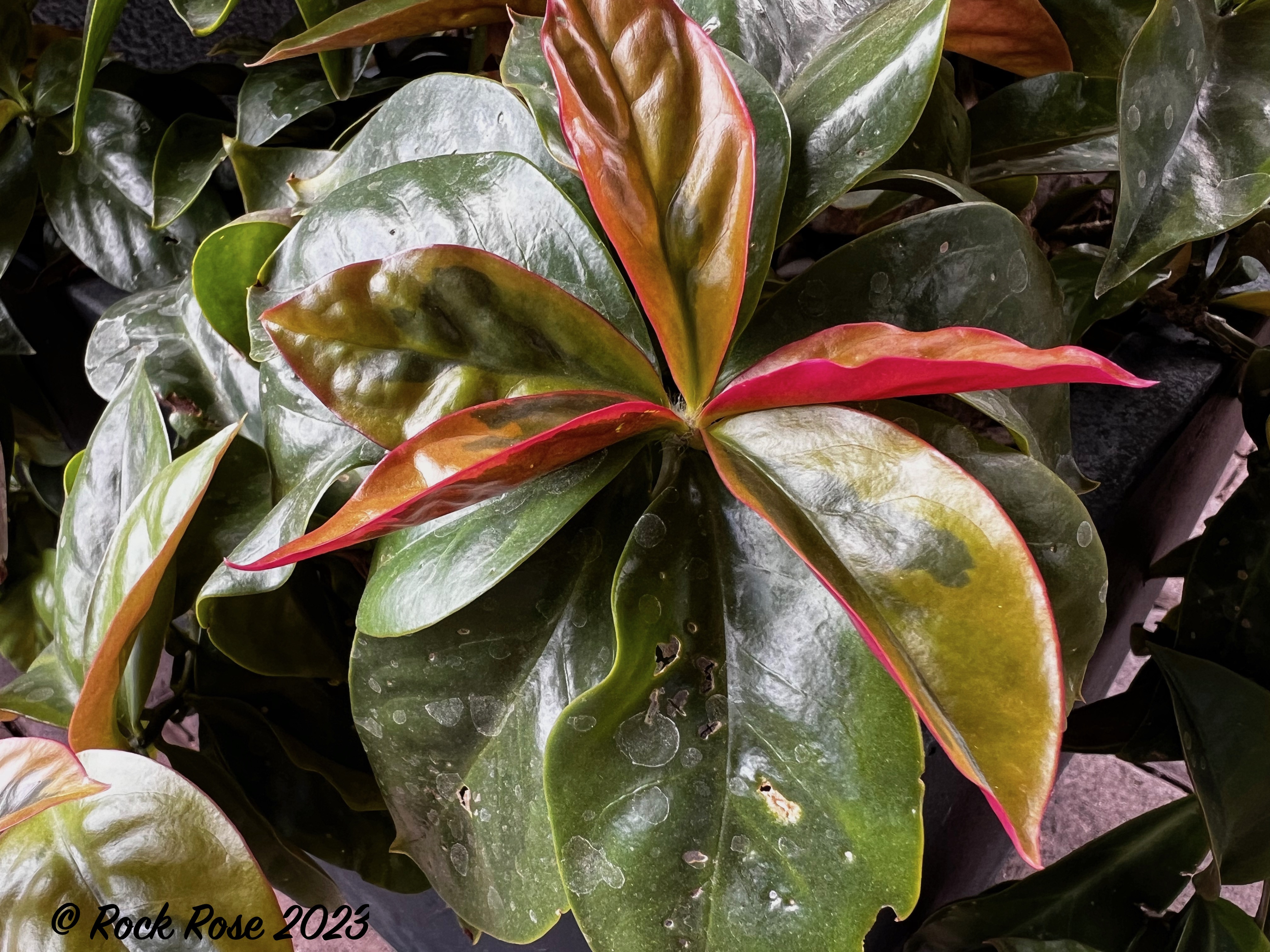
I have never been a huge fan of variegated plants but  now find they are very suitable to tone down my large areas of grey. The plant below, Pereskia acuelata also came from my Austin garden. It seems to prefer this climate and has coped well with a long hot summer.


Looking across from the patio are the 3 A. desmettiana variegata and Joe Hoak I planted 2 years ago. They have grown well despite having their lower leaves eaten by critters I try to rescue pups as soon as they appear or they would be eaten too. Is there any hope for this one? Of course,but it may take a few years of potted life. 


The old bird bath stand and planter have joined the grey world too. 


I do have plans to add color to the edges of the garden. Newly purchased Tecoma stans 'Sparklette' seemed like a good choice as it grows to 3' and is frost hardy. It may die back to the ground during a very cold winter. In another part of the garden I have replaced a Photinia with sparklette. There was nothing wrong with the photinia as it was healthy and evergreen and did put on a great display in the spring but I just felt there were too many other plants with more merit.


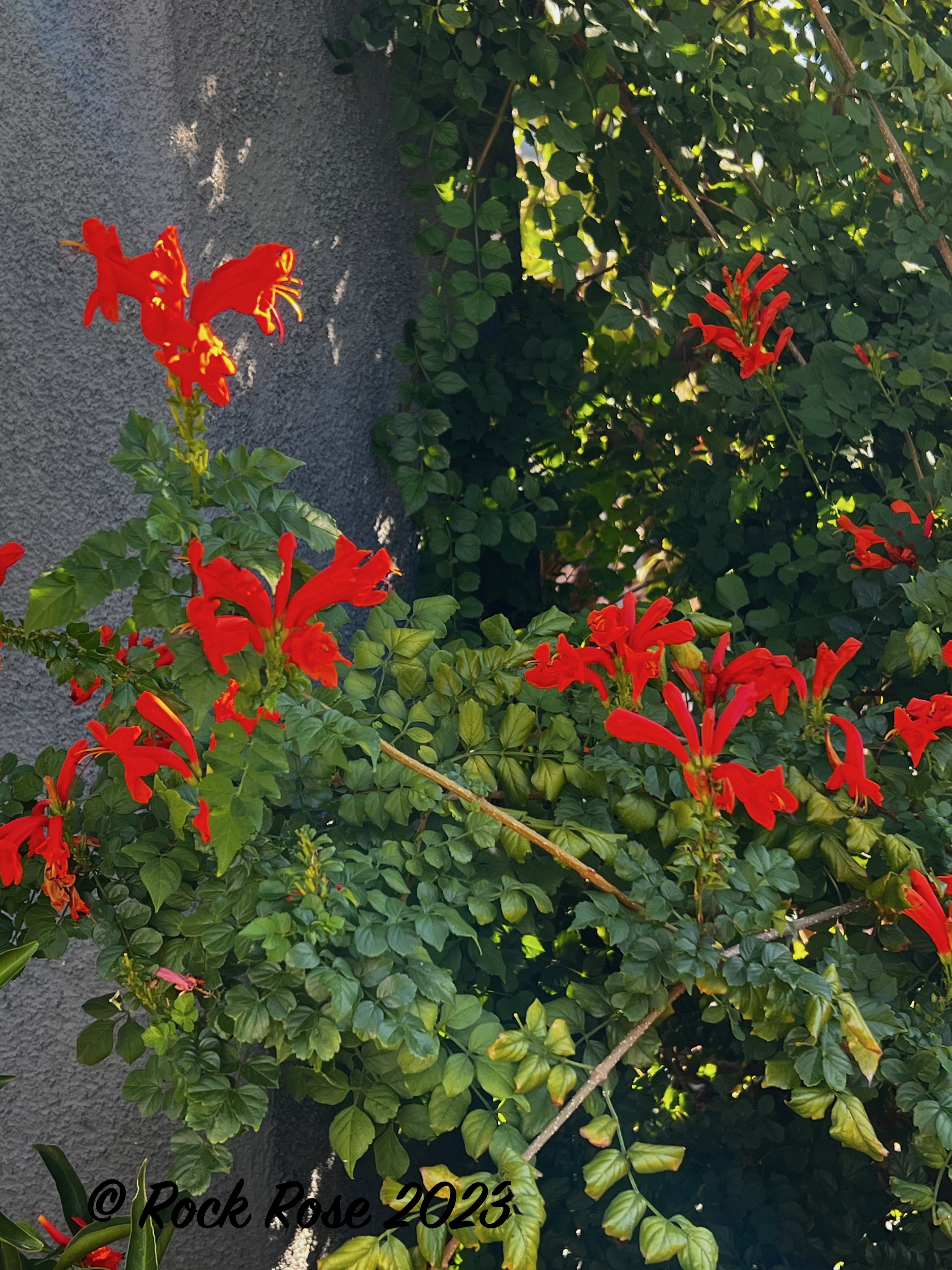
 It grows alongside aloes and  Tecoma capensis, Cape honeysuckle, an original planting. The hummingbirds love this bush.

This white alyssum has returned from last year. It seems to be an easy variety to grow, unlike the purple with which I have had no success.

I am thinking of taking out some of the pavers alongside the pillars and planting vines. The only problem will be irrigation during periods when we are gone. But that will be a job for the new year when we return from our winter travels. 

Happy Thanksgiving to all my garden friends. May the holidays bring you lots of gardening joy.