My Blog List

Friday, April 12, 2013

COOL MORNING HOT AFTERNOON

The temperature was hovering around 40° this morning and steam was rising off the unheated pool.


It won't be cool for long, but for now we are having our breakfast, inside, looking out.


My friend Ally, who blogs at Garden Ally, gave me some of her wonderful eggs. They really are the most delicious. Look at those yolks and perfectly cooked! "Go to work on an egg" was the very successful slogan of the UK egg marketing board when I was growing up in England, in the 50s. Of course everyone had an egg for breakfast and bacon, sausage and tomatoes too! The Full English.
We are just having an egg in an egg cup and we are too grown up for toast soldiers.
Thanks to Ally I'm going to work today on an egg....in the garden.

Wednesday, April 10, 2013

OH! THOSE PINKS

Today it is raining and the temperature has dropped 40° overnight. I just cancelled a garden group who were to visit today. I have time on my hands.
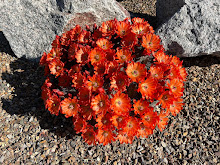
Monday was the last day for the blooming of the one flower on my ladyfinger cactus, Echinocereus pentapophus. She has bloomed not stop for 6 days. I shall really miss her.


But taking over is rosa 'Felicia' (1928) Felicia is a repeat flowering Hybrid Musk rose. She is the sweetest rose with clusters of pink flowers which perfume the garden with a baby powder fragrance. I cut this rose right down in February but next year I think I will try to have her grow on some kind of support. Her thin branches have difficulty in holding up the weight of her blooms and I think she would look better as a pillar rose. Because of her modest size she is also well suited to growing in a container.


The other sweet smelling rose, but growing in a different garden, is Zepherine Drouhin (1868). Although described as a repeat bloomer her main bloom time is in the spring when her clusters of cerise flowers perfume the air.


I have three of these roses. The original, in the front garden, never performs as well as this one at the back of the pool garden. As I have mentioned before, this rose appeared after I removed a potted cutting standing in this particular spot. It is in full sun and the branches are allowed to arch and grow in a spontaneous manner. Tension on the branches results in the best blooming with branches studded with blooms along their length. I have another potted rose in the herb garden. She has no flowers this year. All were cuttings from the original rose in the front garden.


They can keep an eye on each other through the archway.

Sunday, April 7, 2013

LINGERING AFTER LUNCH

One of the delights of having lunch outside is enjoying the garden. You couldn't possibly go back to work immediately after eating so why not linger a while and enjoy.


I have never been a great fan of Texas betony, Stachys coccinea, but I think it pairs quite nicely with this little groupling of artichoke agave, Agave parryi var. truncata,  Zexmenia, Wedelia texana, and purple skullcap, Scutellaria wrightii. I watched a hummingbird visit the other afternoon. It was busy visiting all the red flowers including this Claret cup cactus, Echinocereus triglochidiatus.


I just want it to keep on flowering but I fear the end of next week all the flowers will have faded. For now I think it is outright gorgeous. Behind the cactus are the seed heads of the Tulipa clusiana. I am told they are sterile and while I would normally snip them off they do have an interesting stripe.


Looking back towards the house is the Whale's tongue agave, A. ovatifolia, and the water feature and all kinds of self seeded Texas natives, including blackfoot daisy, Melampodium leucanthum, and four nerve daisy, Tetraneuris scaposa. Their blooms are a favorite because they keep on coming.


And a long shot of the garden looking back to the lunch spot.


A quick trip to the outside to look at the bluebonnets and it's back to work!


And a nod to this brown anole sunning himself on the cactus pad. Does he look a little old to you?


Saturday, April 6, 2013

BE CAREFUL WHERE YOU WALK

If I have said this once I have said it a thousand times. Is it any wonder. And what happened to the resolution that I would keep the pathways cleared this year?


I can't help that the rose Zephirine drouhin happened to start growing right at the top of the ramp. We can't use this entrance any more. Even without the rose the bluebonnets bar entry at the bottom. This ramp was supposed to make it easy to get the wheelbarrow up into the garden!


And do be careful as you go round this corner, please.


I wouldn't even try to walk this way.


Or this.


It's getting tough to get to the water barrels.


And those bluebonnets are taking over in the English garden once again.


And soon you will have to jump over the trailing wine cup. Ah, well. Maybe next year.

Thursday, April 4, 2013

NEW HYPERTUFA TROUGH GARDEN

The makings of my trough started at a garage sale last year. A couple of large sheets of insulation board going cheap. Just what I need to make the forms for a large trough.


I made up the box and it sat there in the garage for several weeks. Somehow I just couldn't get round to finishing the project. It was the thought of deciding how much material it would take and of mixing up the material. I enlisted D to help with the calculation and the mixing.


2 parts peat moss, 2 parts vermiculite to 1 part portland cement and water added to make a cottage cheese like consistency.


I strengthened the box using tape and bungee cords looped together and added some chicken wire for reinforcement and 5 corks in the bottom for drainage. Then I added the hypertufa, building up the sides to form the right thickness and height. After 2 days I removed the form and wire brushed the surface.


Planting time. I bought a couple of new sedums, Sedum rubens 'lizard', and from my own garden, bunny ears cactus, Opuntia microdasys, Confederate rose agave, Agave potatorum, and Sedum potosinum.


Monday, April 1, 2013

I HAD THE MONDAY MORNING BLUES...AND THEN

I have had the blues for days now. Especially these ones.


Our native bluebonnets, Lupus texensis, always seem to prefer the paths to the beds.


But now today I saw a new wildflower, Phaecelia patuliflora. It is a member of the waterleaf family so I am not sure what it is doing here. I think it arrived when they were working on putting in a new street light and brought in some soil to repair their worksite.


Then the flowers on the blue eyed grass, Sisyrinchium pruinosum, opened. They open after lunch and stay open into the early evening.
Then suddenly my blues left me and the pinks arrived.


Today, one flower opened on the ladyfinger cactus, Echinocereus pentalophus.


At the same time the first flowers on Rosa felicia. She has a baby powder fragrance.


And the unpruned Zephirine drouhin rose with her delicious fragrance.


Believe it or not this rose grew from a root that grew out of the bottom of a potted cutting that was here. I moved the pot and shortly after this new rose began to grow. It gets no water or fertilizer but always puts on a spectacular performance. Who would be blue with all this!

Saturday, March 30, 2013

HAPPY EASTER

From far away our grandchildren hunt for easter eggs in my garden. How many do you see among the claret cup cactus?


Happy Easter from Texas.

And here is where the 16 were hiding.


Friday, March 29, 2013

IT'S ALMOST THAT TIME, CROSS VINE.

When D told me he wanted to paint the gate last year I had to tell him "After it has flowered"


I said those very same words a few years ago when he said we should remove the cross vine, Bignonia capreolata, from the greenhouse roof.


At the same time I am removing this vine from the gate I will be removing it from the greenhouse roof.


And from the Yaupon holly growing next to the gate. This is one big vine but it can be held in check.

Wednesday, March 27, 2013

TEXAS WILDFLOWER BEAUTIES

Texas may not be having its best wildflower season this year because of drought, but where plants receive a little extra water its business as usual.

It is bluebonnet time and there is no parking in the granite parking area during spring.

Amsonia ciliata, var Texana, sometimes called bluestar

Blackfoot daisy, Melampodium leucanthum, Chocolate flower, Berlandiera lyrata. Love my chocolate in the mornings.

Columbine Aquilegia chrysantha var. Hinckleyana. Visitors include the sphinx moth.

Blanket flower, Gaillardia pulchella.

Damianita Chrysactinia mexicana.
It is a special time for us all as winter sheds her cloak and the fields and roadsides begin to bloom with native species. Do you invite native species into your garden?

Sunday, March 24, 2013

HERE COMES WINTER, AGAIN.

Just when I thought it was safe to get everything out of the greenhouse I discover it wasn't. A strong cold front with blustery, unfriendly winds will drop our temperatures into the low 30s tonight. The forecast is for 34° but like as not, in my garden, there will be a frost. Preparations have been made.


The wind has already knocked down my pretty heirloom narcissus 'cheerfulness'. I moved the bulbs from under the yaupon tree where they had not bloomed for 2 years. Now, they have more light and were rewarding me with blooms. I would prefer to see them in the garden but their musky fragrance is welcome in the house too. I think I love these ones above all the others.


When the blooms on the grocery store primroses faded several weeks ago, I put the plants out in the garden in morning sun. Now they have started to bloom again. I wonder if there is any chance of their survival to next year. Probably not, but this second blooming is a bonus I was not expecting.


I have spent most of the day in the potting shed and greenhouse. Both were in a terrible state. Passing from one to the other I enjoyed the cross vine which now covers the whole of the greenhouse roof. I will have to cut it back this year because when out of flower it is not the most attractive and if left will likely bring down the roof. Pruning this vine is a regular occurrence.


All my tender plants are in the house or up against the house. I am hoping the wind will drop before it goes dark so that I can go out and cover the peas, tomatoes and succulents. Now it's tea time!