My Blog List

Saturday, March 31, 2018

THE MOST ANTICIPATED SPRING BOOM

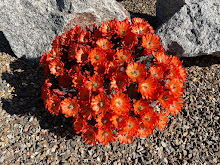
Would you find it hard to choose the plants in your garden whose bloom you most anticipate. It isn't hard for me. Today two of those much anticipated plants were blooming. The first is the Claret cup cactus, Echinocereus triglochidiatus. My anticipation begins when I start to count the number of blooms I am going to have this year. Bud formation began a few weeks ago and I counted 16 buds.


If you look closely you can see more blooms which will open later this week. Whereas many cactus blooms are ephemeral these ones are made of sturdier stuff and last a number of days. Do I remember saying I didn't like red flowers? I soon got over that when this cactus arrived in my garden. For most of the year it sits quietly among the rocks preparing for next year. I don't fertilize or water and that's just what it gets in its native Texas Hill Country setting. I gave it just a home like that in my front courtyard garden among the limestone rocks. It makes a great partner for the bluebonnets, Lupinus texensis, and the square bud primrose, Calylophus sp. In front a purple skull cap has seeded and its blooms will give some shade to the claret cup during the hot summer.

Then there is another cactus where I find myself counting buds. The ladyfinger cactus, Echinocereus pentalophus. On one small plant 13 buds. This is a banner year and I think our colder winter takes credit for this bloom. The three cactus plants were in the potting shed and the temperature in there got down into the high 30s. They can take some cold but would have probably been lost during the two 18ยบ F nights this winter. Mine are in pots. Plants with long trailing stems would really prefer to be in the ground where they can trail along the ground rather than hanging over the sides of a pot.


And deep in the heart of the flower, rolling around in the pollen is the same fruit fly-sized bee that also visits my Echinopsis flowers. What is it that attracts him to this kind of flower I wonder? Is he a specialist bee who visit cactus flowers? Was he waiting for this flower to open because it was not open until after noon.


And in a few weeks I will be anticipating the flowers on my lace cactus, Echonocereus reichenbachii. As you can see this genus is one of my favorites when it blooms in my spring garden. It all helps to soften the end of bloom time for the Lady Banks rose. Farewell! See you next year. I'll be saying the same of my cactus in a weeks time.

Sunday, March 25, 2018

THE POOR MAN'S POT FEET

I have a lot of pots. They sit on various surfaces; stone patio, hearth and wooden decks. Most of them are on saucers but even those don't protect the surfaces on which they sit,  from staining. After heavy rainfalls water can gather underneath and cause unsightly mold stains. The answer is, of course, pot feet and there are some really lovely ones out there, but they are expensive. You may also be able to find some inexpensive ones made from plastic.


I was very fortunate to inherit some clay pot feet from a friend who was leaving town. They add a special touch to my garden pots. One of my favorites is the maple leaf.....


but then there is the fun little piggy...


and an acanthus leaf..


For years I have been making my own pot feet out of corks. Yes, that is the reason for that ever growing collection of corks in the kitchen drawer.


Quite simply I cut down the corks to size, depending on how elevated I want the pot to be, and either stick them to the base of my pots saucers or just place them underneath. I use them outside and in the house when I want to protect a glass or wooden surface. The best cutting tool is a sharp serrated knife.


They also come in handy to use as a spacer when hanging something on an outside wall.


If you have a lot you could use them as a light weight pot filler. Anyone have any other ideas for their use in the garden? No cork boards thank you!

Monday, March 19, 2018

ALL THE LADIES

When my Lady Banks rose, Rosa banksiae 'Lutea' started to bloom a week ago I breathed a sigh of relief. I had already decided that this year was not going to be a big bloom. Why? Because lack of winter rain and several bouts of temperatures in the teens had denuded her of every leaf. Did I get a surprise.


She is as beautiful as ever although the blooms are smaller than in other years.


And her show doesn't stop inside the garden. On the other side of the wall she blooms just as magnificently, even sending her some of her branches up into the oak tree. "I'll give that Texas Mountain Laurel and the Agarita a run for their money" she says.


But I don't get to enjoy her just when I am outside. From my seat in the living room I can look across and see her through the window.


Her flowers may be diminutive but so many blooms in a cluster makes for a big impact.


If you have followed my blog for a while there will be no need for me to remind you how this rose was given her name. She was named for the wife of Sir Joesph Banks who sent William Kerr on a plant finding mission to China. He returned with a rose which was named for his sponser's wife, Lady Banks. I learn about Lady Banks from a garden visitor.

But there is another Lady Banks Rose in my garden, this one Rosa banksia 'Banksiae' which has white flowers. Her flowers are a little smaller but no less prolific and carry a faint fragrance of violets.   This rose has a very special provenance, grown from a cutting from the original Lady Banks rose brought from the Fa Tee garden in China by William Kerr. I picked it up on a trip to Tombstone several years ago. You can read the story of our visit here. Rose Museum Tombstone.

I'm not planning on building a trellis for my rose. She will have to make do with the under branches which have died off and which seem to provide sufficient support.


My white rose is planted behind the pool in the sunken garden.


She is loaded with buds this year. There is more than one reason to love this rose even though she is a single bloomer. She is thornless, never shows any signs of blackspot nor does she have any insect problems. She is, however, a big rambling rose and requires serious pruning to keep her in bounds. I have seen photos of her being trained over a small archway or along a fence. Either way prune after the flowering. Then enjoy 4 weeks of blooms in the spring.

Thursday, March 15, 2018

SPRING BULBS

I am in two minds over which spring bulbs will be in my garden next year. I have to weigh up how they look for weeks after the bloom has finished. I know the large public gardens and parks yank their bulbs when they are over, planting new ones every year. For me that is not an option. Or is it? I had never thought of doing this myself.
I have a few favorites which I think are definitely worthwhile leaving in the ground. Number one is the Species tulip Tulipa clusiana, Lady Jane.


Originating from the rocky poor soils of Afghanistan and the Caucuses, it is ideally suited to the poor, dry, limey soils of the Texas Hill Country. It naturalizes well and although I was told the seed are not viable it pops up in several places away from the original bulbs so I think it does reseed occasionally. And the seed pods are what makes the plant tolerable during its bulb regeneration mode. They are one of the few bulbs where I leave the seed pods to mature. It doesn't seem to harm them.
I have tried several of the species tulips including Tulipa clusiana Cynthia, and Tulipa humilis, Persian Pearl, but none return quite so faithfully as Lady Jane.
The flowers close up in the evening and in the early morning their pretty pink undersides are visible until the flowers open once again.


The spring star flower, Ipheion uniform, a native of Argentina and Uruguay, will always be a keeper. It's short grassy leaves are easily hidden among summer growth. It is a great plant for the front of the border.


Why is this next bulb called summer snowflake? It is one of the first spring blooms arriving at the same time as snowdrops in northern climates. The blooms of Leucojum aestivum are similar to the nodding blooms of snowdrops and last for at least two weeks. I have never divided this large clump so I may try to divide 'in the green' this year.


Each of the nodding tepals carries a characteristic green dot.


I love the fragrance of the narcissus family, particularly those with multiple flowers but once the flowers are gone their wide strappy leaves become rather messy as spring progresses. I find the blooms to be fleeting and often damaged by heavy rainfall and late frosts. Maybe they are best grown in a pot where they can be removed from the garden after the blooms die. That is what I did with my paper whites this year.


But it's hard to resist the fragrance of Narcissus tazetta 'Erlicheer' with its double flowers and sometimes as many as 6 flowers on each stem.


and the pretty delicate flowers of Narcissus 'Thalia'


Or this unknown multi-flowered stem.


I certainly have preference for the multi-stemmed flowers with the later flowers Narcissus 'Cheerfulness' yet to bloom.
My personal feeling is that the perfect place for daffodils in in a woodland setting or in grasslands where their foliage can be left to die back. Will I have the heart to pull mine out? I really don't think I have it in me.

Sunday, March 11, 2018

A PLAN

Every night, before I go to sleep, I think about what I am going to do in the garden the next day. I rarely stick to my plan. That is why nothing ever seems to get finished.
I garden just like my father did. He would begin by pruning the roses and then part way through move to the rockery and have a little weed there always leaving behind a rake here and a fork there. That's me. It's a miracle anything ever gets finished. This morning I am going to try to weed out all those extra seedlings growing between the stones in the sunken garden.


Last week I completed a very pressing job. That of trimming the fig ivy on the outside wall before it begins new growth. Our extended fall had resulted in a lot of growth too late in the year to trim. Then along came some very cold spells and all that extra growth was burnt to a crisp. It was a chance to use my newly acquired hedge trimmer purchased for just this purpose. And it worked a treat removing all that extra growth within 20 minutes. With the hand shears it would take me more than an hour.


But of course that is never the end of the job. That his just the beginning. It is inevitable that fig ivy will not stay just where you want it to stay. It had crept over the top of the wall. That I had to tackle from the inside garden using hand clippers. Followed by the growth at the bottom of the wall spreading across the path. When all was done it was time to rake everything up. A full garbage can of material. Then a quick blow to remove most of the smaller debris. All that remains is for me to try and remove, once again, the garlic chives growing along the bottom of the wall.
You may question why I planted fig ivy on the wall in the first place. I felt the wall needed something to break up the monotony of the long house wall and this extended retaining wall. I love the look of a hedge and for most of the year that is how this looks. Plus it is a favorite hiding place for anoles, preying mantis and green lacewings. Worth that little bit of extra effort in the spring and an occasional trim through the growing year.
I'm was feeling pleased with myself that day that I had actually finished a job. Now back to weeding the sunken garden.

Sunday, February 25, 2018

LONG LASTING SRING BLOOMER

Gopher plant, Euphorbia rigida, is one of my favorite early spring bloomers. I don't know why it is called gopher plant unless it is because gophers don't eat it... nor do the deer. That would make sense because the milky sap produced by all euphorbias is not only poisonous but can be extremely irritating to the skin of some people. Care should be taken to wear gloves when cutting the stems.


It is a mystery to me why it was given the species name 'rigida' because it is anything but rigid, the stems trailing along the ground like the tentacles of an octopus. It needs  plenty of room to complete its annual growing cycle.


The foliage is a delightful blue green and when the bracts on the tips of the branches begin to turn chartreuse in the early spring they light up the garden.


That change in color is a sign that the plant is about to flower, although you will have to get down close to view the flowers as, like many euphorbias, they are quite discreet. This morning the plants were buzzing with the sound of bees.


I have them growing above my sunken garden where they can trail over the edge but they look just a well where they are allowed to soften the edge of pathways or patios. They also would dress up a large expanse of mulch or decomposed granite. The bonus is that they are drought, heat and cold tolerant but do require good drainage for best performance.


When the flowers fade you can either cut them back living next years new growth or leave them to set seed. They reseed easily.
At the base of the plant is the new growth which will elongate over the summer in preparation for next year's flowering. Strangely this year it looks as though the new leaves at the crown are also going to flower. That may be due to our late fall and seemingly short winter. I hope the plant has enough umph to make new leaves for next year. During hot, dry weather the stems may lose leaves and become bare but it does nothing to detract from the magic of their long-lasting spring show.


I bought one plant originally and the rest are from seed.

Saturday, February 24, 2018

50 YEARS AGO TODAY, I HAD TWO WORDS TO SAY


David and I were married at St David's church, Austin, on the afternoon of February 24th 1968. It was the most glorious winter day with bright sunshine and warm temperatures.


But why did we marry so far away from our home in England?

In the summer of 1967 David was offered a place to do a Masters degree in Chemical Engineering at the University of Texas, Austin. We had become engaged that year and the plan was for him to do his Masters and return to the England for our marriage.

Sometime in late September I decided I was going to join him. I can't remember now if I even asked him. A friend and I took the day off work to visit the American Consulate in Liverpool, where I learnt that in order to work I would have to apply for a green card and this must be done through the embassy in London. I began the snail mail process. Always another letter asking for this, that and the other. My finances, my education, references from my work etc. And then at the beginning of February a letter came inviting me for an interview, two days hence, at the American Embassy in Grosvenor Square, London.

I travelled down on the train with no idea of where I was going to stay. I remember walking out of Euston station and asking a policeman if there was a hotel close by where I could stay. Policemen were a good source for everything in those days. He pointed down a street where I saw a sign in the window 18/- Less than a pound a night. The mind boggles. It was a pretty awful place and I don't think I slept all night, partly for safety reasons and partly because I was terrified of oversleeping. A taxi took me to Grosvenor Square where I spent the whole day. Endless interviews, medicals including chest x rays and tests for syphilis! But at the end of the day I left with my green card, my  documents of immigration and my chest Xray. I was on my way to America.

I handed in my 2 weeks notice at work and headed home to spend a few days with my parents. David was busy making preparations in Austin. He moved into an apartment, the Braeburn, on Speedway, and regaled me with stories of swimming pool and laundry room! I went shopping for my wedding outfit. A white lace dress and coat and one of those, silly to me now, hats made of white petals. And the 'going away outfit' although I didn't think I was going away anywhere after the wedding. I bought my ticket for February 19th. I had never flown before.

On that Monday morning Manchester airport was fogged in and they scrambled to get me on a different flight to the US. PanAm to Chicago, Chicago-Dallas and Dallas-Austin. I arrived at 9pm to David waiting for me at the airport. I wonder how he knew about the change of plans or did I manage to get the same Dallas to Austin flight.

 Someone today might ask why we got married such a rush. After all we could have just lived together and returned to England to be married with our families. All I can say is things were quite different in the 60s.

The next few days were taken up with preparations. Fortunately, The International Society of Austin had assigned a Mrs Betty Kemp to help David with his transition to life in Texas. She was an enormous help, offering to have the reception at her house and helping with all the other arrangements; church, license, blood tests, flowers, caterers. Fortunately my father had given me some money to make sure we had a nice wedding. Can you imagine doing all that in 4 days?

Her husband was to give me away and her daughter, Donna, was to be my bridesmaid. One slightly different custom was the bridesmaid walking down the aisle in front of the bride.

Mr Kemp

Donna Kemp

I spent the night before the wedding at their lovely house on Windsor Drive. I recall being exceedingly impressed that Mrs Kemp served these warm rolls for breakfast. Had she rushed out to the bakery to buy them? They were Pepperidge farm. We had never heard of such a thing in England.

We were a small group and I didn't know anyone save for the Kemps. David had met several international students, rooming for a couple of months with 2 of them, and they all came to our wedding, most with their American girlfriends. He invited Dick Oliver, an Architecture professor at UT, whom he had met on the rowing team at Pembroke College, Cambridge, to be his best man.


Everything went off smoothy and in no time we were married and heading off to the Littlefield Fountain, on campus, for photos and then back to the Kemps.


I'm not sure I ate anything at the reception although it was a wonderful spread. (I doubt I even knew where I was with all that had gone on in the last 6 days). Mrs Kemp had taken along her vases and bowls to the florists and indicated the colors of the rooms so that the flowers would match! When it came to the cake I had been quite surprised by its low cost and was to discover why when we cut into it. It was a sponge cake. In England the wedding cake was always a fruit cake with marzipan and icing. Usually with 3 tiers and, by tradition, the top tier saved for the christening. If you have ever looked at old census records the first baby usually arrived within a year and sometimes quite a bit sooner. I wasn't going to be putting little pieces in boxes to send to people back in England who couldn't make the wedding. Another English tradition.
Someone had provided a little guest book and there were little bags of rice to throw. Another different custom.


And then we all went outside for a group photograph after which we headed off in a guest's red triumph spitfire. It was his wedding present lent us for the weekend. I keep asking myself why were there no photos of the reception and that car. The following day we headed out in glorious sunshine for our honeymoon visit to Hamilton Pool. It was privately owned at the time. We saw our first armadillo and have a grainy image of it disappearing into the bushes-but no picture of Hamilton Pool! Since then there have been many photos as we return there year after year on the 25th. This year will be no different.

Sadly the Kemps are all gone including their daughter Donna who was killed in a car accident. We attended Mr Kemp's funeral some years ago. The best man died in his 40s. It seems all the more poignant that we are back here in Austin to celebrate this special day and remember each and everyone who shared that day with us.

And the rest, as they say, is history. We never went back to England, David took a job in Canada where we lived for 12 years before a transfer back into the US in 1981. Then in 1994 back to Austin. My Longhorn was delighted. It is the longest place we have ever lived and I think we will stay.

I thought I would add a photo of my maternal grandparents' wedding at the beginning of WW1 and my parents' wedding who married during WW2, just for comparison. They celebrated their Golden Weddings in 1964 and 1991 respectively.


Happy Anniversary to the man I have been fortunate to share my life with for so many years.

Sunday, February 18, 2018

BACK TO THE BUSINESS OF GARDENING

I have been side-lined for the last couple of weeks by recovery from surgery. Something that was probably caused by all the time I have spent outdoors in the sun either gardening or hiking. I will be more cautious in future but let this be a warning. WEAR SUNSCREEN.
Even though it is February there is much to do cutting back and removing plants that didn't make it through several unexpected deep freezes.  Here is one plant that has been a star through all kinds of weather.


The large rosemary is planted out front by the side of the driveway. It has never been watered and has withstood drought, summer heat, hail and freezing temperatures. Yesterday it was blooming as it has never bloomed before and I even spotted a bee visiting one of the flowers.
On one of my non-gardening days I did the rounds of the nurseries. For a moment I thought that I might have missed spring as all were overflowing with spring bedding plants, grasses and vines. Of course I was tempted just as I was last year. Five pots of grape hyacinths at $1 a pot was easy. The patio table needs a little brightening. I still have the ones I saved from last year but they are making a slow start. Once in a while it is worth having someone else do the planting for you.


One plant I wasn't tempted to buy was a large pot of climbing jasmine, Jasminum polyanthum.


And this is why. I have had maybe 3 or 4 good years when the plant made a worthy bloom. Yes, the scent was heavenly but this is a vigorous vine forming a big tangle of finely cut leaves. This was cut to the ground last year! It roots easily and I don't doubt there will be a stray shoot somewhere that will try to make a comeback.


After cutting it back to the ground I used the pick axe to remove the root.


The question now is its replacement. Something which takes less work. I don't mind dieback in the winter if the plant performs well in the summer. Nor do I mind a bare trellis in the winter. I'm pondering on remaking the trellis so that it reaches to just above the weep screen. That way it is easier to get smaller vines started. This is a south facing exposure but sheltered from early morning and late evening sun by the wall of the house. Maybe I'll try a Mexican flame vine or even a clematis. I wish our nurseries carried better selections of clematis but I will be out looking for a summer bloomer this time.
The roses in the English garden are all pruned. It doesn't seem to make a difference how early we prune because they were already leafing out. I see a lot of weeding to be done. Last year I planted iris  around the bird bath. They seem a little slow to take.


The citrus are out of the potting shed. The Mexican lime still has fruit as do the lemons.


Some seedlings are outside to harden off. Some destined for the window box and planters others for the ground.


Brachyscome, Swan River daisy

10 week stocks
The grasses are all cut back and it will be a a waiting game to see if the ruby crystal grasses will return. If not there are plenty of Mexican feather grasses to take their place.
A cloudy, cool day is my favorite day for gardening so that is where I am heading right now. It's good to be out there again.