My Blog List

Friday, February 26, 2021

PICKING UP THE PIECES

When my boys were little I used to read from a Hilda Boswell book of poems, nursery rhymes and stories. To this day I know many of them off by heart. One such rhyme..

On rainy days we stay inside, we have a lot of fun, but there is so much work to do when rainy days are done.

Let us substitute ice, snow, frigid temperatures for rain, although I am not sure about how much fun we had.


Having prepared my greenhouse, potting shed and garage for in influx of plants during the winter, snug and warm with 2 portable heaters, the last thing on my mind was a total failure in our electrical supply. So when the power went out at 4am and and there was news that it was not going to return and the temperatures over the next 2 nights were going to dip into the single digits there was no choice but to bring the greenhouse into the house. Here it is and here it will stay for a while.

With David's help we dug out a few small Agave weberi knowing they might not survive such low temperatures. We covered many things but the hardiest of plants, which included the whales tongue agave, Agave ovatifolia, the A. parryi, A. Lophantha quadricolor and the large A. weberi all of which have been in the garden for more than 15 years, we did not. That was a mistake. Two hanging baskets found a home in our closet and flats of annuals on the floor in what is normally a sunny spot...but there was to be no sun for days. 

As to ourselves we had no heat in the house but a little warmth from the gas logs we had put in this winter and we were lucky enough to have a gas cook-top so food was not a problem. We put the contents of the fridge and freezer outside, filled the bird feeder constantly and boiled water to keep a dish of water for them from freezing. The water pressure dropped and I began to save water in jugs and I trickled water into the bath. I was glad I had as eventually it stopped. We were still boiling water after 6 days but at least it returned after 3 days. Some were not so lucky.
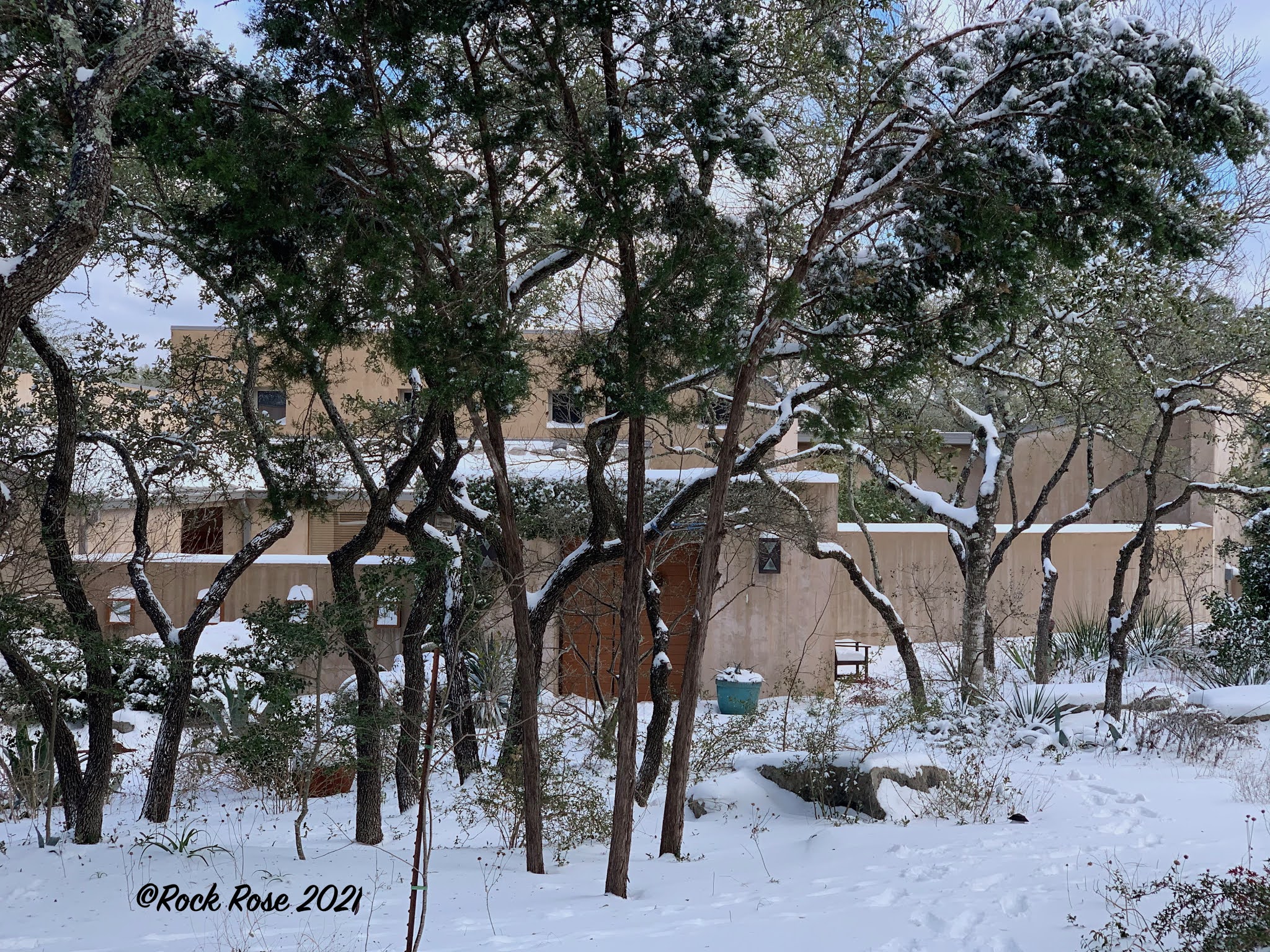
 

Our first venture out into a snowy world after 3 days. It was safe to walk as long as snow covered the layer of ice. Little did we know how this scene would change.

But that is behind us now. The sun is shining, the snow has thawed, we have surveyed the damage and it is enormous. The first day day I tried not to dwell on that, looking only to the things that appear to have survived.

The blue eyed grass, Sisyrinchium sp. hesperaloe, iris, species tulips, small plants of blanket flowers, some bluebonnets. It depended on where they were located. In the vegetable garden the kale I covered survived the best. Most other vegetables have turned to mush including the Swiss chard.  That isn't a surprise because we already had a freeze which knocked them back. They had just recovered and were producing when this happened. Fortunately I dug up some small plants that I had started from seed, saving them in the potting shed, and replanting today. Many herbs are gone including sage and oregano I have had for years.

Blue-eyed grass


Chocolate daisy

Bee balm


 Trailing wine cups

Gulf coast penstemon,

This spiky aloe has survived in a pot and I think will go in the ground next year in a safe place.


 Windflowers. Anemone berlandieri.

The worst place is in the front garden where it looks as though all the Agaves are lost. Also the front courtyard garden where I found that the A. parryi were severely damaged  being wrinkled with white patches of frost burn. They grow so slowly that I don't think there is any hope to see them rebound. The same with the A. lophantha. Time will tell with them but their cells seem to be very soft. It was harkening to see the species tulip, Tulipa clusiana, weathered the storm but they are used to the mountains of Iran. There is hope for a spring bloom from them and bluebonnets and of course there are plenty of windflower leaves that look healthy. 

Agave parryi 

The agave in the front courtyard and outside the walls are a major loss. They were my structural plants. Even the hardiest did not survive these temperatures. With every passing day they tell me it is the end. And to think in the past the things I worried about were hail damage, the agave weevil and whether they might flower. Loss from cold had never entered my mind. 

Damage has progressed from this.......


 To this.

Every one needs to come out and it is a major job to do as well as disposal. It looks ghastly on this dull morning. For now we are sawing off the soggy stems and piling them up in the hope that their weight will be reduced over the next few weeks. The cores are a different matter.

Nature did an imperfect job of pruning my prickly pear cactus in all parts of the garden. The weight of ice and snow was just too great for them. I believe they will survive although I will have to put my imperfect pruning skills to the test. Or maybe I will just start them anew.


 It will be wait and see with most of my plants and I fear will be a disappointing spring. It is probably time to rethink my gardening strategy and garden with less. If I was planning to have fewer things in pots I shall think again as right now that is where my garden is for this year. 

Already my Austin garden friends are offering  extras of plants that have survived. 

Yes, there is so much work to do now icy days are gone.


Wednesday, February 10, 2021

A M0RNING IN THE GREENHOUSE

 "I'll just spend a little time in the greenhouse this morning while it is still cold outside" 

That little time turned into a whole day. If only I hadn't let it get so out of hand. I had good intentions when I started to take things inside last fall promising myself that I would keep plenty of space between each pot and nothing on the ground. Suddenly every bit of shelf space was filled, above and below and then the floor started to get crowded out. That pot of dwarf papyrus, the two branches of plumeria, a box of agaves which I had planned to take to Phoenix at Christmas, a bird of paradise I dug out from the edge of the path. Empty pots, pots of soil. No room to move in there. The first job was to move everything outside so I could work on the shelves.

Next was to organize the shelves moving a few things around. There is shade cloth and a cross vine growing over the greenhouse so the only really good sun is at the end. That is where I need to have my winter blooming cactus. Some have already started blooming and some are now making buds. I think they are going to be earlier this year than any before. 


I have several pots of lady finger cactus, Echinocereus pentalophus. All are beginning to make buds. If you aren't familiar with this plant the flowers are the most wonderful Thai-silk pink. But it will be a few weeks yet.

And more and more mammilarias.

I moved this plant up from the lower level and into a more sunny spot when I saw this bloom stalk.

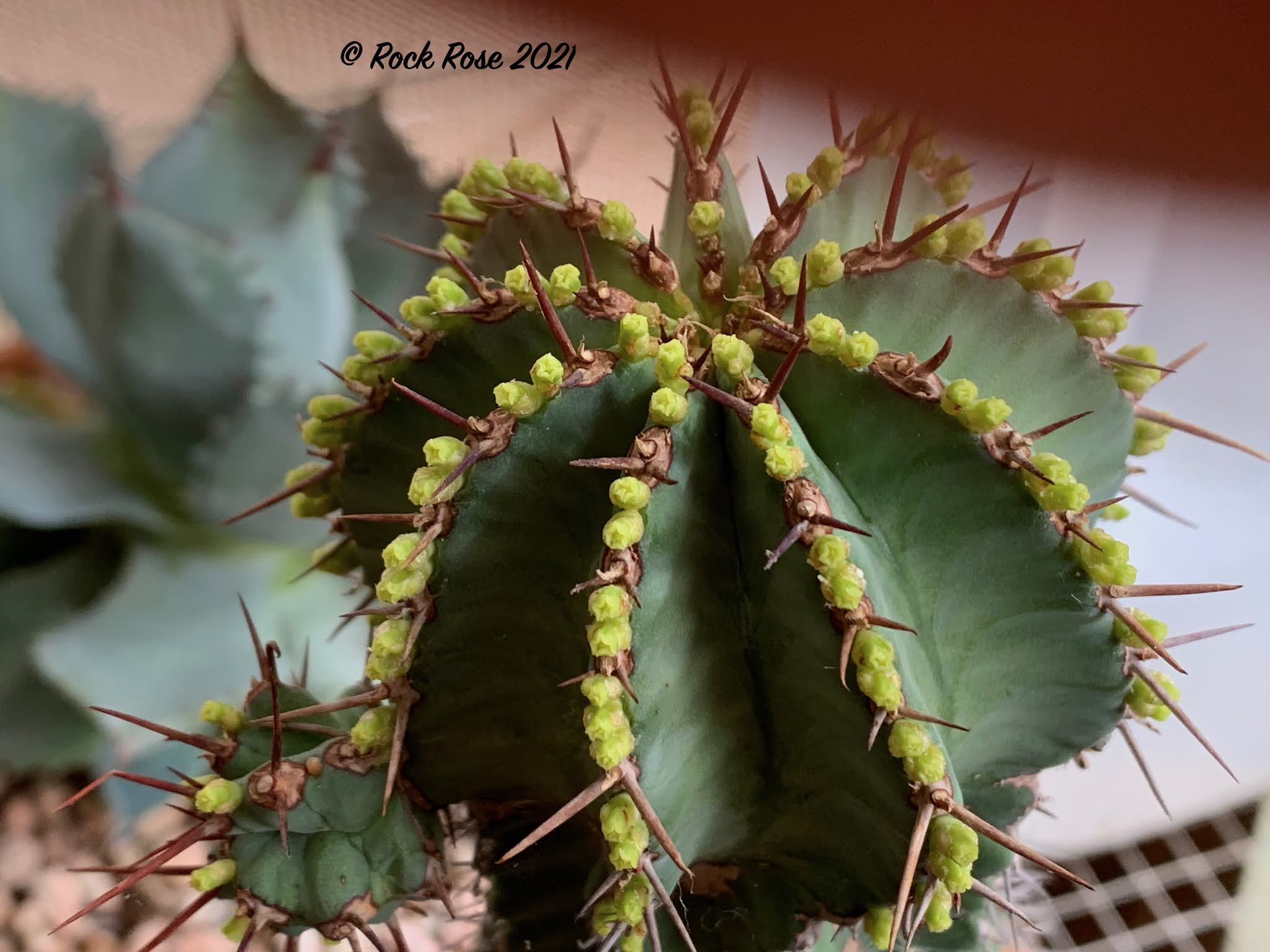
And a euphorbia blooming. You know how tiny their flowers are and if it weren't for the fact that they are yellow you might even miss them.


Finding more scale on some cactus I broke off tidying and got the paint brush and alcohol out. I was not expecting to do that but it seemed like a priority.

I was sad to see I had almost missed these sprays for flowers on the copper Sedum nussbaumerianum. I felt rather badly that they had been under appreciated being on the lower shelf. The plant is rather straggly and needs a complete pruning. Not a job for today.

When I got down to moving the last pot which was on the floor by the door I discovered that the ants had come up through the bricks and into the pot. What next! It was the newly potted bird of paradise which I quickly removed and took outside far away from the garden. Then I put the kettle on to boil. I'll make their life unpleasant. 

I only have 3 orchids left and they are in much need of attention. I heard on a gardening program that an orchid needs at least 4 good strong leaves in order to bloom so there is a good chance that this one will soon send out a bloom stalk. One has a small stalk and the other only 3 leaves. Some nurturing is needed. I knew that orchids like to grow in clear pots. Don't they all come that way from the nursery. Their roots like light as they photosynthesize through them. I don't know why I was anxious to put the other two in clay pots even though they were so-called orchid pots. From now on its clear pots for my orchids. 


I have a couple of hanging baskets. The first is the Huernia schneideriana, which spent the summer hanging in the live oak tree, totally under appreciated. It will probably go back there again next year but will need some trimming as eventually the longer stems start to fail. In Arizona I saw this plant creeping along the ground and it will set down roots easily along the length of the stems.  


Finally a quick wash down hoping to make the ants more miserable and the greenhouse is ready to receive many plants that will have to come in during the upcoming inclement weather. 

Now a week later we begin to feel the start of the weather. It is 43° out there and for us bone chilling and damp. Tonight will probably be the first night of 7 nights of freezing temperature with some possibly in the single digits. Freezing rain is also in the forecast followed by snow next week. The heaters are on in the greenhouse and I have brought even the foxgloves inside. I have been nurturing these since they were 4" pots. You can't take the English out of the girl. She has to have her foxgloves. 


It will not be good as the garden is so far ahead. I have already picked daffodils and many of my vegetables that will not take even those low temperatures. Shiver , Shiver! I don't want to think about the possibility of a power failure due to this unusual weather. 

Thursday, January 28, 2021

WINTER FLOWERS THAT BRING JOY

We send flowers to friends in hospital, on their birthday, Valentine's Day, when they lose someone dear and we celebrate weddings with flowers, the bride carrying her favorite flowers in her wedding bouquet. Flowers bring joy to everyone. These days we can enjoy flowers year round with winter no longer a problem because flowers can be grown in glass houses and from there transported to flower shops and grocery stores. 

For the gardener flowers that bloom during the winter season are special. Yesterday when I went into my greenhouse I was thrilled to see flowers blooming on the Mammillaria compressa. This is the best flowering I have seen in many years.


The original plant was bought many years ago at the Austin Cactus show, a gift from friends who were staying with us. It was cluster of about 7 growing closely together. When I tried to repot into a larger pot the individual plants, which had been growing very close together collapsed. They never regained their original form.

There was only one thing to do and that was to cut off the individual plants, let the cut dry and pot up in some really good succulent mix. The only one I have found, which in my opinion is the best, is from East Side Succulents and is called Cactus Gold. I made up several pots, this one with three and several singles. This time I would really take care of them. As you can see I was rewarded. 

Over the late fall and early winter tufts of white fiber began to fill the spaces between the tubercles and it was from these that the flowers burst. Furthermore new branches have begun to sprout from the sides which means that it will eventually make another clump. It is for this reason that it has often been called Mother of Hundreds. This cactus comes from Central Mexico and is supposed to be hardy down to -5°C or 23°F if kept dry.


Other mammillarias are flowering too. This pink flowered variety.


And recently a much larger one which is also starting to make off-sets. This one blooms multiple times throughout the year.

They seem to favor having a cold dry spell during the winter and although in my greenhouse they are not in full sun. A sunny window ledge in the house might suffice.

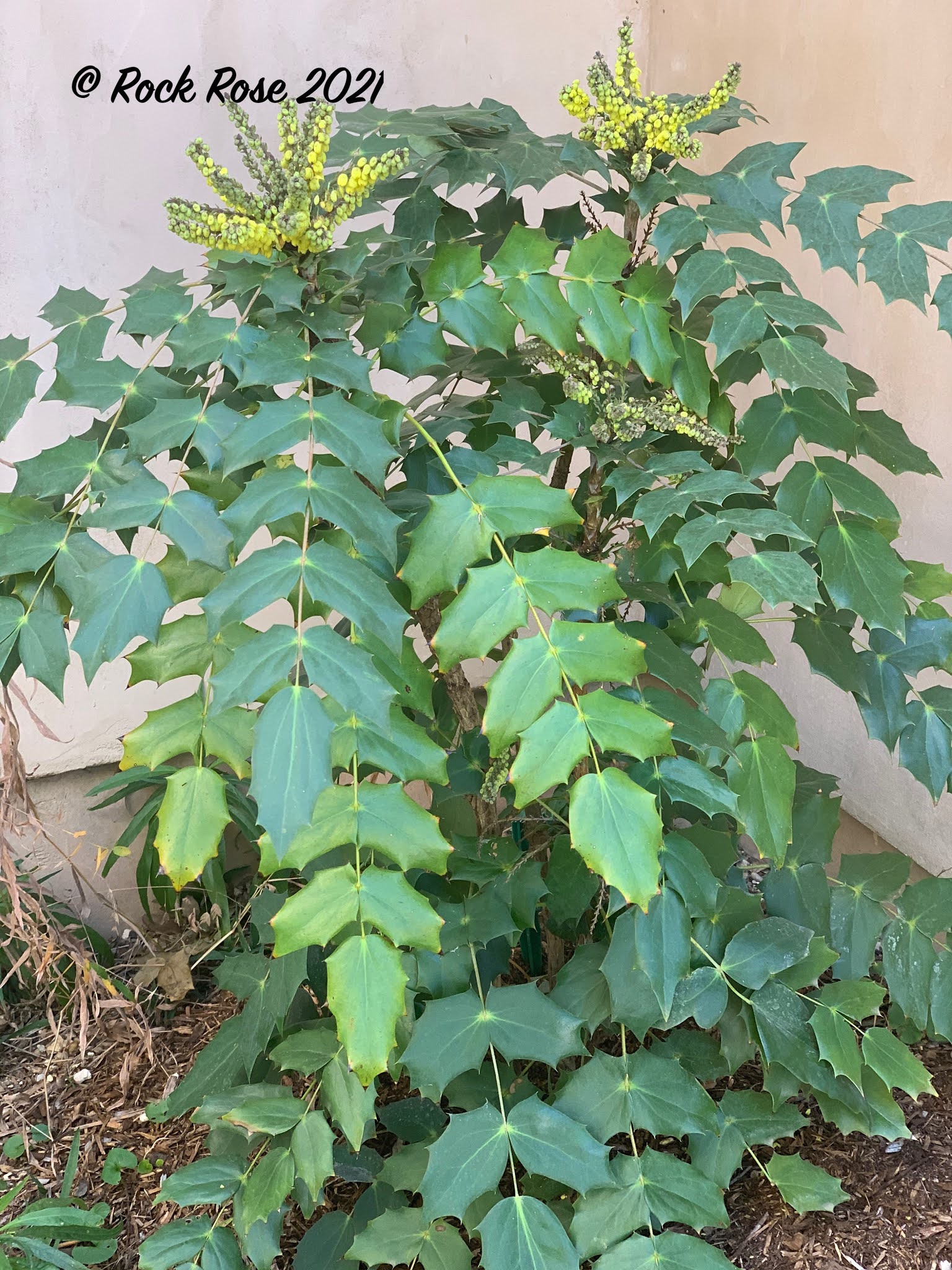
In the garden there are a few early bloomers. The Mahonia is one.


 It grows in the shadiest spot I have in the garden never receiving any sun. For this reason it blooms later than most in the area.

Yesterday I was thrilled to see several bees had managed to find the flowers.

And sweet alyssum, Lobularia maritima, is of the early bloomers. It re-seeds around the garden and is  loved by bees.


Plant it now and you will never have to plant it again and at the same time you will enjoy its sweet honey fragrance for months.


Saturday, January 23, 2021

MY GARDEN HAS INSOMNIA

When I lived in Eastern Canada gardeners were well assured of having a respite during the winter. It was a time when browsing through seed catalogues and placing an order was the highlight of winter gardening. Seed starting came next, geared towards being able to plant frost sensitive flowers and vegetables outside by May 24th. The garden slumbered under a thick layer of snow.

Now here I am in Texas with its unpredictable climate and often mild winters. Because I knew there was to be no winter travel this year it gave me the opportunity to be more diligent about planting a winter vegetable garden. It has been a great success.


We have had an unusually mild fall, although frost has made an appearance on several occasions necessitating the covering of my peas.  I was  determined to keep them going in order to get an early spring crop, but because of mild weather was rewarded with a winter crop. 


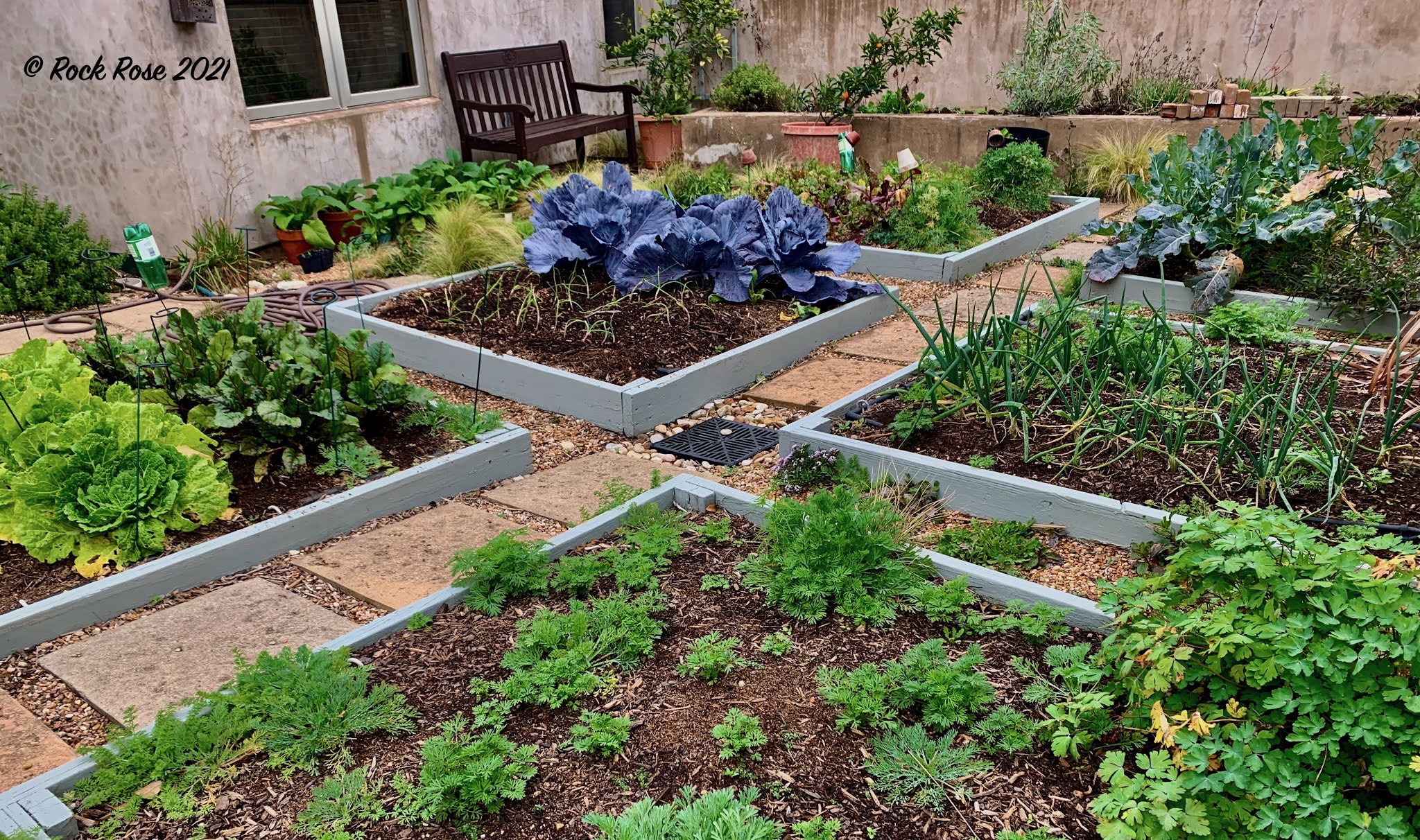
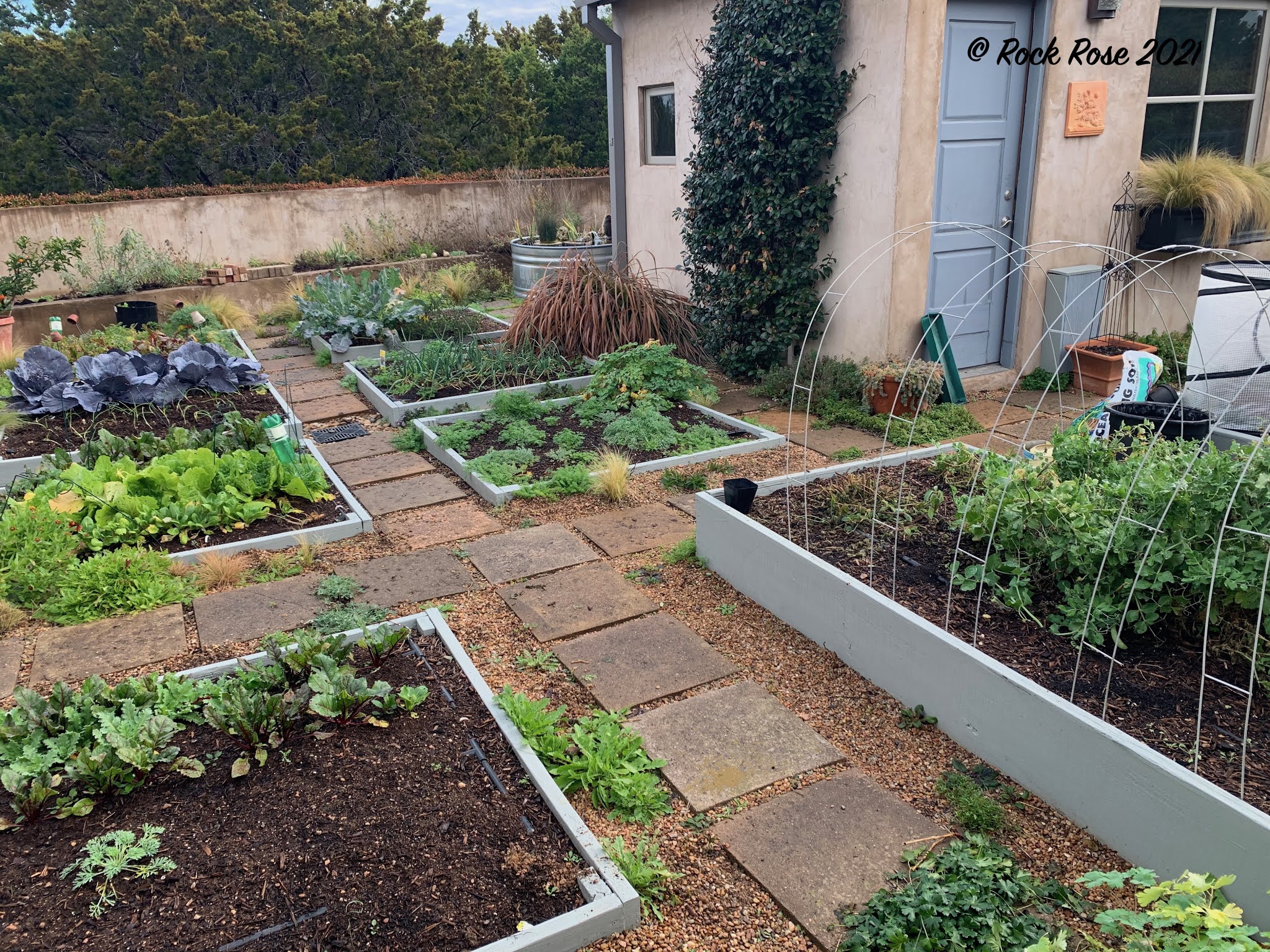
We have already devoured two crops of broccoli, pak choi and a succession of chard and kale not to mention peas, carrots and beets. All these plants are contained in beds in my vegetable garden. Even so there are many intruders in those beds chiefly larkspur, California poppies and the most successful seeder of all Love-in-a-mist. Known as hardy annuals this is their time to germinate, growing over the winter in time to flower in the early spring. I regret I have allowed them to take over. 


Those spaces between the pavers create an ideal spot in which seeds from last years flowers settle and particularly with Love-in-a-mist it seems every one germinates.  

And they found an even better home in the vegetable beds among the cilantro.

And poppies too.


And bluebonnets. Knowing how they can cover a diameter of 3' I may need to remove the one in the center of the path.

Every year I vow to keep those paths free of these opportunists and every year I relent which means even more will arrive every year. 

Blanket flowers, Gaillardia pulchella give me great difficulty. That is because they behave like perennials and these rather shop-worn plants are beginning to flower again. Soon they will have to go because they make a tripping hazard but I will leave them in case the bees come by looking for nectar or pollen. There are hundreds of seedlings just getting going.

It is my firm intention this year to reduce their numbers before they make it impossible to walk down the paths. 

Some plants don't seed quite so prolifically  so I am happy to see a few rose campion, Lychnis coronaria, just beginning to develop. I plan to remove them from where they are growing at the edge of the path to a more prominent position.

 Those that are a little larger will have to stay. A happy trio of rose campion, Lychnis coronaria, Gulf coast penstemon Penstemon tennuis,  and alyssum, Lobularia maritima. They are in the herb garden and will stay there.

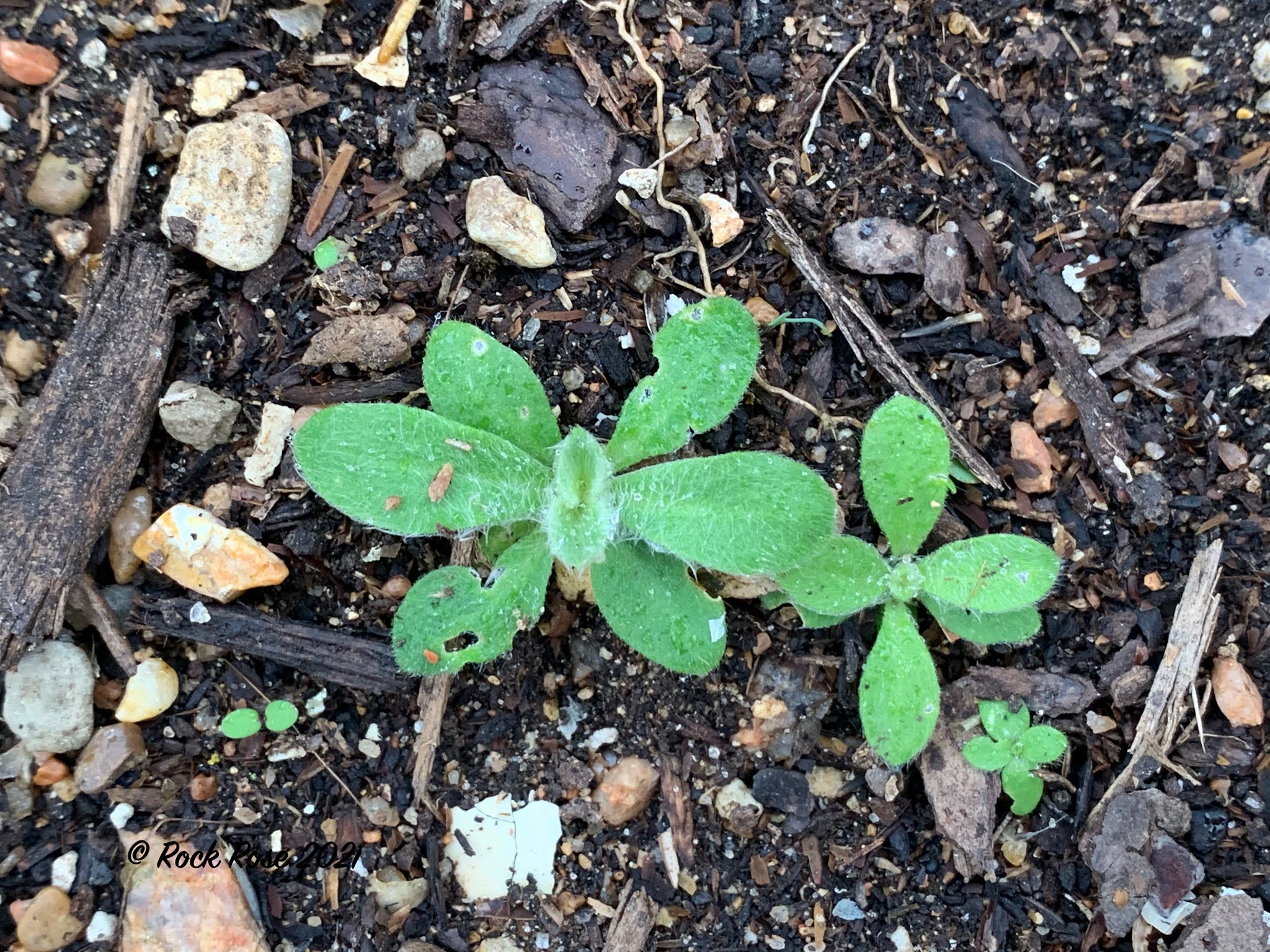
Verbena bonariensis by the hundreds! I have already shared many and have potted some up in case of a some weather mishap. Last year's plants are looking strong and healthy but there is much winter to come yet. 

 Larkspur seedlings in the sunken garden. A little thinning required. They won't grow as large as the ones in the beds because the soil is poor. The same being true of love-in-a-mist.

Here is a plant that hasn't slept in 2 years, Scabiosa. One of my favorites in the rock garden becaseu its foliage is never touched by insects.

Someone once said my weeds were a lot different from theirs. The fact is a weed remains something that is growing in the wrong place and I have plenty of those.