My Blog List

Saturday, June 21, 2008

I have come across this quote on several occasions and thought it very appropriate for me.

"Show me your garden and I will tell you what you are" Alfred Austin

What I think he should have said was, show me your closet and I will tell you what kind of gardener you are. You see, I have the greatest difficulty pruning and pulling out plants that are really in the wrong place. This spills over to everything in my life including my closet.


On my pomegranate tree I know I should remove two of these fruits but it is just so hard for me to do. In fact D was hoping there would be no fruit on the tree this year because the tree is quite huge and I think he would like it out. It is full of fruit so it gets to stay for another year.


A rock rose is growing up through the middle of this Indian Hawthorn bush. How long will it stay there? Probably all summer.

 I have to admit that these blanket flowers and black eyed susans along the rock wall don't look too tidy.


Now these are going to be very difficult to pull out but there are some plants that I actually planted growing underneath.


However, I did pull out the rest of the tomato plants and the deer were the beneficiary of the damaged and green tomatoes and the foliage. New crop going in and guess what, one of them was growing in the path. I potted it up until it had established some more roots and now it is in the ground.


Wednesday, June 18, 2008

HOLEHIRD GARDENS


On the same day as our visit to Levens Hall we visited Holehird Gardens. I have been to the Lakes many times but had never heard of these gardens. Entry to the gardens is by donation. They were designed, installed and are maintained by members of the Lakeland Horticultural Society. Aside from the rockery, with the alpine troughs, ( I think I have a new project for D!) the gardens were extensive, with herbaceous borders, open grassy areas with island plantings, and woodland walks. Rhododendrons were everywhere. My favorite place was the alpine greenhouse although I'm afraid my photograph does not do it justice. I love the idea of the rock wall on the left side and the more informal rockery on the right. At the end of green house was a lakeland slate trickle water feature. For many people gravel gardening may not hold the attraction that is does for me. We have so many wonderful rocks in our garden that it becomes a necessity to put them to good use. I love rocks.
The Lakeland gardens were ablaze with yellow rhododendrons. 
At the end of a wonderful day we headed back down the M6 to St Annes.

Monday, June 16, 2008

ENGLAND IN MAY

We spent two weeks in England this May. I don't remember a time when we were so lucky with the weather. By the time the two weeks were over David was about to move back there-after 40 years! We stayed on the north  west coast of Lancashire in the town of St Annes. We both grew up there and that is the place we always go back to when we visit. It is close enough to the lake district in Cumbria for easy day trips and that is what we did for the first four days of our vacation. I had read about the gardens of Levens Hall and they were our first stop. On a picture perfect morning we entered the world of topiary.


The gardens were laid out in 1694 by Guillaume Beaumont. The idea of clipping evergreen hedges into fantastical shapes was brought over from Europe and many of the yews are original to the garden.


In celebration of the Golden Jubilee of Her Majesty Queen Elizabeth 11, the umbrella yew was designated one of 50 great Great British trees, in recognition of its national heritage.


The trunks of many of the yews form passageways underneath which wild garlic grows. 


Walking through the estate of Levens Hall we were to see wild garlic growing everywhere.


We were to return on two occasions to the buttery at Levens where they served a wonderful cream tea in the most delightful setting.
Stay tuned for more of our garden visits.

Sunday, June 15, 2008

GARDEN BLOGGER'S JUNE 15th

June 15th and summer has already been with us for weeks. I'm afraid my garden is really starting to show that it can't take these temperatures day after day. My drip irrigation system is not keeping up. Please, please can we have a day below 100 degrees and some rain- but not 15 inches all at once!

The datura is looking a little ragged around the edges. I don't know the variety because I brought the seeds from friends in Dallas. We saw theirs blooming in September and it was just spectacular.

The catmint, a variety called Walker's low, seems to like the heat. In fact I am noticing that quite a few of the flowers of the moment are blue.

Like this Agapanthus.

This Salvia clevelendii. I did not grow this for its flowers but for its incredible fragrance when it rains.

It is quite apparent that this fall aster is wanting to get the year over with in a hurry.

Moving on from the blues to the oranges I must not forget the faithful Texas lantana. There are still plenty of coreopsis, blankets and cosmos but the heat is taking its toll on them too. No time to post the list.

I bought this silver leaf Gazania in the fall as a perennial. It has been wonderful. The flowers are a little small now but I am wondering if it really is a perennial. Does anyone else have this plant?

Tuesday, June 10, 2008

Flowers, succulents and bugs

As I write this the weather man is telling us that we broke another record today. The temperature reached 101. Even in all this heat the garden comes up with a surprise every day. This morning the yellow primrose, Oenothera missouriensis, which was growing in the gravel in the vegetable garden, produced its first bloom. Who knows how he got there but he can stay.


As many of the flowers fade in the unrelenting heat I am grateful for the succulent family. A couple of years ago we took the plunge and drove down to San Miguel de Allende in Mexico. We were able to bring home many of their wonderful pots. This ceramic hanging pot is the perfect home for one of those succulents.
 
Remember the overgrown vegetable garden from two weeks ago? Well, now that the blanket flowers have been removed I can see the pathways again.

However, some things that happened whilst I was gone could not be righted. Unfortunately the leaf footed bugs had a field day with my tomatoes. Although the crop was large, many were completely destroyed by the juice suckers. I am still out there every day, killing them in an attempt to reduce their numbers before the next planting.


I wonder if other gardeners have discovered that both the leaf footed bugs and the harlequins have an aversion to water. So, turning on the hose under the plants makes them all move up the stem to a spot where you can see them and do away with them. I'll be out there again tonight when the sun goes down.


Sunday, June 8, 2008

 Since we returned from our trip and every day has been spent in the garden trying to regain some sense of order. It is not easy for me to pull out plants that are still in flower but the Coreopsis, Gaillardia and Salvias had taken over and I was beginning to wonder what exactly might be growing underneath. There is still more to come but now I can see the structure of the garden once again. The mullein has put on a splendid display but its presence in the garden is fast drawing to a close. It produces thousands of seeds.


The California poppies are still blooming, albeit with smaller flowers but they surround the Agave with a sea of yellow.


Bergarten sage should be a standard in every Texas garden. It performs well under hot dry conditions and adds a blue grey hue to the planting.


In the English garden the purple coneflower has re seeded along the dry stack wall. 


I am only just realizing how much I rely on those hardy annuals like cosmos and blanket flower. Here they are again to add color to the garden.


I think I'll just sit outside on the patio this evening and enjoy "The Glory of the Garden"

Thursday, June 5, 2008

TOUGH PLANTS FOR TEXAS

With temperatures in the high 90s and no rain for weeks you need to be tough to survive in Texas. Here are a few plants that do well in my garden. They are all good re seeders, especially if there is gravel.


Echinacea"white swan" loves this spot in the gravel.

The less common form of skull cap is the native Scutellaria wrightii.

Coreopsis tinctoria, which can be seen growing along the roadsides may grow to 3 feet if given plenty of water. Keep it low by planting in dry rocky areas.


Beware of this little beauty, the pink evening primrose.


A trio of self seeders between the pavers in the vegetable garden.


The narrow leaf zinnia Zinnia augustifolia. My summer garden would not be the same without it.

Monday, June 2, 2008

OVERGROWN

"Let me caution all , not to undertake more than can be looked after with hands enough for the well management of things in their proper season; for a small plot of ground well ordered, turns to greater advantage than a large one neglected" 
So wrote Leonard Meager, in his book The New Art of Gardening in 1697


I returned from a month long trip last week and my garden had certainly taken on an air of neglect. The new bed in the English Garden has taken on the cottage garden look. Somewhere lurking under the blanket flowers and cosmos is a Philippine Violet I planted in the spring.
 

  The vegetable garden is a jungle of blanket flowers and Texas sunflowers.

The patti pan squash are the size of dinner plates but despite the heat and lack of rain there is a good crop of beans and tomatoes and once the overgrown squash were removed they started to produce again. A few hours of work in the early morning and I hope to have it whipped into shape.


Wednesday, April 23, 2008

Clematis


CLEMATIS
Ah! what is the correct pronunciation of the name? The English call it Clematis(Klem-a-tis)and the Americans call it Clematis! Sort that one out. Not a scientific survey but I did ask the bloggers when they came to Austin and visited the Lady Bird Johnson Wildflower Center. The only other English lady used the same pronunciation as myself. We were outnumbered.
 My Clematis number two, and this is their moment in the garden.
Unfortunately I have my hybrid showy, Ville de Lyon flower in the Texas garden and my shy, pitcher-shaped Texas native in the English garden. Both seem quite happy in their surroundings. So just like this transplanted English girl I think I'll just leave them be.
 

Monday, April 21, 2008

Exposed


          THE GLORY OF THE GARDEN

I started this blog in November last year! Better get busy with another post!
Scattered around my garden on Saturday's tour I had a quotation from the poem The Glory of the Garden by Rudyard Kipling. It was a poem I learnt at the age of eight, in school, in England. It has always been a favorite.
I had no idea that last night, on Masterpiece Theatre they would have the story of the Kipling family and the death of their son in WW1. The production was taken from the play My Boy Jack. 
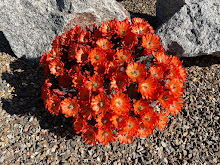
How does this relate to my garden you may ask? Well, the poppies have been outstanding this year and in particular the Flander's poppy. I have never seen them so beautiful. Mine came from a packet of wildflower seeds I scattered a few years ago but next year I will have poppies from seeds taken from the poppies growing among the graveyards in Flanders. Several of our master gardeners have these in their gardens and have promised me some seeds.