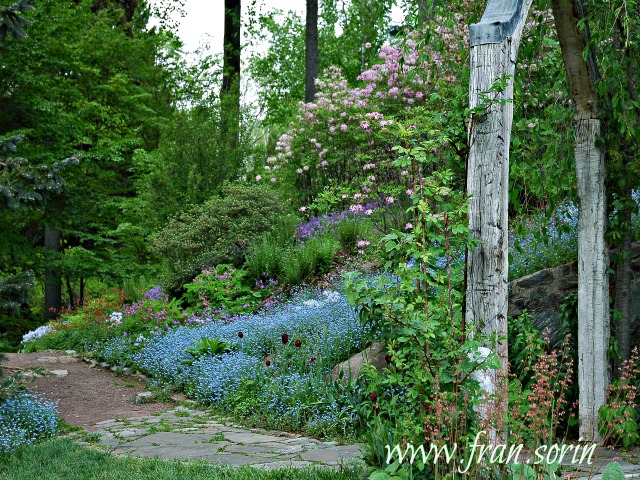
For most of our visit we would be staying in B and Bs, chosen for their proximity to the National Trust properties we were to visit. The first, Little Tidebrook Farm, which I had booked for 3 nights was in the hamlet of Wadhurst. I always book farms, if at all possible.
 Arriving in the late afternoon we took a walk in the surrounding countryside before heading to the local pub for dinner.
NYMANS
 The next morning we visited Nymans in West Sussex. The 600 acre Nyman estate was purchased by Ludwig Messel in 1890. From first glimpse one might think the house was built during the Tudor period. In fact it was built during the 1920s.
  In 1947 the house caught fire and although some of the rooms were restored, much of the building is a ruin. The estate was given to the National Trust in 1953.
 The right hand side of the house is just a shell.
 Beautiful clipped topiary and long views seen in so many English Estate gardens.
 One of the finest herbaceous borders in the country.
 The wisteria walk.
 Fields of Oxeye daisies overlook the surrounding Sussex countryside.
 A perfect stand of lupins.
 Stunning dogwood trees.
One could easily spend a whole day here, but we had to move on. Two more gardens to visit today.
WAKEHURST PLACE
 Wakehurst place is known as the country estate of the Royal Botanical Garden at Kew. It is also the home of the Millenium Seed bank. The seed bank is a plant conservation project which currently holds 10% of the world's plant specimens. The seeds are cleaned, dried and stored in the underground vaults. It is a world wide project with partners in many countries, including our own Lady Bird Johnson Wildflower Center, where Flo Oxley heads up the project.
 The center is part research, part conservation and part indoor garden.
 Visitors can follow the pathway that the seeds take once they arrive at the center. The laboratories, where the scientists work, are open for viewing, although as this was a Saturday no one was working.
The great plant hunts of long ago are on again as scientists travel to the four corners of the globe to collect seed. Some of the seeds are saved and some propagated to plant in the great botanical gardens for others to enjoy.
 We hiked the cool shady woodland trails to the Himalayan Glade, the Southern Hemisphere Garden, the Winter Garden, and finally into the walled garden by the house.
 This garden was created in 1973, inside the old walled garden, as a tribute to Sir Henry Price who was the last owner of Wakefield.
 Our last stop of the day was Sheffield Park and Garden. Now I have to admit that I love the English cottage garden look, the garden rooms with their clipped yew hedges and walls, best of all. There are no garden rooms here and yet I have only one word for Sheffield Park. Magnificent.
 The gardens at Sheffield were laid out by 'Capability' Brown to showcase the house, which had been remodeled in 1791, in the then, popular gothic style. Later Repton added his touch by landscaping the areas closer to the house..
 I never cease to be amazed by the vision these landscapers had.
 The rhododendrons and Japanese maples framed against a backdrop of green.
 Later additions to the garden, in the 19th and 20th centuries, included an arboretum and plantings of rhododendrons, azaleas and many exotic plantings.
 We may have missed seeing the spring show of daffodils and bluebells but the maples and rhododendrons made up for that.
 Huge swathes of gunnera along the water's edge.
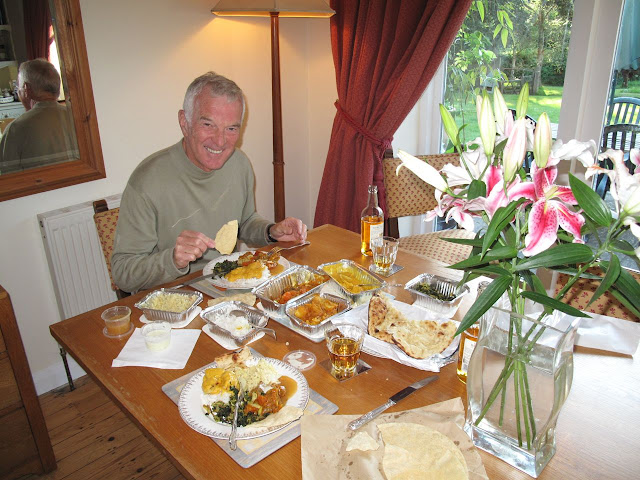 At the end of a long day we picked up Indian take away to take back to our B&B. Tomorrow we visit Batemans, Scotney Castle and Sissinghurst
 We hiked the cool shady woodland trails to the Himalayan Glade, the Southern Hemisphere Garden, the Winter Garden, and finally into the walled garden by the house.
 This garden was created in 1973, inside the old walled garden, as a tribute to Sir Henry Price who was the last owner of Wakefield.
 Our last stop of the day was Sheffield Park and Garden. Now I have to admit that I love the English cottage garden look, the garden rooms with their clipped yew hedges and walls, best of all. There are no garden rooms here and yet I have only one word for Sheffield Park. Magnificent.
SHEFFIELD PARK AND GARDEN
 The gardens at Sheffield were laid out by 'Capability' Brown to showcase the house, which had been remodeled in 1791, in the then, popular gothic style. Later Repton added his touch by landscaping the areas closer to the house..
 I never cease to be amazed by the vision these landscapers had.
 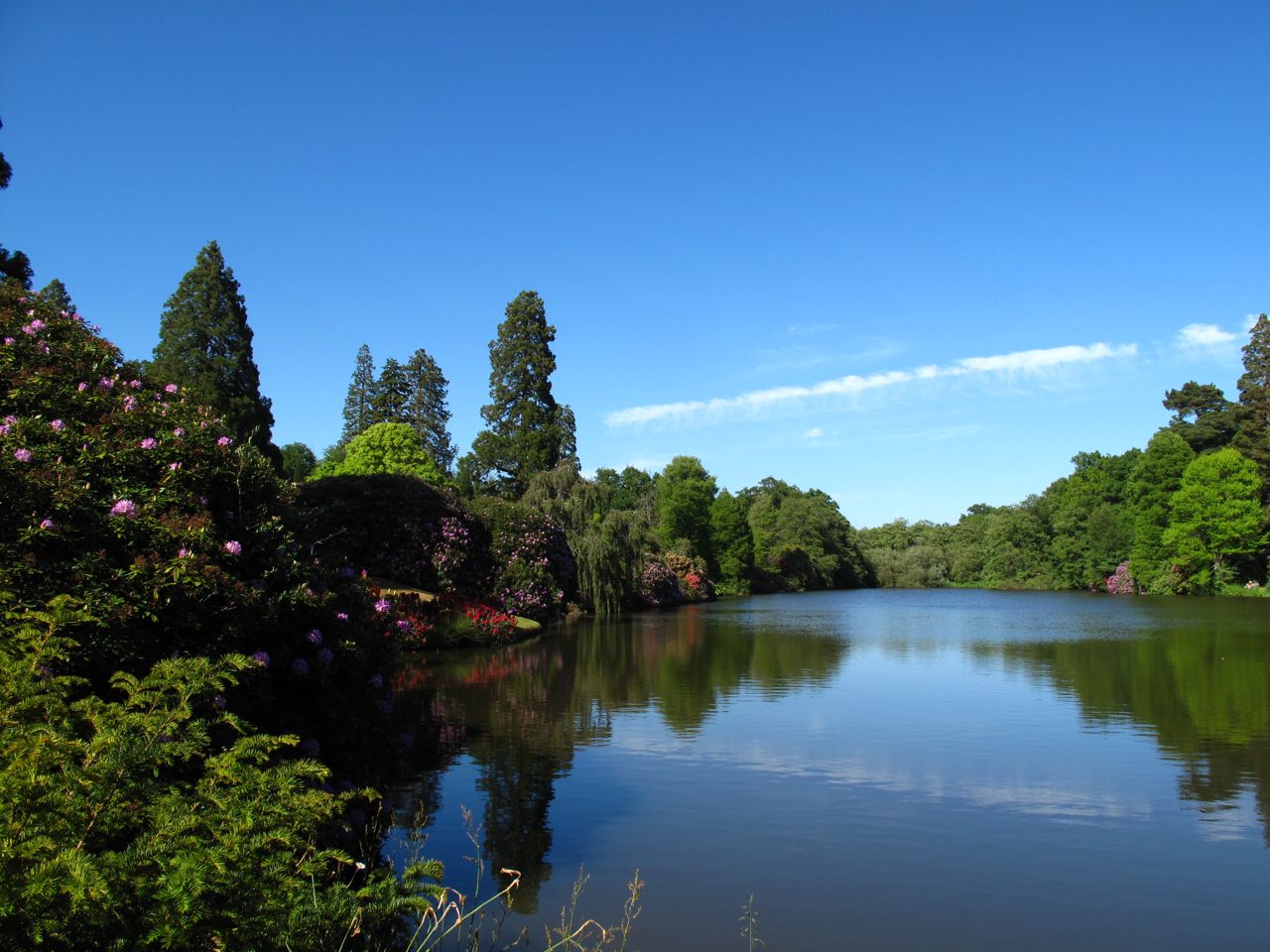 The rhododendrons and Japanese maples framed against a backdrop of green.
 Later additions to the garden, in the 19th and 20th centuries, included an arboretum and plantings of rhododendrons, azaleas and many exotic plantings.
 We may have missed seeing the spring show of daffodils and bluebells but the maples and rhododendrons made up for that.
 Huge swathes of gunnera along the water's edge.
 At the end of a long day we picked up Indian take away to take back to our B&B. Tomorrow we visit Batemans, Scotney Castle and Sissinghurst