We can look to the Enclosure Acts for the reason why so many walls were built and are still built today. Before the Enclosures many people lived in the countryside and practiced strip farming on common ground and grazed their sheep and cattle on 'waste' land. They shared what they grew and farmed and had a say in the village life. Then the landowners looked for a way to make their lands more productive and the Enclosure Acts of Parliament permitted them to now enclose this land driving the peasants away. As this coincided with the rise of the Industrial Revolution, those who were not given a small piece of land to farm for the lord of the manor, as tenant farmers, moved to the cities where they took on hard labor in the factories for a minimum of reward and no say in their lives. This is very simply put, but changed England forever. A disenfranchised nation with no say in their lives. This desire to enclose ones property was passed down from generation to generation. When I was a child you would never go to get your ball from the neighbor's garden without first knocking at their door and asking permission. An Englishman's home was his castle.
One of the highest brick walls we saw was at Alnwick in Northumberland.
 |
| Poor Humpty Dumpty really did have a great fall. Alnwick |
 | |||
| Cotswold stone wall, Hidcote |

Then there are the dry stone walls dividing fields sometimes snaking up the sides of hills in the Lake District. The materials and hours of labor that went into all this wall building must be staggering. Depending on what part of the country you are visiting you will see walls built of brick, native field limestone, slate and flint.
 |
| Mixed stone with flint |
 |
| mixed brick, flint, limestone |


Walls cascading with roses.

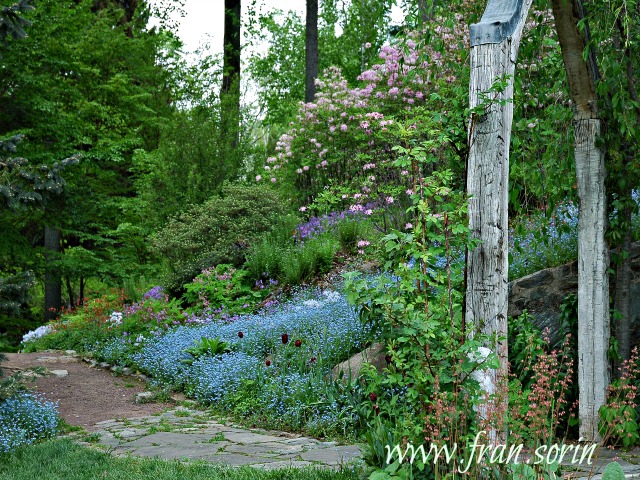
Walls in which campanulas and ferns find a place to grow.

 |
| Wall topped with plants in the Lake District |
FELBRIGG HALL WALLED GARDEN, Norfolk
 |
| From the garden brochure |

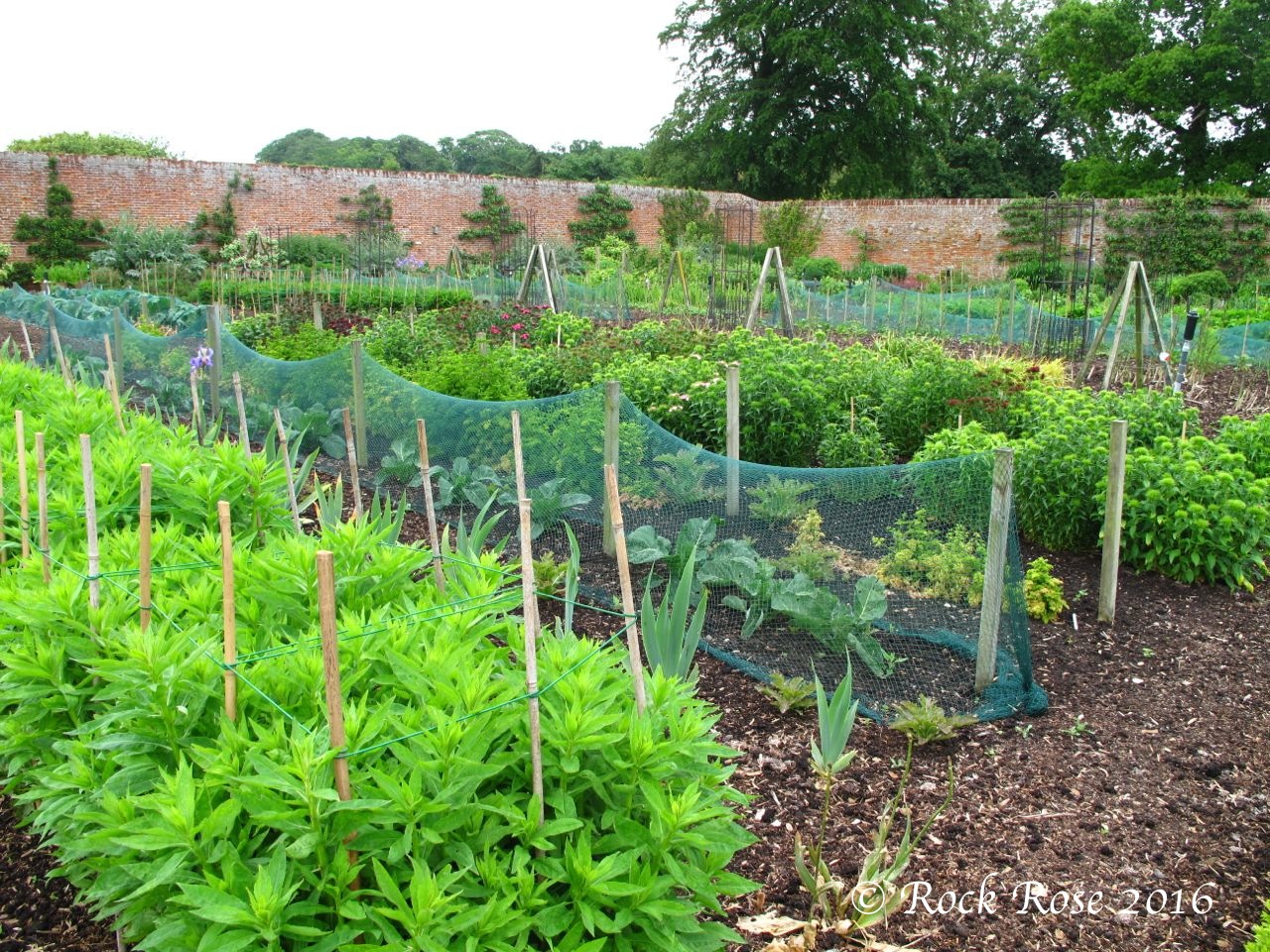
Only part of the garden is given over to vegetable, fruit and flower growing these days. Espaliered fruit trees are grown on the most sheltered of the walls and there are two additional walls which bisect the garden. The section furthest from the gate is the most productive, providing the house with fruits, vegetables and flowers.


 |
| Rhubarb and forcing jars |

In the center of the far wall is the Dovecote. Built in the 1760s the dovecote was used to house pigeons, for a source of fresh meat during the winter months. The pigeons also provided a source of fertilizer for the garden, as well as eggs, and feathers for mattresses. Sleeping on feathers was rumored to extend ones life. My grandma had a feather bed.

Inside there are 968 deeply recessed holes. Each has room for 2 nests.


The wall and archway seen here divide the vegetable garden form the Mediterranean garden.

As in our previous visit the California poppies steal the show. But it isn't hard to see that the cold spring has delayed a lot of the flowers.


In one of the glass houses it was interesting to see them growing blue plumbago as an espalier.

And through the archway into the next part of the garden.


Oh! where are the pretty mesembryanthemums that were growing here last time? No garden ever stays the same!

And finally back to the front section with lawn and trees.

SCAMPSTON HALL WALLED GARDEN, Yorkshire
You may never have heard of this garden but you will certainly have heard of the man who designed it, Piet Oudolf. The walled garden at Scampston was completely redone in 1999. At the time it was considered to be of the "New European Garden Style" with many naturalistic plantings. Since that time many have emulated Oudolf's style. There is a suggested route which takes you along the Plantsman's Walk which is inside the walls but divided from the rest of the garden by a hedge. Pleached limes, in groups of 3, line the walkway.


Turning the corner and midway along the next pathway is a gap in the hedge leading into the Drifts of Grass garden. Molinia grass is still in its early green phase but must be stunning in the fall when it matures and turns brown.

In this same garden 4 wooden seats edge a brick patio.

But the garden is not without its perennial planting borders where some staggeringly big poppies were in bloom.

Columns of clipped yew stand like silent giants in the Silent Garden.


School children were responsible for planting and maintaining several of the circular gardens in the flower garden.
You may never have heard of this garden but you will certainly have heard of the man who designed it, Piet Oudolf. The walled garden at Scampston was completely redone in 1999. At the time it was considered to be of the "New European Garden Style" with many naturalistic plantings. Since that time many have emulated Oudolf's style. There is a suggested route which takes you along the Plantsman's Walk which is inside the walls but divided from the rest of the garden by a hedge. Pleached limes, in groups of 3, line the walkway.


Turning the corner and midway along the next pathway is a gap in the hedge leading into the Drifts of Grass garden. Molinia grass is still in its early green phase but must be stunning in the fall when it matures and turns brown.

In this same garden 4 wooden seats edge a brick patio.

But the garden is not without its perennial planting borders where some staggeringly big poppies were in bloom.
 |
| The Spring and Summer Box Garden |

Columns of clipped yew stand like silent giants in the Silent Garden.


School children were responsible for planting and maintaining several of the circular gardens in the flower garden.
 |
| The Cut Flower Garden |
 |
| Vegetable Garden |

The Conservatory, built by Richardson of Darlington in 1894 has been restored and houses an exhibition.

The Serpentine Garden has 6 serpentine hedges of clipped yew.

And finally The Mound allows you to walk up to the top and view the garden from above. Unfortunately I think you need to be much higher to appreciate the layout in full.

 |
| Plants for sale |
GERTRUDE JEKYLL'S WALLED GARDEN AT LINDISFARNE, Northumberland
The Island of Lindisfarne is reached by a causeway which is covered at high tide. The tides were perfect for our drive across the causeway affording us plenty of time to visit the castle and the garden as well as stopping several times to admire the stunning swathes of sea thrift.

The walk to the castle, which stands atop an old volcano, is about a mile. Built in the 1550s following the dissolution of the monastery there is some debate as to whether the stones came from the abandoned monastery, dating to 635AD and later priory. At that time there was no road and the visitors to the priory had to walk across the sands at low tide. This can still be done to this day by following the line of stakes in the mud. There are a couple of wooden platforms along the way in which someone caught out by the tide could shelter.
We visited the castle before walking down to the garden.
 |
| Walled garden seen from the castle |


You have to understand the harsh conditions that plants have to withstand on this island. Summer comes late so we didn't see the garden at its best, but the planting remains true to the Jekyll style. Her signature grey-leaved signature plants with roses, cornflowers, sweet peas. Imagine a gardener from the south of England designing a garden in this wind stepped part of the country. She made mistakes as all gardeners do. Not all the plants she chose were suitable for the climate so substitutions were made but the plan remained true to her original plan for a summer flowering garden.
It would be wonderful to see this garden at the height a good summer but that is probably not going happen. we contented ourselves with watching video which showed the garden at its best.
WALLINGTON HOUSE WALLED GARDEN
Wallington gardens were built by the Trevelyans n 1768. It was a productive vegetable garden until the second world war. The garden is unusual in that being on a hillside it is built on several fdifferent levels. We entered through Neptune's Gate.

To the left side a long walkway follows the wall until it reaches the glass houses.

The low all on the right overlooks the rest of the garden.

As with many English glass houses the wall forms the back of the glass house.


At the far end of the wall lie the cold frames.

At the bottom we followed the wall along until it opened up into a large grassed area with a pond.


 |
| Meconopsis poppies |


Newly laid dry stone wall.


The lower pathway leads back to the front with the Mary pool. A gift to National Trust when they transferred ownership.

We walked the grounds and paid a quick visit to the house which was just closed. We literally ran from floor to floor which only gave us a taste of the wealth and lifestyle of the Trevelyans.
INVEREWE GARDENS, Scotland
Our travels took us up to the very top of Scotland and back down the west coast and a visit to Inverewe gardens on Lock Ewe.

When Osgood Mackenzie came here in 1862 this was nothing but a barren rocky landscape. It shares the same latitude as Hudson's Bay in Canada but with one big difference.

It isn't hard to see why he found the location attractive and he clearly saw the potential for a garden which benefitted from the warm waters of the Gulf Stream passing its shores.

He created shelter belts of native and Scandinavian pine which sheltered the garden and house from the strong winds and salt spray. This enabled him to grow a wide variety of plants from both northern and southern hemispheres. We headed on down to the walled garden which is right alongside the sea shore.


Notice how they have made use of the high wall to create a garden shed. A similar idea to using the walls for glass houses.

The land slopes down to the beach and has been terraced with wide pathways at several levels.

We took the highest path along which was a rose arbor with bench and pleached apple trees.


If many walled gardens have given up their original purpose this is not the case at Inverewe.


This is a more traditional walled garden with fruit and vegetables still being grown.

The gate leading to the shore.

And there is always room for sculpture even in a kitchen garden. This piece by James Parker represents the delicate ecosystem in which Inverewe survives. The ball representing the ecosystem and the cone the shelter belt of trees which protects the garden. Without this this ecosystem would not survive.

View from the walkway which runs along the top wall of the garden.

HOLEHIRD GARDENS, CUMBRIA
(Previously posted in late summer)

Holehird Gardens is the home of the Lakeland Horticultural Society. The 10 acre site is leased from the Holehird Trust and managed by a group of volunteers who do all the planning and development of the garden, each member having their own area to garden. As well as opening the garden to visitors, for a suggested donation of £4, they run education classes. They also hold the National Plant Collection of Astilbe, ( meadowsweet) Meconopsis, (Himalayan poppy), Daboecia, (heather) and Polystichum( sword fern). None of these are plants that I could ever grow in my garden but I do share a love of rock gardens and trough gardens.
 |
| Entry through the original walled garden |
The original gardens were built in the late 19C but were derelict by 1945. In 1969 he LHS was formed to restore the gardens. Situated about 500' above sea level on a sloping site above Lake Windermere, the area receives around 70' rain a year.
The first part of the garden is contained within the original walled garden. We entered the garden through the gate revealing a low dry stone wall, planted with alpines.

Plants are well labelled although for me it is of little help because these plants would not enjoy our hot humid summers. Still, for those who live in the milder English climate it is a good education tool. Troughs look very good in a separate display area and raised above the ground not only for drainage but so that the plants can be more easily enjoyed. The backdrop of the low drystone wall above which is a grassy area with dispay beds is perfect.


Further along the wall, steps lead up to a grassy area with island beds.

At the end of the gravel walkway is a patio with seating area under a large prunus.


A collection of miniature hostas in a 'theatre'


Along the far wall is a wide herbaceous border.

I really would like to go through that door. But it says LHS MEMBERS ONLY. But I think I might be disappointed to find that it was the inside of a building built on the back side of the wall. I imagine they store their equipment in there.

At eh ed f this border we went out through a gate and turned left to visit the first of the greenhouses.


The tufa greenhouse is built into the hillside for protection from cold. It is the only one I have ever come across during many garden visits. The tufa is mounded up high so that it creates a bank of stonework bring the plants to eye level. At the far end is a water feature and pool.

A planter hewn from solid rock.


The rock garden with a backdrop of ornamental shrubs, including acers and conifers for winter interest. A bench, with thoughtful placement, to enable the visitor to enjoy the plantings and views.

Hi David! I am so lucky that he enjoys garden visits as much as I do. Well, almost!


We left the garden by the fell gate, walking across the field until we reached the road. Crossing the road we picked up the path back to Troutbeck village. My head was full of wonderful ideas for new garden troughs and rock garden planting.
Hope you enjoyed this tour of just a few of England and Scotland's walled gardens.