My Blog List

Monday, January 9, 2023

ONE YEAR ANNIVERSARY AND BEYOND!

What started out as a story at 9 months then 10 and 11 and finally...... we are here in the New Year and a month past the anniversary of the day we moved into the house in Oro Valley, Arizona.  I think I may have asked David whether he wanted to carry me over the threshold. He declined.

I was about to get a few hard lessons on desert gardening. But, they have not deterred me from trying to make the small garden areas around the house more to my liking. You may wonder if the summer heat stopped all outside work. That was not the case, although all outdoor work must be done before 10am. It was a small window. Even so the summer has been quite a surprise and much cooler than expected. (We were gone for 3 weeks when we drove up to Wisconsin to attend the Madison Fling). Elevation undoubtedly makes a difference, we are at 3000'. Just when the desert started to take on a dry dusty beige look, the monsoon rains arrived. The days and nights were cooler and the desert became green and bloomed again. 

But during this time there was much to observe and learn. 


POTS IN THE DESERT

                The lace cactus and paddles went into the ground in the early spring. They seem at home.

In Austin I had many cactus in clay pots. There they were happy to spend the summer out in the garden where they had afternoon shade and the winter in the greenhouse or potting shed. Not here. Very few of them can tolerate the summer sun in Arizona, even the morning sun, and being in a clay pots makes them doubly susceptible to a slow death, their roots dried and fried. That Austin 'death star', bears no resemblance to the fierce sun that shines down on my small garden. All my potted plants are hungry for shade. A few are in temporary places under trees but they will either find a home in the ground or go to The Little Free Garden Stands. I aimed to have dealt with them before winter arrives. (It did not happen). Many have succumbed and I have boxes of empty pots in the garage. And one thing I didn't have in Austin was critters who like to eat succulents although the birds did peck them from time to time. Some of my prettiest plants have been nibbled mercilessly. One of the miniature prickly pears was eaten down to nub overnight. The tops of some succulents just eaten off. They were so shocked they didn't produce any blooms this year. They just got busy repairing the damage.

This plant started to close up the wound and began making a new baby.

 And now has a chubby little offspring.

 There is no counting the times I moved pots around. Firstly settling them along the north wall of the house which had complete shade. 


But not for long as the sun moved across the back of the house to its final summer solstice location. That shady area was now in full sun for a good part of the day. Now they moved to the east facing patio. A better location for the summer but only if the solar screen was down. With insufficient large pots the numbers of successful potted plants dwindled. This photo is a good reminder of exactly what I have lost since the spring.

CRITTERS

Almost all pots have to be elevated to prevent the pack-rat snacking. The one disadvantage of living right on the edge of the desert. There is little hope of stopping them. The pest people put out traps with bait but they ate it and pooped all around the edges of the wall. I regretted having left 3 Havahart traps at our last house and had to buy another one. The snacking I could stop but I could not tolerate the rat poop. We showed no mercy. A few staddle stones would be in order( look at those on line prices for genuine antique staddle stones) or I could make my own with upturned pots or any other supports that will hold a pot. The challenge is to make the scene look attractive. Another answer is to put the smaller succulents inside a large planter. Or find a place to hang on the wall. Call me fussy but from a design point of view these pots just don't go with the style and color of the house. It would be a good place to have a cactus theater. Unfortunately I don't think we have the equipment anymore to make one.


The Euphorbias are a pretty safe bet. I thought the huernias would be safe too, placing them on the ground, but the flower on one was taken during the night before they began snacking on the ends. Not my favorite way to prune. The two pots are now safely on the wall.

A complete pot of paddle plants was decimated but ones I planted in the ground have so far been left alone. Those rats prefer to run along the edge of walls.

The agave, A. desmettiana variegata and A. demettiana Joe Hoak found a home in in the ground in the shelter of our overhead patio. This and the fact that they don't get any rain may also protect them from low temperatures in the winter. We are more susceptible to winter frost at 3000' Unfortunately pups growing at the base are perfect for the rats to nibble and they did.

 The barrel cactus I had in pots have all been planted among barrels that were already here. They seem happy. Damianita is a great companion plant and has been highly successful with almost continuous flower.

 One planter that will probably remain has the only squid agave that I brought from my old garden. So far no pups but it has had a happy summer on its pedestal. 


We recently found a home  in the garden for the potted Meyer lemon tree. It involved taking out a photinia -why did they plant so many- and digging a large hole. The bigger job was getting the plant out of the pot and getting it settled. Then creating a shade structure to help it through the summer.  Fingers crossed that it will settle in and bear fruit next year. It has not taken well to the conditions here and even though it bloomed twice it never set fruit.


 The lime tree will remain in a pot as it is the least hardy of the citrus. It bloomed twice and only began to set fruit in the fall. Now, in January it is blooming once more and looking as healthy as ever. 


The grapefruit, planted a year ago seems to have settled in. It is looking a little yellow from the cold but soon it will be time to fertilize and hope for a crop this year. 


It doesn't stop us from looking enviously, over garden walls, at trees laden with fruit but ignored. They are probably at least 15 years old.


AGAVE REMOVAL

The A. weberi looked pretty impressive on first glance. Some of them were about the size of the ones I had had in Austin before the devastating winter event of 2021, but I knew well that they didn't have many more years left. A decision was made to remove the ones in the front bed and one down the side of the house which was planted too close to the path. 


David undertook the job of removing them. One thing I had noticed was how few pups there were, once again remembering my Austin agave. A few months later we were to find out why. The agave weevil had been at work removing most of them and now moved on to some of the larger ones. In fact a message went out in the neighborhood that someone had lost his A. ovatifolia to the dreaded weevil. One of the telltale early signs is rat and rock squirrel activity going after the grubs in the base. Although I had experienced weevils in smaller agave in Austin there were usually only one or two. This time there was an infestation of grubs. In all we took out 10 agave. The bonus was a space to plant the lemon tree and a pomegranate.

THE PALO VERDE


Oh! how we enjoyed the blooming of the palo verde tree. We learnt ours was a hybrid "desert museum' Thornless, upright and less messy than the native variety. We remarked on the sound of bees as it bloomed not once but several times after a rain event. I was cleaning the rocks along the side of the driveway when I came across a root that had been severed as it tunneled under the paving. Several pavers had lifted. That was when I put two and two together and came up with the cause of the blocked sewer line we had shortly after moving in. Tree roots had invaded the line which runs down the driveway. The tree still stands but has been pruned heavily, several roots going under the driveway removed and reluctantly we will take it down in the New Year. How they could possibly have thought of planting this tree so close to the sewer lines just shows the thoughtless planting of the landscaper.  I have already planted a replacement, a desert willow, further away. It is small but I am told it is a fast grower. It was one of the 3 trees I ordered from our electric company along with the another desert willow and a pomegranate.  They offer the following selection of trees from which I have ordered 3 more.

I have some space along the driveway and between our and our neighbor's property. Yesterday, David took out a Texas Olive which was planted far too close to an Anacacho orchid tree. It has exposed the neighbors electric meters but I will plant some evergreen bushes to shield them. The removal of the olive means one less tree to keep pruning and less fruit to dispose of. I have at lest 6 more that may be for the chop.

THE SUN

I was aware of the sun's movement across our garden in Austin but it never seemed to cause much of a problem. Suddenly plants that were shade by the patio in summer we’re exposed to the lower travel of winter sun. I have yet to have  full understanding of what will work well under such exacting conditions. But so far I have had success with white alyssum, damianita, Chrysactinia mexicana, dahlbery daisy, Thermophylla tenuiloba, purple skullcap,  S. suffrutescens, Gold coin daisy, Asteriscus maritimus, blackfoot daisy, Melampodium leucanthum, chocolate flower, Berlandiera lyrata. All made it through the summer. Some may be short lived.

White alyssum. A survivor.

All the shrubs I planted have survived and some are coming into bloom. We had generous rain over Christmas so I'm looking forward to the wildflowers I planted showing their faces soon.

Happy New Year everyone. Rock Rose is back in the garden with renewed energy.


Sunday, June 12, 2022

SHADE NATURAL OR OTHERWISE

When we moved to the Sonoran Desert in December I had one thing on my mind. Now I can grow all those wonderful cactus and succulents in the ground. Not so fast. We live on the edge of the desert and when I walk out there I notice that there are a limited number of cactus growing and no agave. Only saguaros, fishhook, mammillaria and cholla. There are, however, lots of small trees and bushes and it is these trees that make a nursery for the cactus to start their life. 


The fruits of the cactus are eaten by the birds, the birds perch in the trees, and their poop along with seeds falls to the ground beneath the tree. Even young plants need a little shade. To garden successfully here you need trees.

I have 3 good sized trees which anchor 3 corners of our small garden. The first is the ironwood, Olneya tesota. It is evergreen with pinnately compound leaves which give filtered light. It has pea like flowers although this one is not putting on the kind of show I am seeing out there in some neighborhoods. It does drop its small leaves which have to be brushed out of the cactus that are growing beneath it.

I am gradually extending the planting area by removing some bushes that had been pruned so poorly they would never recover. I am thinking of putting my lemon tree in the ground here. I think it would benefit from a little filtered shade. I have added rocks and a few skullcaps and blackfoot daisies.A drip irrigation system is in place.

I have also added a couple of penstemon and plan to try some wildflowers beneath the tree next spring. I threw a packet of scarlet flax in January and they have done quite well. The soil is desert soil and appears not to have been amended which is perfect for wildflowers.

Unfortunately the tree doesn't offer any shade for us but a patio set and umbrella close by allow us to enjoy the tree, the view of the desert, the hummingbird feeder and the birds that come to drink at the bird bath. We have been eating most meals out here and I do feel as though I am on vacation. The fact that daylight arrives early before 5 am means our days have shifted somewhat. That and the coolness of the desert mornings. At least for the moment.


Our second large tree at the opposite end of the patio is the Texas Olive, Cordia boissieri,  


What a show it has given us this spring. We removed all the bushes that were growing beneath this one,  added a few agave  and covered the area with rocks. The olive tree does have a few disadvantages. It holds onto its leaves a long time so it is a constant drop for several months in the spring. It makes fruits which are attractive to wildlife including javelinas. For that reason I am in the process of pulling them off before they mature. Plus it is extra work for the tree to mature the fruit. It seems we got more than our fair share of this tree as there are at least 6 more in the front of the house our house being the only house in the neighborhood which has them. A desert willow would be nice or a fruiting pomegranate.


The tree has a long bloom season and is visited by hummingbirds.  I am pruning most of the ones out front to be more like trees. 

It would be hard to compete with the Desert museum Palo verde tree for blooms. It has been spectacular for several weeks but of course now all the flowers are down and there is work to be done. They say this tree is less messy than the more common one! To stand under here in the warm sun is to hear the buzz from hundreds of bees. There is a lot of honey being made somewhere. I haven't even begun to work under the tree yet. That will have to wait until the monsoon rains arrive.


This tree is in the front right of the house on the edge of the driveway. For a tree that was only planted 5 years ago it is enormous and of some concern for the future. Its great value right now is to provide wonderful filtered shade for much of the day as the sun moves around and overhead. 

There are several other small trees which have been pruned into bushes. Two Texas mountain laurels which I am trying to prune up to be trees. I am learning which plants bloom on old wood and which on new wood. The mountain laurel I know will be making next year's flowers now so there will be no pruning except to shape up the tree. Judging by the lack of seed pods these trees were never allowed to bloom. It was when I was pruning the mountain laurel in the side garden that I had my close encounter with the Gila monster. A good reason to prune up all the bushes.


 I began to notice a number of my agave bleaching out. At first I was concerned that they had been visited by the agave weevil but then wondered if it might be the incredibly strong sunlight. That used to happen to my A. ovatifolia in Austin during the summer and I would often give it some relief by shading it. So I experimented by cutting pieces of 70% shade cloth and laying it over the plants. Within a few days they gained back some of their original color. It looks as though the covers will stay on until our dry summer is replaced by our wet summer when the monsoon rains arrive. 


 Newly planted agave get the shade treatment during the summer.

Many nurseries have markings on their cactus to show which direction to plant. As many are field grown it  assures the plant will be placed according the direction it had been growing in the ground.

My large collection of potted cactus and succulents have had a hard time finding their rightful place in the garden. The problem is the seasonal movement of the sun. While I was aware of such changes in Austin it is strikingly evident as the back of our house backs directly to the east. Clear blue skies mean a fierce sun. Most of my plants were getting scorched.

In December the north side of the house was almost completely shaded by the house. We purchased several masonry blocks and a plank of wood to raise the plants off the ground. That didn't stop the rats from nibbling off the flowers on several cactus. As spring progressed sun began to creep around the corner so we moved the structure around to the east side with some shade from the ironwood tree. That was not enough so we moved the plants under the patio. Pack rats came around and ate down all the succulent plants. The heat has become too much for some of the plants and I have moved them into the house. What next? We will be traveling for several weeks so I am hoping a good watering before I go will suffice. We really have no idea the challenges summer will bring. 

Friday, May 6, 2022

THE THREE Rs OF DESERT GARDENING

 I have been reading Jeff Moore's book. Under the Spell of Succulents. It is a wonderful book, beautifully illustrated and loaded with information.  There is only one problem. Many of the gardens are in California- In my eyes the perfect climate for growing, well____ just about everything. It seems I squandered my 6 years in Southern California growing the wrong thing! Sadly he devotes only two pages to desert gardens. Clearly he knows what will and what won't grow here.

I did learn two major things which seemed to be directed at my new adventure in desert gardening. His mantra of the 3 Rs. Rocks, Restraint and Repetition. Let's see how I am doing. 

Rocks-I had 9. I knew I wanted more, even before I read his book. We have now collected from a local source over 36 decent sized which I have been using to create a rock garden. It may look a little bit currant bun at the moment but I am hoping plants will fill in and soften the look. They are not rocks I would have chosen but this is what we have. The expense of having someone bring in and place larger ones was beyond what we wanted to spend. These broken chunks of granite tend to be rather angular but surely I can soften their edges with plantings. 


 I am also thinking of giving them a diluted paint wash to help them blend in. I did that with some limestone ledge stones at my old garden. Then there is the 4" riprack and 1" stone mulch. We rented a UHaul for that job picking up a load at the stone yard. So far two UHaul rentals and two dusty stone yard visits. 


Restraint- I have always been known for that. At least from the money angle. I would buy 4" pots and only occasional gallons. But I think Jeff was referring to using a small palette of plants. Maybe I'm not so good at that but hope to manage this better in the desert. The odd large agave may look great as a statement plant but smaller ones look better when they are in groups.

Repetition-I'm been good at repeating some things-namely things that seed themselves or pup. But that was in Austin. I have lots of pups of A.americana and A.weberii but I would like something more exciting. I purchased 3 Agave "Blue glow" of which there were several already planted. I do worry a little that they will not like the full afternoon sun so I will probably protect them with some shade cloth through the first summer. I had hunted around for A. ovatifolia to no avail and then one day we visited Tucson Cactus and Koi and they had several. Sadly they were pock-marked from a hail storm that had passed through the area a few weeks ago. I was just going to buy one but David persuaded me to buy 3 at the discounted price. They are quite small but I know they will grow out of the damage if I treat them well.

                                                    A. ovatifolia "Frosty Blue"

 I had plans to put the second one on the other side of the front planting bed, beneath the large remaining A.weberii. Incidentally when I told a local nursery that these weberii did not have completely smooth edges he told me that almost all of the ones here were a cross between americana and weberii. They could give you a nasty gouge. On the spur of the moment I told David we should take it out. Within minutes I had cut off most of the leaves and he was there to do the final job. Now there was room to plant the A.ovatifolia. 


Of course I read too late his advice about taking out any current planting so as not to have to work around the plants and compromise the design. On the front walkway I couldn't bring myself to do that as the barrel and echinoeereus cactus were about to bloom. They looked too comfortable to mess with. 


I worked around them trying to create a drainage swale and mounding on either side, disturbing the cactus as little as possible. He was right of course. He also talked about bringing in soil to create the mounds. We did not. We used what we had. It's just desert sand which is fine for most of the desert plants that grow around us.


My garden is now a desert garden and I am surrounded by saguaro and barrel cactus at every turn and discovering the desert is not necessarily the place for all cactus and succulents. Some will withstand the baking summer sun but others demand shade if they are going to survive. I brought with me a large collection of cactus and succulents and herein lies the struggle. Clay pots were perfect for Austin. Not so in the desert. The air is so dry it sucks any moisture out of the pot. I find myself watering more frequently than in Austin. In my former home I would leave them for 6 weeks in the summer, under the shelter of a patio. They quickly responded to a little attention when I came home although they may never have been prize winners, bearing the scars of winter and summer damage. But here they are and I have been doing my best to make them feel at home. Some have been put in the ground. I brought 3 barrel cactus one of which I picked up in a neighborhood concrete wash in a subdivision in Phoenix. At first I thought it was growing in a crack in the concrete but was surprised to find it totally unattached. "I have a home for you" I also brought some agave- A. demettiana, variegata. My neighbor has one so they found a new home in the ground. Also an A. demettiana 'Joe Hoak' I may have to give all some frost protection in winter. I have planted a ladyfinger cactus, Echinocereus pentalophus, in the shade of the ironwood tree. 

I have moved them from one spot to another as the sun moved across the sky finally settling on a place down the North side of the house.  Until I discover the sun has found its way to that spot by the afternoon. So now the only place is under cover along the east facing patio or in the house. 

Most have flowered well this spring but it might be a struggle to keep them happy if we go away.  This cactus asks for little in the way of water or fertilizer and puts on a stunning show of blooms. The blooms last for several days.


                                                 Echinicereus pentalophus

This is not going to be as easy as I thought!

Sunday, April 3, 2022

ADDING MORE ROCKS AND NEW PLANTS

It is characteristic of me to be working in more than one place at the same time. A few weeks ago I turned by attention to the front of the house, abandoning some of the others areas I had been working on. The whole front needs a revamp which includes removing plants that have grown too big for the area. A huge A. weberi and two baja ruellia, Ruellia peninsularis. Baja ruellia, is a great plant, but when squeezed up against a wall and in poor soil with no attention but chopping they don't do well. No sooner do I say to David, this one is going and those two as well, than he is out there with his saws and choppers. It's a two day job.

We have garbage pick up twice a week and this is our way of disposal. It's a full bin every week.

There is also a giant hesperalo, Hesperaloe funifera, which David does not like which will remain for the time being. Purely a well established structural plant for now. And one Agave weberi at the back.


And a photinia, Photinia x fraseri, which will also remain for the time being. They add some height and winter structure, I am still thinking about what to put there. Maybe a desert willow. For all the bad press the photinia received in Austin, it seems to thrive here and no one would disagree with how wonderful the new growth looks in the spring. I read that it can be trained into a small tree so I will take a look at this one and see if that is an option.

It also does well as cut branches in the house. It is now blooming although as someone said the blooms have an unpleasant smell. 

So with a good area now cleaned out I turned my attention to adding more rocks adding 12 more to the front. We have found a good local supply of both larger granite rocks and the Coronado brown rip rap that are used for erosion control. Monsoon season demands this. To bad we no longer have a truck  but we are managing with car loads for now. We will eventually rent a trailer in order to bring in some of the smaller rock to use as a ground cover. I redid all the edge rock adding more around the sides. 

Then planting began. I added the 3 barrel cactus I brought with me and purchased 3 Agave 'blue glow,' one A. parryi, a damianita, Chrysactinia mexicana,  and a chocolate daisy, Berlandiera lyrata. The A. blue glow is a cross between A. attenuata and A. ocahui. It is prized for its blue green floiage with red and yellow margins and its compact size. I will see how well they do in this location, which is west facing. I removed a sad clump of claret cup cactus, Echinocereus triglochidiatus,  that were rotting due to too much moisture. I am trying to rejuvenate the parts that still showed life but am not too hopeful. 

I am on the hunt for a Whales tongue agave, A.ovatifolia, but as yet have not come across any.


 I also found a home for the concrete balls I made for my Austin garden.

A nice specimen of the blue barrel cactus, Ferocactus glaucescens, is starting to bloom. It reminds me of the crown of thorns starfish.

The area at the back is where the clean outs are for our sewer line and for now I have just added a germander, Teucrium fruticans "Azure Blue' 


I see lots of plants growing in gardens that I would love to have but it is a matter of  balance between seasonal bloomers, structural plants and plants to carry the garden through the hottest months of the year. And we shall be gone for a few weeks this summer as we drive up to Madison, Wisconsin to attend he Garden Bloggers Fling. Click here for details.

Will you be there? I hope so.


Sunday, March 13, 2022

FAKE IS FINE....SOMETIMES

 I have had a few fake flowers and plants in my time but these days I am very selective in my choices. Gone are the days when I had the fake ficus in that dark corner. And gone is the lovely azalea basket. A friend once told me he was surprised at me for having such a thing. Me a gardener. 

They have some very fine metal agave in our neighborhood and the club house has a beautiful art sculpture which looks real from a distance and even up close. I actually had to touch one to be sure. They actually fit well into the landscape and the agave create a uniformity in a series of of planters in the center of the road as we enter the neighborhood. 


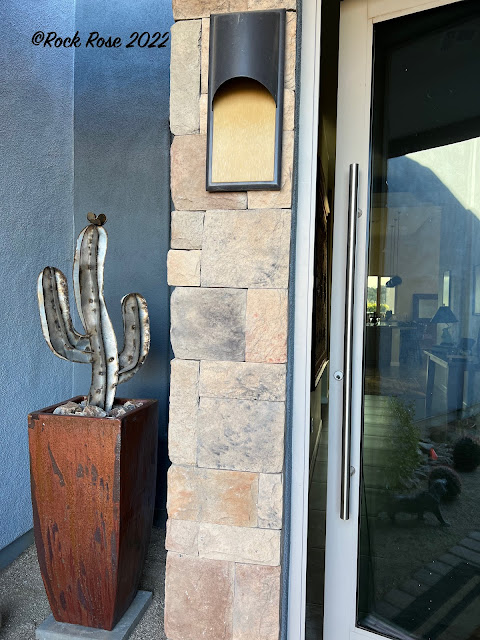
I had been toying with the idea of putting some such metalwork in a very difficult place in the garden. We inherited a tall planter to the left of the front door. Open to the sky the space is narrow and receives sun only in the late afternoon. The previous owners had never done anything with it and it had become a depository for discarded water bottles. Wouldn't it be so much easier to put a metal agave in there-if I could just find one. Last week while visiting a nursery and having nixed a number of pieces David beckoned me over to see the perfect one.


 It was a saguaro. What could be more perfect and I did not have to balk at the price. A good sized plant and soil would likely cost more. I'm not sure whether  should treat it but for now we went ahead and 'planted' it.


We had to rack our brains as to what we were going to fill the pot with as well as how best to secure it. In the past I have filled pots with plastic and bags of mulch. They didn't seem stable enough. It was our son who came up with the idea of using masonry blocks. We headed to the local store and purchased 2 blocks and a tile to make a platform. We robbed our dry creeks for the rock to secure and cover the base.

The added bonus is that we now have something to look at through the window just inside the house.


Wednesday, March 2, 2022

WAIT A YEAR, THEY SAY

 I'm sure you have heard this piece of advice given when you move into a new house. Take the time to understand the passage of the sun through the year, mark the various micro climates around the garden. When the garden is already planted watch through each of the seasons as plants come and go. Catalogue which plants you have, which will stay and which will go. All the while planning new areas and new plantings.

Sound advice but not for me. I will say I complained the first time I saw the house. "It's already planted. There is no gardening to do" How wrong I was. After moving in and taking a good look around I very quickly saw there was no time to lose. Most of the agave have reached a point where they need to be removed. So far we have removed 3. There are at least 3 more to remove. One monster, one large one and one smaller one at the back. If David thought he would never have to remove another agave after the tens he removed at our last house he was wrong. Thank goodness we kept the chain saw and the pick axes which I insisted on bringing.

Why would anyone plant an A. weberi so close to the fence? It had grown so big that growth of the Texas Mountain laurel planted next to it had been compromised.

I cut off the leaves and then called in the big guns to get out the root. 


Next to go, this monster. I have always thought A. weberii to be pretty innocuous as agave go but these ones have small teeth.

This time David didn't beat about the bush but got out the chain saw, making quick work of it. 


I have my eye on this spot to plant either a new calamondin or an satsuma tree. The shops are full of citrus at the moment so I shouldn't have a problem finding one.

I have begun work on making a retaining wall around the mound. Originally the area was piled up with rocks, which prevented us from walking down the side. Now with the soil retained further back I can use left over rocks to make a pathway. 

I am not 100% happy with the rock work but I must make do with what I have on hand and these angular lumps of granite are not as easy to work with as the flat limestone stones I have used in the past. Still I am hoping that succulents and cactus will soften the edges and find a happy home in the nooks and crannies.

After reorganizing the rocks beneath the roof scupper outfalls I will get a few bags of gravel from the local big box store to put down on the rest of the pathway and between the cracks.


There is more rock work to do here but I am making a list of plants that I hope to introduce to this part of the garden. Most are desert dwellers. On my list are,

Agave parryi, var, truncata, Artichoke agave,  Euphorbia resinifera Moroccan mound, Echinocereus triglochidiatus Claret cup, Echinocereus engelmannii Engelmanns hedgehog, Aloe x 'Blue elf', as well as many flowering perennials with which I am familiar like Melampodium leucanthum, Blackfoot daisy, Tetraneuris acaulis, Angelita daisy, Damianita and Berlandiera lyrata, chocolate flower.

Let the shopping begin.