My Blog List

Tuesday, November 11, 2008

NOVEMBER IN THE GARDEN

Copper Canyon daisy, Tagetes lemmonii, is the hands down November favorite in my central Texas garden. The plant is daylight sensitive so it blooms during the fall. It is deer resistant and can withstand the fierce summer heat of Texas. For this reason it will do well on the west side of the house. I photographed this plant this morning before the 9/10" rainfall. It has spent the summer in the vegetable garden. Not the place where I really want it, but this is where I planted the young plant just before we went away in April so that it would not be stressed from lack of  watering during the heat of summer ( the vegetable beds are on a drip system).  A month later it was too big to move. As it grew larger I would brush past it as I walked down the path and the air would fill with its distinctive fragrance. I suspect this is what keeps the deer away.
I frequently put young plants next to a drip when I have to leave the garden for any length of time so I always have flowers in the vegetable beds.


My garden relies heavily on serendipity. This blanket flower and the alyssum have seeded here in the sunken garden. Both are prolific re-seeders. The air is filled with the sweet fragrance of alyssum and the bees are having a ball.


How could I evict these flowers, narrow leaf zinnias and alyssum from this bed. This summer it held peppers so there was plenty of room for these guys to grow; now they  bed alongside Nappa hakusia, tenderheart, a small chinese cabbage from Kitazawa Seed Co. I wonder if they will form a head like the picture on the seed package?


This is not grass growing here but larkspur seedlings which have just germinated. I'm going to have quite a job thinning them out. I turned over this area this summer and maybe exposed seeds from previous years. Much as I love larkspur even I find this over the top.


In front of this is a planting of Osteospermum. The seeds came from a friends garden in California. Spring is their prime flowering time but the recent cool evenings have prompted them to put out a few flowers.


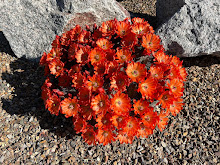
The same is true of Delospermia cooperii along the edge of the pool and enjoying the cooler temperatures of fall.

This succulent has similar foliage but has red flowers.


This succulent is also in flower at the moment. It is rather annoying to purchase  a plant with a tag that says "succulent" with no further identification. Maybe someone can identify it. It is a delightful succulent to grow in a hanging pot as the fleshy leaves are long and pencil like and then it makes these interesting flowers. When enlarged the detail on the petal is interesting.


Butterfly pea, Clitoria ternatea. might have found a better place to grow than at the bottom of the steps where it is often crushed as we walk by.


Even the cross vine is enjoying the cooler evenings. 

After the rain today I have no doubt that seedlings will be popping up all over the garden, and weeds too. Work doesn't stop during the winter in Texas.
And just to show that fall is on the way in Central Texas----


Monday, November 10, 2008

GREEN TOMATO CHUTNEY


This is a great recipe for using all the green tomatoes left at the end of the season. As frost is in the forecast for this weekend Austin gardeners might like to try this chutney which is great with curry, cheeses, ham etc. Every bit as good as Branston pickle!
I went ahead and picked green tomatoes this weekend. I don't think they will ripen this late in the season although I have left some of the larger ones on the south side of the plants in the hope that they will.

After all the chopping was done the pot went on the stove.


And it wasn't long before the chutney was in the pot.


As I am a great saver of all things that might have a second life, I pot the chutney up in old jam jars. Here's the recipe.


Green Tomato Chutney
3 lbs green tomatoes
2 lbs tart apples (I use granny Smiths)
2 c raisins
1 1/2 c diced onions
2 tsp garlic minced
2 c packed light brown sugar
1 c granulated sugar
2 tsp nn- iodized salt
1 1/2 c apple cider vinegar
3-4 T minced fresh ginger
1 1/2 T mustard seed
2 tsp ground coriander
1 tsp cinnamon
1 tsp finely minced fresh red pepper or 1/2 tsp dried red pepper flakes

1. Cut up tomatoes into 1/2" chunks, removing stems and blemishes. About 8 cups. Place in large deep saucepan.

2. Peel, core and cut apples into 1/2" chunks and add to toms with raisins, onions, garlic, sugars, salt and vinegar. Bring to boil and when boiling reduce heat and simmer for 30 minutes, uncovered, stirring frequently.

3. Add ginger, mustard, coriander, cinnamon and hot pepper and continue to boil slowly until the chutney holds its shape.

4. Ladle into sterilized hot jars and add lids. Process 10 mins in water bath.

I usually omit this last step. I find that packing into hot jars and capping is sufficient as long as the lids pop. If the lid fails to pop I put in the fridge.
Keeps for months.


PHOTOGRAPHY AT MAYFIELD PARK


Austin garden bloggers had a busy weekend. A group visited Peckerwood gardens on Friday and on Sunday several members of the group met at Mayfield Gardens to learn a little more about garden photography. Rachel of In Bloom shared some of the knowledge she had acquired from her photography classes. Thanks Rachel for sharing your Sunday afternoon with us. Being somewhat new to photography I already know that I have a good deal to learn; not just about the how to compose the photograph but also about the camera itself. I think I came away from the afternoon having learnt some good tips and I hope to be a little more thoughtful in composition in the future. Here are a few of the photographs I took today.


A few paperwhites were already in bloom. 


This statue of a little boy reading will soon be surrounded by paperwhite blooms


Most of the leaves have fallen from the beautyberry but small clusters of the brightly colored berries still remain.

 The property sits on a steep limestone cliff so there is no shortage of rubble limestone with which to build. Judging by the shelves inside this was used as a storage shed in the past. 

Limestone rubble was also used for this wall.


A solitary water lily on the pond is reflected in the water.

After today's class I am trying to be more thoughtful about composition. One of the next steps is to invest in a tripod. Im hoping this will improve close up photography of flowers.


Wednesday, November 5, 2008

DALLAS ARBORETUM


Last Saturday was a simply gorgeous fall day. A perfect day to visit the Dallas Arboretum. The entrance was filled with pumpkins and gourds. What I wouldn't give to grow a few of these although they may have to be of the miniature variety. The theme in the gardens was definitely fall with oranges and yellows everywhere.

I think I might just grow some of this variety of Gaillardia ( Gaillardia commotion "frenzy") next year.The petal form is like Cosmos "sea shells". I particularly like the yellow and this plant seems to flower throughout the year in central Texas.

Anyone know what this plant is?

I loved this water feature.

The armadillo on the edge of the pond was eyeing the koi intently.

Even they were dressed for fall.

I know I have seen these lily pads ( Victoria amazonica) before. Kew Gardens? Do I remember seeing a photograph of a Victorian lady standing on one?

This pot maybe left over from the summer but what a wonderful combination.

The Dallas Arboretum has a reciprocal arrangement with the Lady Bird Johnson Wildflower Center so there is no entry fee. What a great deal! 


Wednesday, October 29, 2008

WHO ELSE LIVES IN OUR GARDEN


If you haven't already certified your garden as a wildlife habitat let me tell you that it is very easy. All you have to do is to provide food water and shelter for the various animals that live in your neighborhood.
Two evenings ago we were having dinner outside at dusk and a large owl came swooping down and landed in a tree. We both looked at each other and said "wow" and then talked about how we enjoy so much wildlife in our garden. We hear owls calling every night. Judging by the number of mice and cotton rats this is pretty good hunting territory. I caught this little guy in the potting shed. He had been shredding gomphrena flowers and making a big mess. I'm not sure what he is but when I let him go he hopped away just like a kangaroo. He probably came back the next evening unless he became dinner for the owl.


Or maybe this snake. Our rocky terrain and dry stone walls are just the kind of habitat the snakes prefer.


For a couple of weeks the wild turkeys (Meleagris gallopavo) have been visiting the open area around the house. The other day there were turkeys and deer feeding together. It was quite a sight to see 20 or more turkeys moving around pecking at the ground and mingling with the deer. I might like to invite them into the garden to eat my snails but I'm afraid they might make quite a mess.


Last June they certainly had a good look around.

They are looking remarkably healthy with their iridescent bronze feathers. Thanksgiving dinner for someone I suspect, unless they stay pretty close to this house.


While deer and turkeys are not welcome to come in through the garden gate the anoles and lizards are welcome. These fence lizards don't usually pose for the camera unless you sneak up on them.

Not so the anoles, who are more than happy to have their photographs taken.


I wish I could capture all the butterflies, monarchs, sulphurs, fritillaries but they just don't sit still for me.
Our bird visitors are numerous. Wrens, mockingbirds, scrub jays, doves, hawks, chickadees and various seasonal birds, humming birds and cedar waxwings. The wrens are very busy at the moment and are always in the potting shed. I think they are looking at the old bird house which is on the shelf after being replaced by a fine English bird house. They turned their noses up at it last spring!


We'll never forget the foxes who moved into our garden whilst we were away this summer. They returned every morning for about a week and then our comings and goings obviously were disturbing their daytime sleep so they moved on. I hope they found another safe haven away from the coyotes.


Of course there are some who are not welcome. I just can't find anything good to say about the harlequin bug. I don't think anything eats these stink bugs and they can devastate crops overnight. They are particularly fond of the brassicas but don't stop there. I would probably reduce the numbers if I removed all the alyssum, which I was surprised to find is a brassica, but I do so love this sweet smelling and low growing plant. There is nothing for it but to keep a vigilant eye and try to hold down the population by removing any I see. The adult can over winter and I have removed a few this past week.


A few aphids are OK but a recent hatching on the new growth of pyracantha caught me by surprise. Not a ladybug in sight! Another reason not to prune too late in the year.

The garden is as much for these visitors as it is for us. It is important that we keep everything in the garden in balance.

Tuesday, October 28, 2008

FROST ON THE ROOF

This morning there was frost on the roof and the sheets covering the tomatoes and beans. Hopefully it wasn't enough to kill the plants or I 'll be making that green tomato chutney sooner than I expected. Last night when I went into the potting shed in the evening I found the wrens had decided to bed down there for the night. I took that as a sign that it was going to be a cold one. I wonder if such an early frost was a record? There was no mention of temperatures below 32 on the news this morning so maybe this was just radiation cooling and it doesn't count. It's a gorgeous morning.

Monday, October 27, 2008

FROST WARNING


When the weatherman says there is a possibility of a frost in the hill country I take note. Although we are only considered to be at the edge of the hill country I know from experience that we get what they get. On top of that we are part way down a hill and the cold air sinks into the gardens. So this morning I set about moving some of my more fragile plants into the greenhouse and house. 
This plant was the first to come indoors and as I walked down the hallway I noticed and anole plastered to one of the leaves. I did a quick about turn, hoping that he would not jump off before I got outside. I think he was too cold to move and he was quite happy to pose for the camera.


Next I turned my attention to the agaves. Several Agave desmettiana variegata in pots were moved carefully into the greenhouse. This is a pot within a pot so quite easy to move. I see lots of pups around the base which will be potted up next spring. I always keep lots of this agave in pots to use in the garden next year. Despite the fact that labels show this plant to be hardy to 25 degrees I have not found this to be so. The protected pups usually survive.


There is no possibility of moving this one. Last winter I surrounded it with a wire cage and filled it up with leaves. An additional cover over the top protected it from the winter weather. It may be too big for that treatment this year.

Next came the citrus. The smaller citrus will get to over winter in the house. It takes quite some effort to do all this moving around but these plants are worth every bit of it. I couldn't live without the agaves or the meyer lemons and limes.

Finally the Mandevilla inside for its second winter.


Tuesday, October 21, 2008

KNOCKOUT ROSES

It is nice to have one or two plants in the landscape that demand little attention and the Knockout rose is one such plant. This single variety shrub rose, "Radrazz", bred by William Radler, has bright green foliage, blooms continuously throughout the season and  is resistant to blackspot. What more could one ask. A yellow one? I think I heard someone talking about that at the nursery one day so maybe one is in the works. Yes, I know this rose is showing up everywhere in the landscape but I still have a spot for it in my garden. I'll leave the fragrance to Felicia.


I know who the stars of this garden are going to be in the spring,  judging by the germination of seedlings which occurred following the inch of rain we had last week. Bluebonnets, and they are everywhere.

 Never mind that in the spring I pulled many of the plants up before they threw their seed just to stop this kind of germination rate. I have gradually been redistributing the bluebonnets around the lot over the years. They still love the granite areas the best. 

The tomatoes have made a remarkable recovery now that the evening temperatures have dropped below 70 degrees. Years ago, when I grew tomatoes for the first time, I would go out in the garden every day and count how many tomatoes I had. The numbers grew daily in the cool Canadian evenings. I don't think I have counted tomatoes in 38 years. That is, until today when I counted 74 on this one plant. I'm thinking now that I may be making green tomato chutney after all. It is unlikely that many of them will ripen before we have the first frost, but you never know. Stranger things have happened this year. The larger ones can be removed and wrapped to ripen indoors if frost is in the forecast.