My Blog List

Thursday, June 17, 2021

OUR WILDFLOWER MEADOW

I don't even have enough time to deal with everything in my inside gardens and outside gardens without venturing onto the septic field. But about 4 years go I decided I really wanted to have that wildflower meadow I should have had 21 years ago. That was when I bought a Texas wildflower and grass meadow mix from Native American seed. It was to go in the tank when they sprayed the cover on the septic field. When I came over the next day there sat the 2 bags by the garage, unopened. There was nothing in their spray tank but left over Bermuda which is what began to take hold within weeks. We tried to get rid of it and then put down our seed but it was to no avail. Weeds came and in the end David just decided to mow. It looked fine. Still I had that hankering to have the meadow. Five years ago David began mowing and collecting, the idea being to reduce the fertility of the soil. No more mulch mowing. I scattered left over bluebonnet seeds from the garden as well as blanket flowers. 


Bluebonnets are now gone, but a year ago native bee balm, Monarda citriodora,  started to grow and has really increased in numbers this year. I am so happy to have the purple one because at the top of the lot, near the road there are some white ones. This is hands dwon my favorite after the bluebonnet whihc is good because they don't share the same season.

And they are not called bee balm for nothing.


While I control the pink evening primrose, Oenothera speciosa, in my inside gardens, I am more than happy for it to spread outside.

 And prairie verbena, Glandularia bipinnatifida,  is a welcome plant.

Coreopsis, Coreopsis tinctoria, has started to bloom. Small plants at the moment but I am hoping next year their see will spread just as it does along the roadsides.

And this rather unusual one has popped up.

Tall vervain

Surprisingly the blanket flowers, Gaillardia grandiflora,  struggle to survive as the they seem to be a favorite of the deer.

The first year we made a path alongside the septic field we had an amazing showing of Mexican hats, Ratibida columnifera. They were all different shades of yellow and brown. Some solid some mixed colors. Maybe the conditions were just perfect, never to be repeated. But one or two this year. All the yellow variety. 

Horse herb or straggler daisy, Calyptocarpus vialis, soveres much of the shady area of the field but is nmaking headroads into the center. Maybe due to long days of rain and cloud. I think it will go dormant now we are well into summer temperatures. 

And it is no surprise that our native lantana, Lantana urticoides. I will be watching out for the pink variety  Lantana camara, which is invasive. 

This year finds me very happy about how the wildflower meadow is coming along. And we haven't had to mow yet. That will be done in the fall.

Sunday, June 13, 2021

WHO WOULD WIN

I often ask myself when I am out in the garden, "Who would win if I just let the garden take care of itself." Would it become a mono-culture or would every year bring a different winner. I think maybe the latter and I say this because I often say, "It's been a really great year for such and such a plant" I think mother nature gives every plant a chance.

This year the cone flowers, Echinacea purpurea, would take the prize.

They were busy preparing for this year last year when they set hundreds of seeds-which, of course, I allowed to remain.  And I am not really sorry because I think they just look marvelous. I wish they would last a little longer although I suppose the idea is to let something else take center stage. They have even muscloed their way into the English garden. Of course as often happens they are right by the stepping stone instead of in the more open spaces.

And who among this group would take over. Mulleins, gopher plants, blanket flowers or wine cups. Each one of them would vie for top dog position in the garden.

Naturally the weather plays a big part on what will bloom successfully in each season. We had a relatively dry winter  and then all hell let lose with one of the deepest freezes, in fact the deepest freeze I have experienced while living in Texas. It wiped out a number of plants, in particular the larger ones. Maybe some of them were ready to go. I had a gorgeous Pride of Barbados that had volunteered in the small strip between sunken garden and pool. Over a period of 5 years, despite dying back to the ground every winter, its girth increased with every year. 


It was really too big for the space but that deep freeze did something I couldn't bring myself to do and that was remove it. But the good news is it left behind some offspring. One a little further along and one in the middle of the sunken garden. Maybe they will be too young to flower this year but I am excited that in the future they will. And in a prior year one grew between two rocks on the other side of the sunken garden. Maybe it was sheltered between those rocks and that was why it survived or maybe the covering of ice and snow helped insulate it. It does seem to be the smaller plants that survived.


Let's look at Monarda 'Peter's Purple' Is there a more successful spreader than this plant? It isn't that it seeds but that it sends its underground runners out in all directions to make new plants. One year it managed to successfully invade the yellow iris. How charming, I thought, when the iris finish here comes the bee balm. That is until the iris failed to bloom the following year, completely crowded out by bee balm. Then the bee balm decided to move out and this year the iris bloomed with a mighty vigor chasing the bee balm in its relentless spread.The bee balm is so adored by all manner of flying insects and hummingbirds too that I don;t have much of a problem letting it go on its merry way. 

My beautiful Philippine violets, Barleria cristata,  took a big hit. The two along the edge of the pathway(volunteers) in the Sunken garden are slowly making their way back but the big one has split itself into four plants leaving a gaping hole in the center. It is a perfect place to add a pot and it so happens that last winter an arm broke off the plumeria, which I potted up and is growing. 

 One plant that is not permitted in the back gardens is the Engelmann daisy, Engelmannia peristenia. I can remember when I bought 3 small 4" plants at the Wildflower Center sale. "Oh! you'll have plenty of those" someone said. Now I have more than even I could have imagined and I constantly pull them out-not an easy propositions as they send down a big successful taproot. That is why they do so well in dry gardens . But they are beautiful when in bloom in the early morning. By afternoon their yellow petals have curve under. They do give the garden a somewhat wild appearance.

 And that was before the American beautyberry, Callicarpa americana, and the liatris, Liatris spicata.  started to move in. I think the latter might be the most freely seeding plant in Texas. At least in my garden. It does add gorgeous color in the later months of the year. 

But of course I am not going to let any one of these plants the chance to take over. I leave that to the next gardener who lives here.


Saturday, June 5, 2021

THE APACHE TRAIL AND LOST DUTCHMAN STATE PARK

 Not ones to squander the early morning hours when we were in the desert in May, we headed out early to drive the Apache Trail, which starts at Apache Junction, near Phoenix. 

 We had a vague memory of having driven this road sometime back in the early 80s when we were traveling with our three boys in our VW camper van. Maybe we had thoughts of finding that illusive gold mine in the Superstition Mountains. But this visit was purely to drive part of the trail and to take a hike on one of the trails at the Lost Dutchman State Park. I called ahead to make sure we didn't need to book. At the entrance gate the ranger asked if were were there to hike because he told us many think they can come and drive through the park. The road is short and leads only to the parking lots for the hiking trails. There was one car ahead of us.

 The park is located at the foot of the Superstition Mountains and takes its name from the fabled gold mine no one has ever been able to find. We chose the Treasure Loop, Tr. No 56. It was of moderate length , 2.4miles, climbing up to the mountainous out-cropping seen behind David in the first photo. The trail is quite wide to begin although narrows higher up.  The surface is stony so eyes down much of the time but frequent stops to take in the views.

This is the Sonoran desert and the familiar cholla, prickly pear and ocotillo fit perfectly into the arid landscape. On the lower level we encountered lot of cholla with their hanging fruits which I had never encountered before.


They are called chainfruit cholla, Cylindropuntia fulgida, for their grape-like clusters of fruits. 


Other members of the cholla family include teddy bear and pencil. All chollas will readily cling to your clothing or skin if you venture too close to them. They have a reputation for jumping at you but this is false. However, you may not even be aware that you have brushed against one until you find one clinging to your skin. I speak from experience! 

As the trail continued on up we speculated as to where the trail would start to make the return loop. Opportunities came and went until we found ourselves right at the base of the mountain. I looked up at a cave wondering if some kind of animal might be taking shelter in there and looking down on us. Mountain lion maybe? As we reached the high point and started to go down I began to wish that I had brought my hiking poles. When will the time come that we take them on every hike? We always carried and used them when hiking in Idaho but recently we have had several occasions to wish we had them with us. They really aid in both going up and going down a steep rocky trail. My replaced hip is fine but the other hip I was supposed to have replaced 2 years ago has difficulty and the last thing I want to do is jar it or fall and break it-or break anything for that matter. And just as we began to go down my phone rang and we had a Facetime with our son in Dubai! Better reception up there than at our house! There was pleasant breeze throughout the hike but back on the desert floor things were hotting up and it was good to get back in the car with AC. 

We left the park and continued on the Apache trail. Stretching 47 miles from Apache Junction to Globe Originally used by the Apache Indians as a migration route, who took advantage of the trails created by the Salado Indians who lived there in 900 AD, to raid villages along the Salt river. Later it became a stagecoach route and was used as a supply route for the building of the Roosevelt dam on the Salt river from 1906-1911. The Apache who worked on the road lived in brutal conditions during the building during which time the road was closed. On completion was opened as a tourist route. 

The road winds through some spectacular scenery which we enjoyed from our car as there are few places to stop on the narrow road. At Canyon lake we went down to the marina to look for somewhere to eat.  We were fortunate to find one with an outdoor deck and we opted to stop for lunch and a cold beer.

We decided not to continue further along the road. There will be other opportunities when we are can explore further along the road and I was anxious to find a stop on the road where I could get a closer look at the unusual yellow/green rocks. There are few places to stop and none it the best spots but I was able to walk up closer to some of the rocks to get a close-up look. As I suspected it was lichen. 

Our final stop fo the day was at the rather commercial mining town. I'll bet we took the boys there in the 80s. A quick walk up the main street. No need to go in the shops or bars. Then we headed back to Ahwatukee where our son and family live. 


Saturday, May 22, 2021

ESCAPE TO THE DESERT

Although I am grateful for the current rain this week I would like to escape back to the wonderful sunny, dry desert. I shall just have to enjoy the  photographs and memories from our recent 10 days visit. Or should I say 6 days because it took 2 days to drive the 1000 miles to Ahwatukee, where our son and family live, with an overnight stop in El Paso. We spent Sunday with the family and on Monday morning we headed to the Desert Botanical Garden. I had called ahead to reserve an early morning spot courtesy of our reciprocal membership program with the Lady Bird Johnson Wildflower Center. 

If you haven't seen the Palo Verde trees in bloom then I must tell you they are a sight to behold. 

All along the roadsides from Tucson to Phoenix just a mass of yellow blooms. 

 And I thought my retama trees were a show-stopper. (Recently removed since they died in the severe freeze). The bark of the Palo verde is green and is used by the tree to photosynthesize. This way the leaves can remain small, meaning they will transpire less in the heat and dry desert atmosphere. 


 We have been to this garden many times and although we see some changes from year to year much of the structure and plant content has not changed much from our last visit. Nevertheless I always say when we walk in "This is the best garden I know"! I will admit those palo verdes had me won over on this occasion. That and some of the cactus in flower.


 Should I complain about the fact that my prickly pear blooms are always yellow.


Many cactus and succulents do well with filtered shade, especially in the summer desert heat, and the mature feathery trees provide just the right amount of protection. Birds sit in the trees and drop their seeds and they begin to grow in this favorable environment. Even early in the morning we enjoyed walking under their protection. 


 Or even sitting there and drinking in the cooler morning desert air. Yes. Everyone was wearing masks.

 Out on the trails there were a few saguaros including this crested beauty.

 And this rather unusual one made from axe heads.


As with many public gardens there are often temporary art displays. This one titled, The Earth Has Been Good To Us, by the artist Mashford Kanyemba, carved from Shona Opal Stone.


 and Lonely Flight, by Lawrence Mukomberanwa, also carved from Shona Opal Stone.

I could have snap, snap snapped a hundred photographs with my phone but for once I decided to enjoy the garden as most visitors do and walk around and drink in its beauty. You can read about my previous visits to the garden Desert Botanical Garden Visits Looking back I think I need to get my camera out again!

Stay tuned for posts about visit to the Lost Dutchman State Park, the Saguaro National Park and Tucson Botanical Gardens.

Saturday, May 15, 2021

ONCE MORE UNTO THE BREACH, DEAR FRIENDS.

I can assure you Shakespeare was not thinking bluebonnets when he penned those words. But those words often come into my head at bluebonnet clearing time.

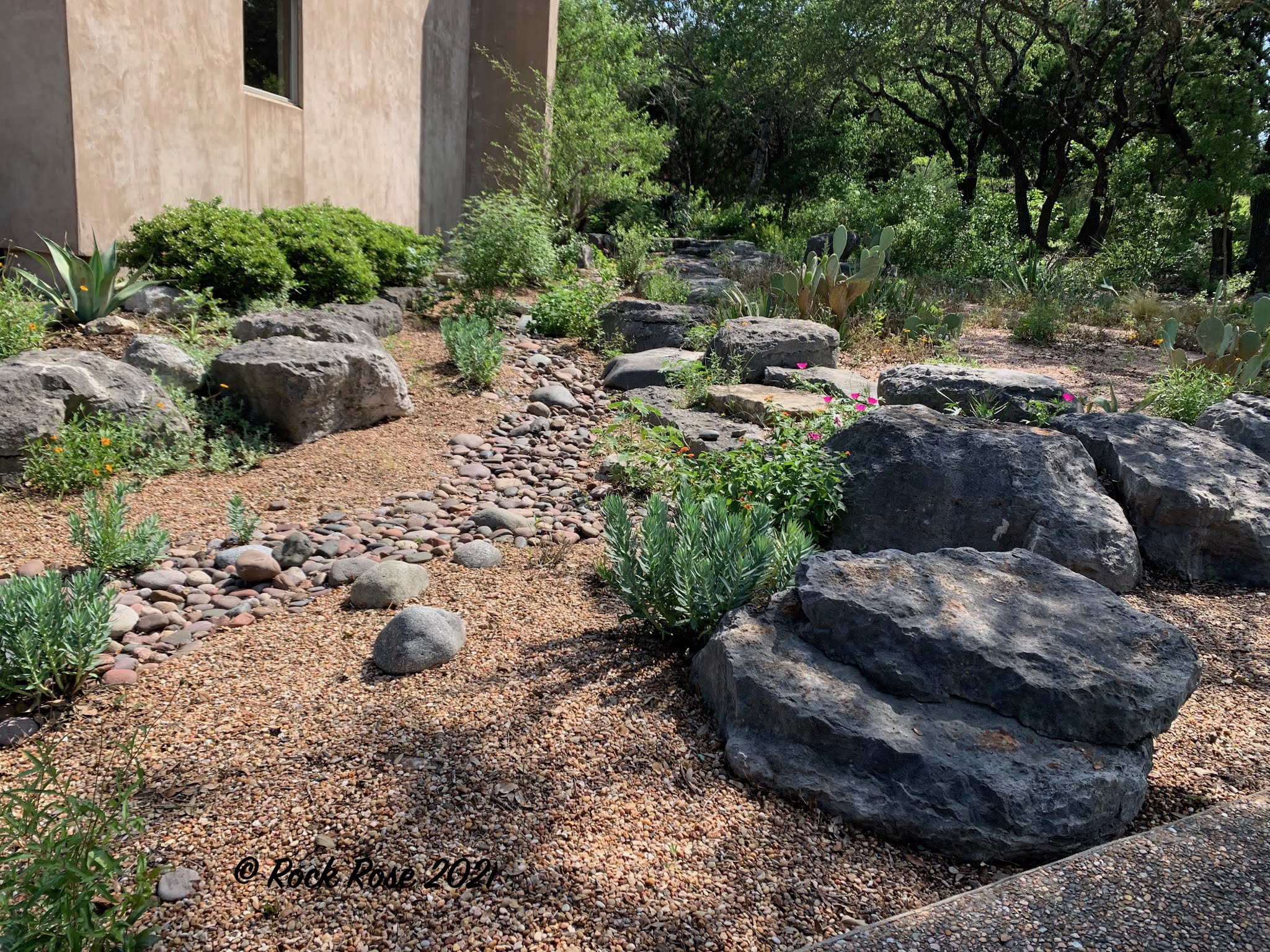
You may recall having seen this photograph earlier this year when the bluebonnets were at their peak. Who could not love this view of the front of our house? But what happened this year? In the past there were but a few bluebonnets in this dry creek. Almost all were in the larger area of granite to the right. It would suddenly seem that they prefer to be in the creek bed and I'm afraid I don't care for all the work that is involved in their removal from the rocks.

It took 2 hours to remove them followed by another hour of blowing and collecting. And then a further pass with the blower.

 On the second day I moved to the area closer to the entrance pathway. First the bluebonnets removed , then the raking of a mass of oak leaves secreted under the bluebonnets and then blowing and gathering. 

And in both areas there were other plants to remove, such as woolly stemodia, Stemodia lanata, that had crept over the wall and set down roots. lantana, Mexican feather grass, Stipa tennuisima,  and weeds. A few like gopher plants, Euphorbia rigida,  and trailing winecup, Callirhoe involucrata, and the native lantana , Lantana horrida, were allowed to stay-for now! 

David took care of the oak sprouts which have really taken over since we removed the failing oak tree. Nothing will stop them.

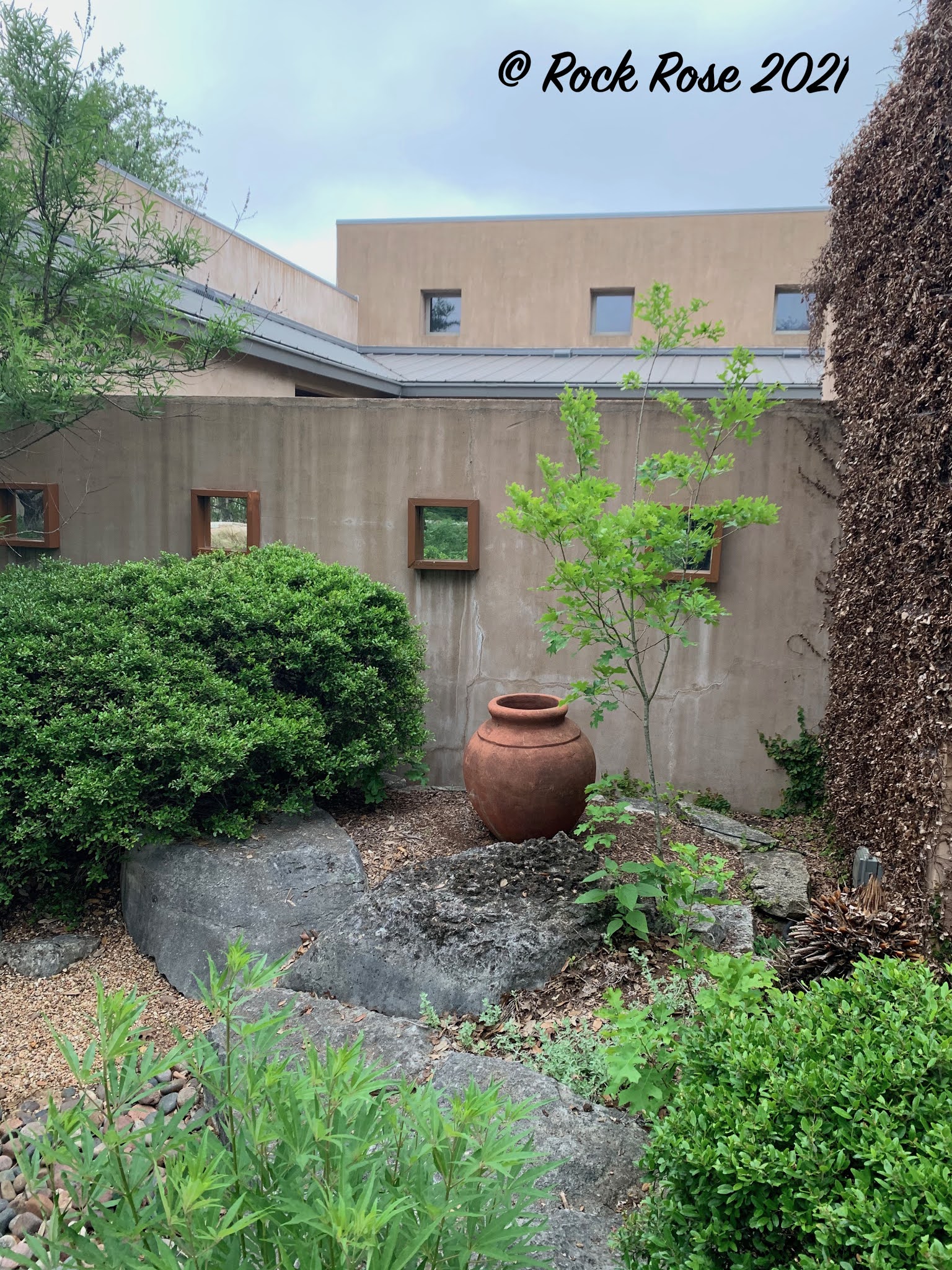
That accomplished I turned my attention to a bare spot in the corner of the wall. The Anacacho orchid tree, which over the years, had failed to thrive ( probably my fault) expired during the winter. But as luck would have it I had left the little oak tree that had seeded there and I moved a large pot that, was hidden among the trees out at the front, into the bare spot.  
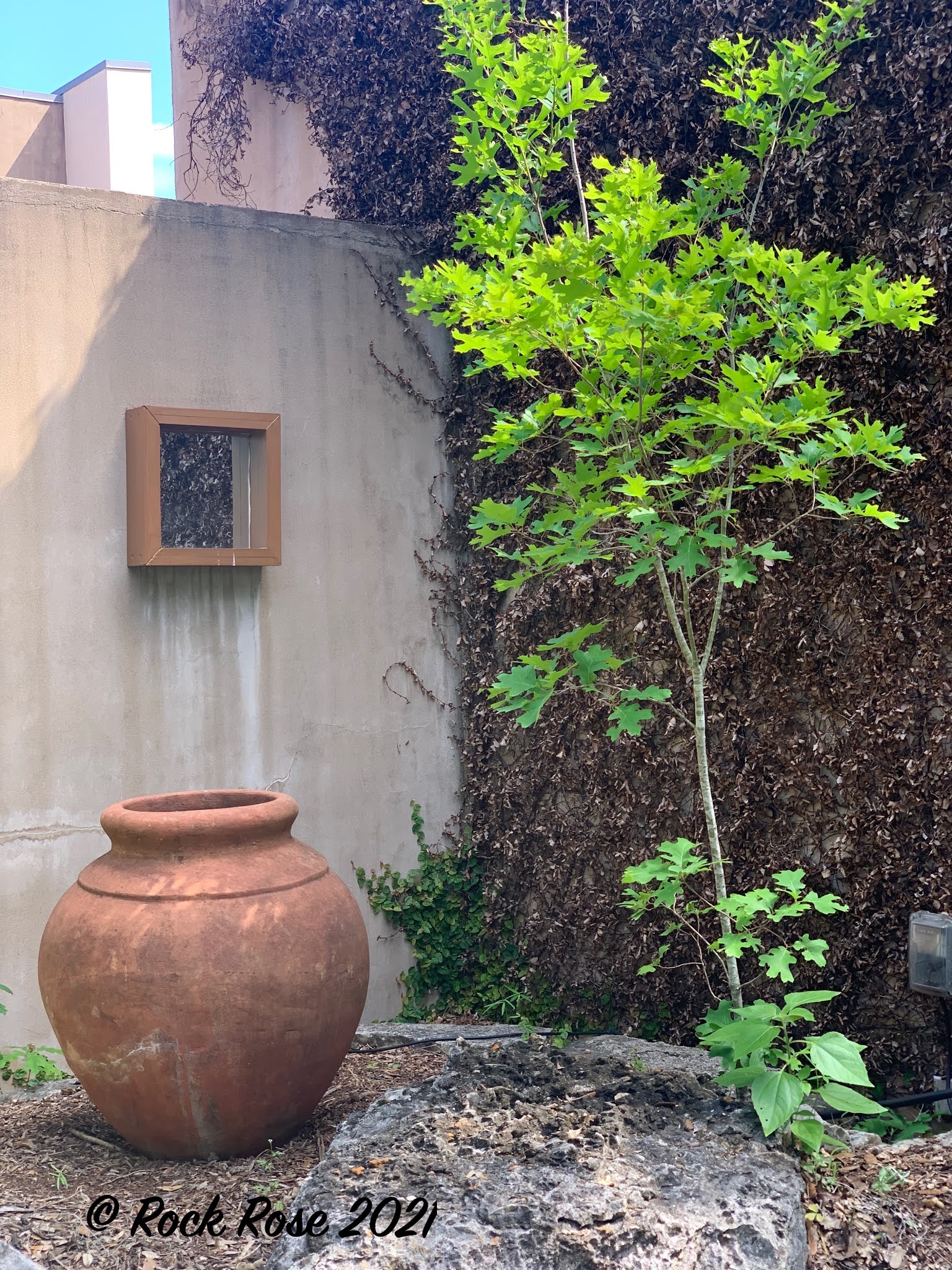
And the color of the pot is a perfect match for the mirror boxes on the wall.

Just the dead fig ivy yet to remove!

And onto the much larger area, once a parking area. The removal of bluebonnets,  raking and blowing of oak leaves plus collecting and disposing took 2 days. Then the weeds. 

As you can see there are just a few plants remaining none of which are very inspiring but I will leave for now. The only plants that are sure to stay are the 4 plains zinnia, Zinnia grandiflora. How I wish there were more. I must look for seeds because the plants are never available at our local nurseries, and they bloom all summer long.

A few prickly pear, A. lophantha and liatris have survived and there are also a few rose campion, Lychnis coronaria, liatris,  and Liatris spicata, which have been pruned by the deer but the other plants have been safe so far. 

I have plans! We have some large flat rocks and I would like to make a walkway through this area with just a few select plants. I realize that it is not the desert but this is a garden I saw recently in Tucson and which I love. Surely I can do something similar? I'm definitely going to try. David!!!!!!