My Blog List

Saturday, November 20, 2010

TWIT TWOO WHO WHO!

Listen to the great horned owl, Bubo virginiatus, twit twoo whoo whoo. I heard him this morning, high in the Spanish Oak tree above our bedroom, as a faint light was creeping into the morning sky. He called a few times and then was gone. Off to hunt for his breakfast.
A couple of weeks ago, when I was just getting up, his call was so close to the kitchen I went outside, with camera in hand, and saw him above me on the parapet wall. You can just see the tell tale ears. As the camera flashed he flew off into the woods. Quite a sight.

Friday, November 19, 2010

A VISIT FROM OLD JACK

I always pay attention when the weather man says there is going to be a freeze in the hill country but not in the city. We are only 7 miles from downtown, but frequently the coldest spot in the area. So last night I covered and brought in and picked.

I picked all the peppers, squash and tomatoes.

Glad I did.

Some plants, like this Berggarten sage, don't mind the dusting of ice crystals.

But the basil is a different matter. By tonight the leaves on this plant will have turned black.

The bees will no longer want to visit the flowers on this Thai basil plant, which I photographed yesterday afternoon. This weekend I will have my work cut out pulling out all the damaged plants. Winter is finally on the way.

Monday, November 15, 2010

GARDEN BLOGGERS' BLOOM DAY NOVEMBER 2010

Welcome to bloom day in Austin Texas. Stop by at May Dreams to catch up with what is blooming in other gardens.

November is a special time for three plants in my garden. First, the Philippine violet, Barleria cristata. Dying back down to the ground every winter, it takes time to fill out into a rounded 5' bush before bursting into bloom.

The copper canyon daisy, Tagetes limmonii.

Seen here mixed with gomphrena.

The Mexican mint Marigold, Tagetes lucida. Sometimes used as a substitute for tarragon. It has a tendency to be a little invasive. Here I have allowed a plant to grow in between the pavers in the herb garden.
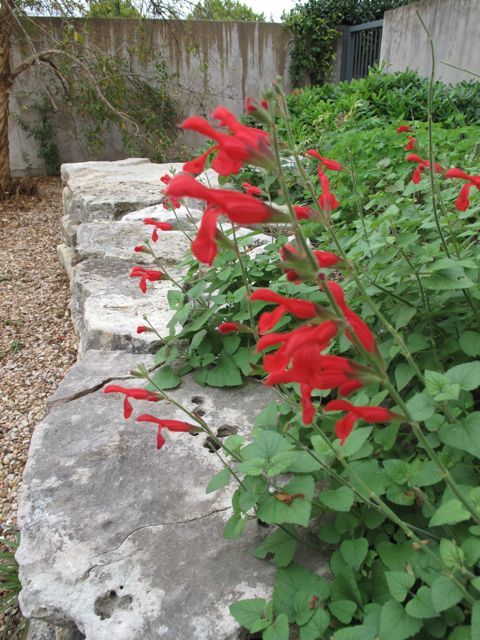
I'm not actually sure what this red salvia or where it came from. It spreads by underground runners forming a green mat and sending up spikes of red flowers from time to time. It seems to flower better during the cooler weather. Thanks to one reader, now identified as Salvia darcyi.

Cat's whiskers, Orthosiphon aristatus, still blooming, but with smaller spikes.

Blanket flowers, Gaillardia aristata, never seems to stop blooming.

This one came back true to the parent plant, which was a hybrid I grew last year. It found a home in between the vegetable beds and of course I let it stay.

And still the cone flowers, Echinacea purpurea, keep blooming.

and the little flowers of the snapdragon vine among the chile pequin.

Wright's skullcap, Scutellaria wrightii.

Wait a minute! This leather flower, Clematis pitcheri, shouldn't be flowering now.

and it is far too early for the Carolina jessamine, Gelsemium sempervirens. However, at the Wildflower Center on Thursday I saw an Anacacho orchid tree in full bloom. Clearly, others are experiencing this out of season blooming. I wonder what will happen in the spring!
Happy Bloom Day.

Friday, November 12, 2010

THIS AND THAT

Cone flowers, Echinacea purpurea, often look rather pale before their petals fully open but they always end up the same old purple. So this flower has really taken me by surprise. It is in the front rockery, where several cone flowers popped up this year, all of them pink, except for this one. I am delighted.

I have been pulling out cone flowers all week long in the back garden. Around the pool they just like to take over and, delightful as they are when blooming en masse, they are invasive. No matter how many I pull they will be back again next year. More white ones please!

I also bid farewell to the cleome, Senorita rosalita, but not before picking her final blooms to use in the house. The only negative thing I have to say about this flower is that it has a slight skunky smell. This was only evident when I brought the blooms in to the house. I'm pleased to say not detectable in the garden. This will be on my list of to buy plants next spring. This plant was in full sun and full sun in Texas means full sun.

The least colorful of my gardens is the front courtyard. I probably don't pay it enough attention. I am also trying to cut back on the workload by planting only those plants which grow easily, with little care and attention and less water. It falls to the members of the agave and cactus family and other less fussy natives. Here an A. augustifolia among several barrel cactus. narrow leaf zinnias peeking through in the back ground.
I have a major project underway in the front courtyard but more about that later.

Thursday, November 11, 2010

A POPPY IN REMEMBRANCE

Today, 92 years after the first world was ended we remember all who gave their life for our freedom.

Wednesday, November 10, 2010

IT'S A MISTY MORNING IN BARTON CREEK

And my garden is just loving it.
Lapping up all that moisture in the air.

In preparation for another November 80 degree day.

But change is on the way later this week.


Monday, November 8, 2010

MONDAY HARVEST

I still have a few summer crops producing well. Patty pan squash started 6 weeks ago, Juliet tomatoes seeded themselves and are a tremendous producer. Small but tasty. Peppers seeded themselves from last year. Not the prettiest but they taste OK. A fresh crop of Swish chard and radish( that purple one is a stray and my name for it is jalapeno radish!). Peas are in flower and I hope they produce before we have hard freeze.

Sunday, November 7, 2010

AUSTIN NATURE CENTER

Looking up, through the leaves, into the clear blue Saturday sky.

But these leaves won't be falling this year. They are part of a metal archway leading into the Austin Nature Center.

Yesterday our grandson was in town and along with his dad we spent a couple of hours exploring the center.

Inside the visitor center they have a room full of skulls, beetles, fossils, skins.


Take a look at these antler-like objects. This months challenge. Probably not a seed pod because there is no way for the seeds to escape.They are hollow, light weight and probably some protective device on a plant or tree. Any ideas? I just spent 15 minutes on google and didn't come up with the answer.

Someone in the lab collects owls! But there are real owls to see too; barred owls, screech owls and great horned owls, all rescued from the wild. Some with broken wings others who had lost their sight. Among the rescued wild animals are red and grey foxes, raccoons, a coyote and a bobcat. There's an amphibian and reptile house and several trails.

Getting sand out of shoes after a visit to the dinosaur pit.

A helping hand to cross the creek.

And finally a yummy drink at the Austin Juice bar. A fun afternoon for children and adults alike.

Thursday, November 4, 2010

TIME TO SAY GOODBYE

Earlier this week we bid farewell to 2 large vitex trees. Today it was the turn of the Celosia spicata. Some of the plants were over 6' tall and, quite frankly, were getting in the way. It was time to bid farewell to them too. But not before I cut of the flowers and brought them into the house.

What I didn't realize was that several bees were overnighting on the flowers and in the morning cold were still dozy. That was, until they came into the house!
Celosia has been a regular visitor to my garden for the last few years. I always allow a few to grow because the flowers are so beautiful and the dried flowers make wonderful arrangements.

In Texas seedlings grow so quickly that just a month ago I cleaned out everything in this bed. The native orange cosmos are back again.

I couldn't garden without the zinnias.

Spilling over the pathway in the vegetable garden. The warm fall days have brought a myriad of bees, butterflies and moths into the garden.

You can see I haven't walked between these two beds in quite a while. Eventually when winter sets in only the mullein will remain. That event is probably not far away now, as we had frost on the roof earlier this week.

The ruby crystals grass is one of my favorites. Unlike the Mexican feather grass its pink seed heads blow away in the wind instead of forming a tangled mass. The plant stays green all summer without supplemental water but as soon as rain comes it starts growing and produces a new flush of plumes.

One trial Cleome X Senorita Rosalita this year. More next year. It's a Proven Winner!

Wednesday, November 3, 2010

BEWARE THE VITEX

Few plants are more troublesome to remove than the vitex. Just ask David. This is the second one he has removed this week. The first one, by the front corner of the garage, took him three days and 2 chains on the chainsaw to remove. Those roots run deep and required removal of a section of retaining wall in order to dig down far enough to sever that tap root.
The second one at the end of the driveway took less time but still put up a big fight.
When he finished the job he said to me, "This time our family motto didn't apply". What's our family motto? Initium es diminium factore, which translates as half the battle is getting started. Starting this project was certainly not more than half the battle!

While David was busy with his battle I have a more long term battle on my hands. Don't think for one minute that this grass looks pretty in the evening sunlight. It is ugly King Ranch bluestem. An invasive bluestem grass introduced as cattle feed and planted along the highways in the 1930s. It found its way onto my lot a few years ago and despite all my efforts I have been unable to hold it at bay. It has crowded out many of the finer native grasses even threatening the basket grasses which grow in huge clumps along the escarpment. There is no easy way to get rid of it save to cut off the seed heads and follow up with herbicide treatment when spring growth starts. That's where I was all weekend-cutting off seed heads.