My Blog List

Monday, July 20, 2020

OUR WEEKLY TRIP TO THE WILDFLOWER CENTER

When the Lady Bird Johnson Wildflower Center reopened a few weeks ago, with special hours for members, I asked David if, instead of walking around the lake on a Sunday, he would like to go over to the Wildflower Center and walk the trails. Since that first weekend it has become a new destination for our Sunday walk. It is a simple matter to sign up for the tickets on line. No charge for members. We just have to get out of the house by 7:45am. Of course the sun is up by that time so I use my sun screen umbrella which is so much more comfortable than wearing a hat.


Over the weeks we have watched the changes that have taken place out on the trails from the blooming and fading of blanket flowers, milkweeds and rudbeckia to the arrival of later bloomers like the skeleton flowers and silver nightshades.

Asclepias tuberosa

Blanket flowers, Gaillardia pulchella
 Now plants have set their seeds and it is a quieter time out there on the trails. Only the fruits on the prickly pear add a dash of color to the now straw colored scene.


Areas are mowed according to their vegetation and mowing has begun.


One of the reasons we enjoy walking the trails, other than the fact that we more or less have them to ourselves, is listening and spotting the painted buntings. As one birder said to us last week, when I asked him for confirmation of what I was hearing, "They are everywhere" And then as we rounded the corner we could hear one singing in the tree and the beautifully colored male flew right across our path. I hear them in the trees at our house but rarely see them. Unfortunately David cannot hear them but he was thrilled to catch sight of this one.
The Research Trail and the Arboretum Trail combined are a good 2 mile walk and we usually add a little on by walking the gardens too. Because they are under irrigation there us more blooming there. There are large stands of partridge pea Chamaecrista fasiculata which is a great butterfly plant.


The Texas bluebell, Eustomia exaltatum is always one flower that, beautiful as it is, just seems out of place in the Texas landscape. I have only ever seen one out on the trails but I have heard people say they have seen fields of this plant. Sometimes called Prairie gentian it grows best in well-drained moist soils.


I sowed seeds of this Mexican poppy this year but they just did not survive in my garden. I will try sowing them outside this fall. They are growing in several places in the demonstration gardens but I think they may have been put in as transplants. This year I will try sowing the seed directly in the garden.


We continued our walk to the Family Garden where the large stands of Giant coneflowers are setting seed.

And passed the cooling waterfall. Always a favorite spot for children.


I always stop just inside the archway of the Auditorium to check on the delicate clematis, Clematis pitcheri. Still a few blooms.


It was time for breakfast in the shade of the oak trees. It's always quite a rush to get everything together in th mornings but this was the first time I had forgotten the plates. Not a problem since I new exactly what to do from an experience in the 1990s when we rafted down the Grand Canyon. First night out our crew told us that they had forgotten the plates and we would have to make do eating our meals off our ammo can lid-covered in foil. And that's what we did for the next 5 days. Today we had a couple of lids and we made do. My egg tasted just as good as ever as I had not forgotten the salt which was much more important than the plates.


Have a great week everyone.

Monday, July 13, 2020

THE BLOOMING

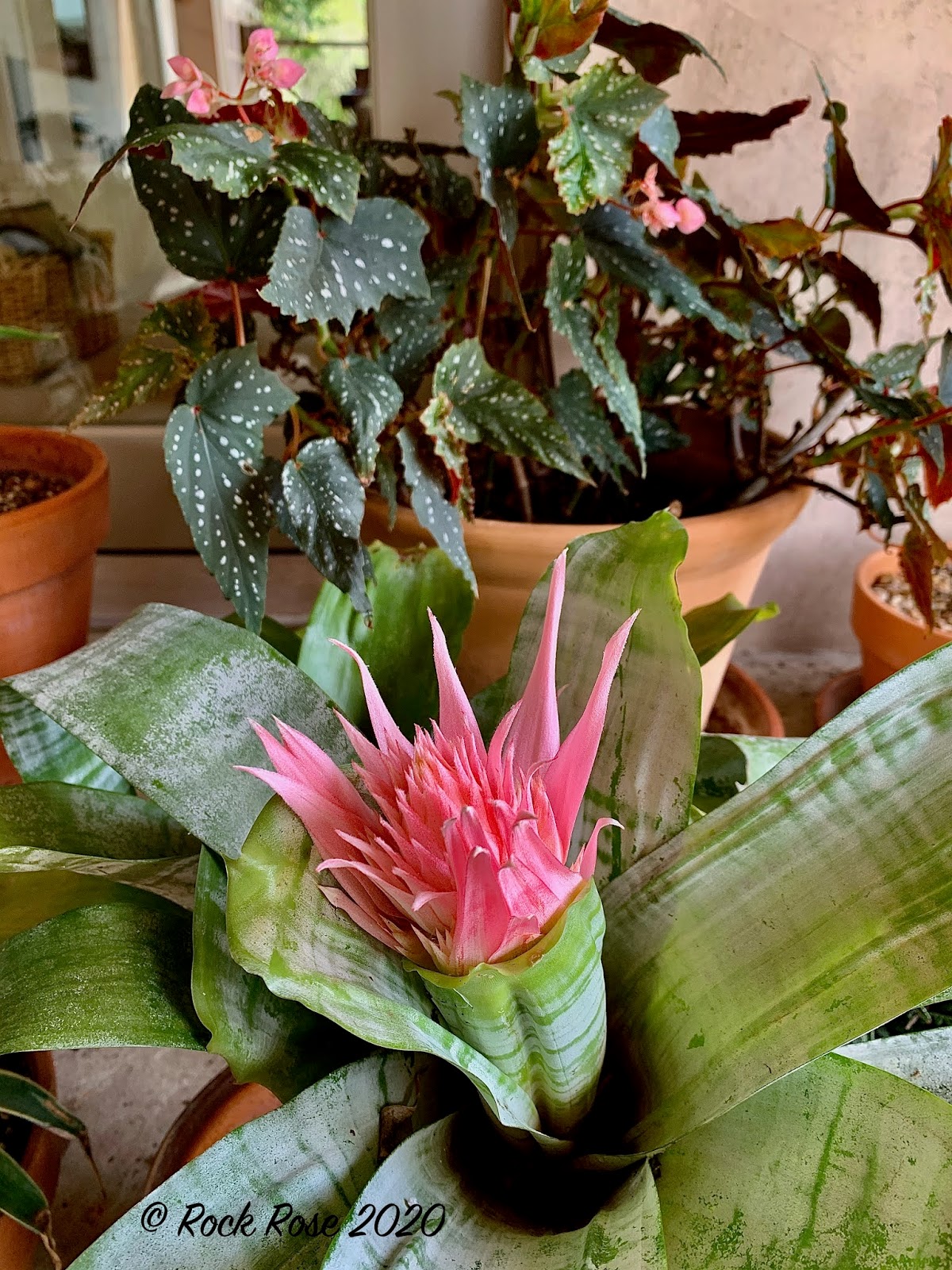
I was making the bed the other morning and thinking about how hard it is to garden in Texas. In fact the hardest place I have ever gardened.....and there have been many. Our climate for gardening is like no other, although some may take issue with this.  Sometimes it is desert-like with no rain for months, sometimes tropical with endless days of rain. Wet summer, dry summer, wet winter dry winter. Winters can be mild and tempting but then the next will kill all those marginal plants you planted. Somehow you have to strike a balance and find what works for you, taking pleasure in the rewards that come your way. That can take years of experimenting. It was at this point that I opened the blinds to look into the Secret Garden and there was one of those rewards. A flash of pink. The Aechmea fasciata, which I had put outside in the shade of the Pittosporum was blooming. I hadn't looked at it for weeks and all that time it was quietly preparing to bloom.


I have had this plant for years and only kept it because even out of bloom it is attractive. I never expected it to flower again thinking that this could only happen under greenhouse conditions. I rushed outside and brought it to its new home, where it can be appreciated. I certainly plan to treat it a little more kindly and will rinse out the cup with rain water every week as per the care instructions.


There have been many disappointments this spring, the greatest being the discovery of the agave weevil in the Yucca desmetiana 'Blue Boy' It has never done well and suddenly it started to look really sickly which made me decide to remove it and put it in a pot. It just came right out of the ground breaking off and exposing that hollowed out interior. There was the grub and then another. Three in all.
Agave weevil grub
I was able to cut off the top of the plant and will now try to nurse it back to health. And a week later I discovered another small agave, a few feet away, had met a similar fate. I am now feeling nervous about all the others, especially my beautiful Whales Tongue Agave, A.ovatifolia,  which is just a few feet away.
I quickly got over this because in the vegetable garden a nice surprise awaited me.  When I saw some kind of squash plant growing in the compost bin I moved it to the vegetable garden. It grew well but never produced anything other than a few tiny flowers. I guess it was just practicing because one morning a huge flower opened and very soon thereafter the identity of the plant was revealed. A butternut squash! No real surprise as we do eat quite a lot and of course the seeds always go into the compost.


So far so good on the squash vine weevil front. Maybe getting the plant in the ground so late has its benefits. Or is it ever too late for them!
As usual the tidy phase in the vegetable garden was short- lived. There is now a rampant growth of cucumber plants and Sakata sweet melon.


I was checking out the viability of some rather old seed packets by putting a number of them between wet paper towels. Every one germinated and I just couldn't bear to throw them away. I figured many of them would be eaten by the snails. I guess one or two was enough for them.

Sakata sweet melon


If you are not familiar with this melon Sakata Sweet has been a favorite in Japan and China for a long time. It is a small Heirloom melon, ripe when it changes from green to yellow. It is unusual in that the skin can be eaten. I hope that these ones from saved seed do as well as they did 3 years ago. They are growing alongside the cucumbers so I hope that will not influence their taste.
Every year will bring some new experiences in the garden, some good some bad but never give up. I haven't.

Tuesday, June 30, 2020

IT'S ALL ABOUT NEXT YEAR

Have you noticed how when each season comes to a close, and we have more than 4 in Texas, we are already thinking about that season next year. I have already made a decision about which seeds I will be sowing indoors next winter for spring and summer flowering. They are the seeds of successful sowings this year. It remains to be seen how successful they will be next year. This is number one on my list.


Out grocery store, Central Market, has a small rack of Botanical Interest seeds just inside the store and, as I always do, I checked out what they had on offer. When I saw this packet of Ammi, Dara, I snapped it up. We had just, that summer, returned from a wonderful trip to Europe and part of the trip was spent on the island of Guernsey. There, when we hiked along the cliff tops, were large stands of Queen Anne's lace. A reminder of the hedgerows of my childhood. There were plentiful stops along the trails to snap some photos and a little research when we returned to our airb&b.

Queen Anne's lace Guernsey
Queens Anne's lace Daucus carota, and Poison hemlock, Conium maculatum,  are very similar and it was interesting to learn how to tell the two apart, because the latter is deadly poison if ingested by people or pets. I am not likely to want to eat the roots of this plant any more than I would eat a wild mushroom unless it was from the grocery store. But I now know how to spot Queen Anne's lace. It has a hairy stem, which hemlock doesn't, its stem is green and that of hemlock is splotched with purple and Queen Anne's lace is the only one to have a single red flower right in the center of the umbel. You can see the red flower in the photo below.
There is a lovely story about Queen Anne working on a piece of lace when she pricked her finger and the drop of blood landed on her lacework. I think it might well be true.


And so to my packet of Ammi, Dara seeds. Of the 30 seeds I sowed only 3 made it into the garden, mainly through my lack of care, but I am thrilled by the performance of the ones I have.


They languished for a while and then suddenly they shot up and flowers began to form.


On the underside of the umbel you can clearly see the 3 pronged bracts which are another feature which distinguishes it from poison hemlock.


I did come across a little controversy about the naming of these plants. Queen Anne's Lace is Daucus carota and is always white and is native to Europe. Ammi majus, originates in the Nile valley and does not have the red flower in the center. It appears that many seed companies call the colored variety Daucus carota which it is not. These seeds I have should rightly be called Ammi majus Dara, false Queen Anne's Lace.


 I have great hopes for growing them in more places in the English garden next year. That is if the weather pattern we have next year matches this year's. Like many of the plants in my garden these have enjoyed a bounty of rain in the last month.

Wednesday, June 24, 2020

SISSINGHURST AND MORE

Almost a year to the day we stayed in the Kent countryside, at an airbnb, for a week of garden and National Trust visits.
We had visited Sissinghurst several time but never been to Knole, the childhood home of Vita Sackville West. That was out first stop on day 1.

Victoria May Sackville-West, known as Vita, heiress to 13 generations of the Sackville-Wests lived at Knole, which was at its height, one of the largest private house in England. But she did not inherit on her father's death because of an Elizabethan clause which said the house must pass to a male. Knole passed to her uncle. Vita was understandably upset and never went back there.

Knole 
We paid our first visit to Knole last summer although you would never have known it was summer by the gale force winds that blew us up to the entrance. Then it began to rain and I was thankful that we would soon be inside the warmth of the building. It is hard to imagine how cold and draughty it must have been in winter. Just like my childhood, with no central heating and only a fire in the main room. But we didn't know any better.
In the 1700 they installed a Buzaglo, coal-fired heater in the great hall. It was very expensive but the manufacturer claimed it would heat the whole room! They eventually moved it into the orangery where it remains today-restored but not functioning. I think they would have needed a crane to lift it. They eventually replaced the heater with a fireplace which must have been in the house originally.


I had paid and booked for a tour of the attics but we had to hang about waiting for everyone to show up-outside. Out of the rain and under cover but very cold. To say the tour was a disappointment was an understatement but I suppose it gave a realistic picture of some aspects of servant life at Knole. Most of the rooms held the discarded trappings of 19 century life, piled rather haphazardly in a warren of small rooms. The elderly guides could not find the key to the locked door that would have admitted us to the screened area above the great hall- but we did eventually get there by going up and down various stairs. ( I wonder if Vita played hide and seek up there) We eventually got to look  through small fretwork holes in the screen and down into the Great Room.

Carved entrance with fretwork screening at the top seen from below.
 Many attics in NT houses have long galleries with art work and this is how it used to be in the 17th century. Then the art work was removed in the 1700s and the Knole attics fell into disrepair.  As a girl she is supposed to have given  tours to house guests. The long draughty corridors were open to the elements at various places along the sides where the roofs came down to gutters. It was the job of servants to clear the snow from these in winter. There was some graffiti on the walls but nothing of real significance. The ceilings in the Retainers Gallery has been replastered but in the South Barracks they remain just as they were. Several fireplaces had been boarded up. I'm not sure how they would have helped with all the openings to the exterior. It was frigid up there even in summer.


 We then moved into the Upper Kings Room where we were told a little history of the carvings and marks left by superstitious staff on the joists. All to ward off witches.This room was above the King's bedroom which had been created for a visit by James 1.


A few artifacts had been found under the floor board including one letter of significance dating to the 1600s. Other than that most were wrappings and cigarette packets left by former workmen.
After we returned to the main hall we quickly did a tour of the main rooms of the house, with their paintings and furniture. and the orangery and beat a hasty retreat to the restaurant for a late, hot lunch. It was just too miserable to contemplate walking around the grounds.
Knole was gifted to the National Trust in 1946. A £19 million respiration was completed in 2019 although conservation still continues.
We were hoping for better day tomorrow when we would visit Sissinghurst.

Sissinghurst.


One of the most iconic of the English, Arts and Crafts style gardens surely has to be Sissinghurst. Visiting would be high on the list of any garden lover finding themselves in the Kent countryside. In fact it is the most visited garden in the country. The gardens were designed and planted by Vita Sackville-West and her husband Harold Nicolson, who bought the ruins of this derelict Elizabethan castle, in 1930. The sale brochure had described the property as " A farmstead of squalor and slovenly property"

Maybe it was a good thing that Vita did not inherit Knole or she and Harold would never have bought Sissinghurst, on which to work their garden magic. They began immediately to clear the land to make a garden, and when Vita's mother died in 1936 they had more money to spend on their dream. By 1938 they opened for the National Garden Scheme, twice a year, and by 1940 the garden was open every day.
Very little remains of the original Elizabethan palace but for the tower and the row of buildings which flank the entrance, but in the garden there remain walls which were part of the original palace buildings.


It was our third time to visit Sissinghurst and I was eager to see what changes they had made, having read that the garden had veered away from the original intent of the Nicolsons, which they planned to rectify.  Vita loved a relaxed atmosphere in the garden with plants spilling over pathways and self seeding annuals everywhere. Roses full and billowing. "Cram, cram cram, every chink and cranny" she wrote in 1955. Her white garden had become almost exclusively white and not with shades of gray as she intended. Over the years the whole garden had become more stilted and formal, everything neatly clipped and plants in more formal groups. Pathways were paved to accommodate the many visitors. The garden had lost its original character.

Vita charged a shilling to visit the garden referring quite kindly to the visitors as the 'shillingers'. It was something new to be handed a 'shilling'  for our entry into the garden. We handed in at the gate.


We handed ours in and proceeded into one of the small buildings to the right to watch the video and hear about plans for the remaking of the Delos Garden. Vita and Harold had visited the Greek Island of Delos in the spring of 1932 and had tried to create such a Mediterranean garden, without success. It was decided by the gardening team to remake the Delos garden. Dan Pearson was the architect chosen to do this. I was keen to see what progress they had made, but I would be saving that for later. Right now I was just anxious to see the other parts of the garden.


The original walls of the palace were put to good use in creating garden rooms.


Sometimes major work is required to keep plants healthy. Fortunately yews can take this kind of treatment.


I love Vitas stone troughs which sit along the walls of the building. I think I must find a way to raise mine so that they can be better appreciated. 


The best place to get an overall idea of the garden is from the top of the tower and we headed up there while it was still quiet. We passed by Vita's study, which you can no longer enter and up to the top.

Harold was responsible for the main layout of the garden creating the garden rooms but it was Vita's plantings which brought the garden to life. She would cram plants into every nook and cranny and allow self seeding everywhere.


The main entrance looking towards the farm and oast houses


One of my favorite parts of the garden has always been the herb garden, in particular the beautiful planter supported by three stone lions which sits atop an old mill stone. It is planted with succulents. The Nicolsons purchased the marble bowl in Constantinople on one of their many travels. And the paving that surrounds this area of reclaimed pantiles. The garden is sheltered by a high hedge which traps the warmth and the bench at one end is a wonderful place to sit on a warm day and drink in the fragrance of Mediterranean herbs.


Creeping thyme softens the pavers

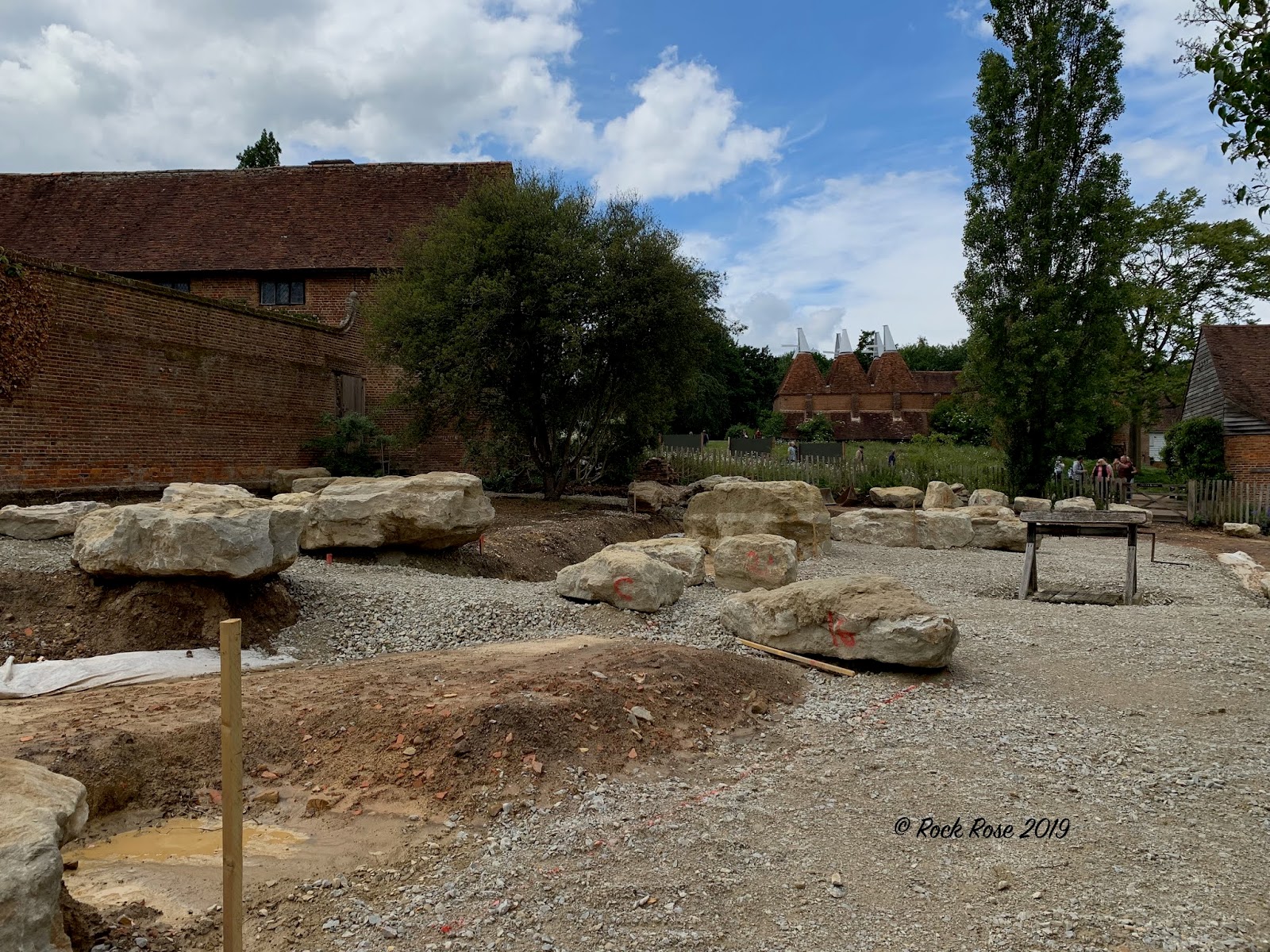
Finally we arrived at the construction site that was to be the new Delos Garden. I wondered what had been there on our previous visits. I think the area had become over run with bushes and trees and all signs of the original Delos garden eradicated. 
The Nicolsons were cruising in the Greek Islands in 1932, when they paid a visit to the uninhabited island of Delos. Steeped in Greek mythology, Apollo and Artemis the children of Zeus were born there and the island at one time  had been a center of commerce, culture and religion. The land is barren and rocky but supports a wonderful array of wildflowers which the Nicolsons were fortunate to see. They came home with a plan to create such a garden at Sissinghurst. Unfortunately the climate bears no resemblance to that of Greece nor to the soils of Kent. They added some old stones from the ruins of Sissinghurst to create a small wall over which plants could spill, a rough paving with little plants growing in the cracks and some pieces of Greek sculpture purchased at a house sale. The Delos garden flourished for a few years but the climate took its toll on the Mediterranean plants and small wildflowers like aubretia, saxifrages and tiny poppies. Even as it was becoming more difficult to care for she wrote about rock gardening on the flat in one of her columns in the Observer newspaper. But eventually the garden failed as the trees she had planted grew too large and by the 1970s it was replanted with shrubs and the stones removed and used as the foundation for the gazebo. 

The landscape architect chosen to design and oversea the work is Dan Pearson. You can read more about his project here 


And this is the preparation work required to achieve success the second time around. 


"The plants we will be using are those that are adapted to thrive in a Mediterranean climate. These adaptations include plants with hairy leaves, silver leaves, glossy shiny leaves, and swollen leaves.

Good drainage is critical, and to achieve this we are adding in excess of 300 tonnes of both 20mm and 40mm of drainage aggregate underneath a free draining formulated soil (made up of 50% aggregate, 25% crushed brick and 25% soil). We will also be using an 80mm deep layer of stone mulch. "

I suppose we were disappointed that the garden was still a work in progress but at least we had the opportunity to see the site. Who knows when we will get back there to see the finished garden but I am sure this time the garden will survive and will become one of my favorite parts of the garden.


It is always good to see a garden change and move forward although this time it is a move back in time but in parallel. Sissinghurst is one of my favorite English gardens and I think it is because I have very similar ideas to Vita's about what I love in a garden: the self seeding plants, the slightly untidy look, the stone troughs, bringing back ideas from other lands. Not all of it works, of course. 

Sunday, June 14, 2020

EARLY ONE MORNING , JUST AS THE SUN WAS RISING

When I went out into the garden this morning I couldn't help but think of an old English folk song which begins  "Early one morning, just as the sun was rising" I learnt this song when I was very young and have come to learn that it was one of the most popular songs for young women in service to sing in the 18th century. The maids were mourning their lovers who were going off to war.There was no maid singing in the valley below but there was a song in my heart over the beauty of the morning.

Surely for every gardener this is the best time of the day.  The cool morning air, plants recovered from the prior day's heat, everything looking its best. Ready to face another hot Texas day.


I always go first to look at the sunken garden because the sun will make its first appearance here and with no shade it gets hot very quickly. It is amazing how differently the sun strikes the garden in the summer.


In winter the sun rises well to the left of the potting shed but now it is coming up over the greenhouse. The gap in the trees means that it eneter the garden just than bit sooner.


Soon it will flood the patio giving the cactus and succulents a few hours of sun which they seem to prefer.


Up the steps into the English Garden and a quick look back over my shoulder.. The sun is coming up over the trees.


 On summer mornings we can no longer eat breakfast on the dining patio. It was one of the reasons we created a patio dining area in the English garden where the high wall shades the garden until about 9am. As this was one of the last gardens we made it gave us the opportunity to watch the sun at various times of the year and help with the design of what we wanted from the garden. We shall be having breakfast here this morning and every morning as long as it is not raining.


It is a very green and serene area, looking towards the house, with just a few blooms of the Mandevilla vine which survived our mild winter. In the other corner the plumeria which spent the winter bare root in the garage. Flower buds are just beginning to develop.


 Of course having created a theme with the sun and moon archway I can't really complain about the sun. Time to get breakfast on the table.