My Blog List

Saturday, September 26, 2020

A BUCKET A DAY KEEPS THE WILDERNESS AT BAY

 I think I would somehow feel cheated if I didn't pull out at least one bucket of vegetation every day. It is what I do best! When I analyze my style of gardening it is to allow plants to grow with wild abandon. Self seeding plants everywhere and plants allowed to remain until even I find it necessary to bid them goodbye. That takes a lot but it does eventually arrive. And every year I look on enviously at my fellow gardeners with their well-managed borders and thriving plants and wish I could do it that way. But I am trying and maybe two buckets a day would get me there.


This week I started to pull out Gomphrena 'fireworks' as well as some of the many ruby crystal grasses in the herb garden. I like to have a few plants growing between the pavers but by the end of summer it becomes too many. The Ministry of Silly Walks has nothing on how we get from A to B in this garden. And in every other garden too! While in that area I tackled pulling out one of the clumps of society garlic. It is actually growing in one of the herb beds but unlike the real chives (not garlic chives) it is prolific in its spread. The roots had become so intertwined that in the end I had to use a pick axe and even with that I left a lot of roots behind. A quick text to my new neighbor to see if she would like some and she did. I am more than happy not to have to put them in the garbage can.

It leaves a nice space to add some new herbs for the winter, like parsley, chives and maybe some dwarf sage-if I can find it and of course some edible flowers like calendula and violas. The one dwarf sage plant, Salvia officinalis minum, I had died this summer. It was so well behaved that I regret its passing.

 Further along I have removed the purple basil which did not like the rain. Cilantro is beginning to germinate from last years seeds. I had to break a little piece off the seed leaf and roll it in my fingers to smell it. Yes! Cilantro. I did the same with another seedling growing in between the pavers-definitely parsley.

It was a bad year for my various thymes. The lemon and variegated thymes did poorly. Only the culinary one seems to make it from year to year, which is a good thing because I use a lot of both fresha nd dried thyme in cooking.

I'm hoping the Mexican mint marigold will flower this year as last year, for the very first time, it failed to flower. I don't see any flower buds yet.

I moved around into the front of the house to tackle a rather large agave that was in the way.  At one time we could walk across the creek and up some steps into the granite area. Delightful when it appeared from beneath the rocks it was now too big and impeding the way.

 If you have ever had the need to remove an agave then you know the only way to tackle it is to cut off the leaves one by one. I use a serrated knife. I suppose you would call that the easy bit of the job.
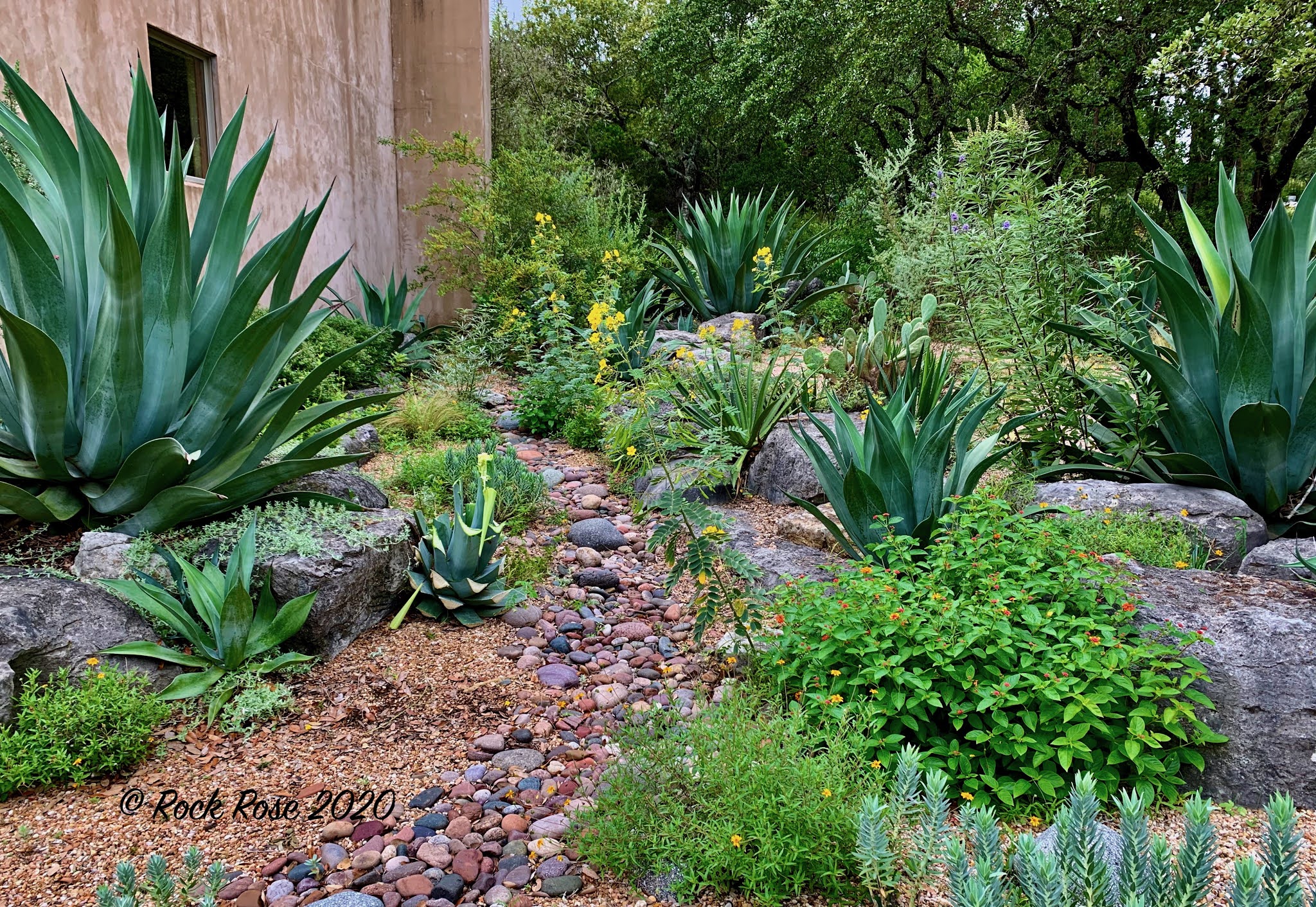
 Now to find someone to do the hard bit. David! And even he complained how difficult it was because the plant had come from up above and its root was firmly wedged under the rock. 

But there is more to be done. This one needs to go too so that once again we can walk up the steps.


But that will have to wait for another day. The buckets are full.


Tuesday, September 8, 2020

OXBLOOD LILIES Rhodophiala bifida

Oxblood lilies, Rhodophiala bifida, are such a common sight in our gardens and on garden posts at this time of year that I was almost hesitant to write about them. Surely everyone knows about this truly delightful fall-flowering bulb. However, there are plenty of newcomers to Texas every year and frequent new questions on Facebook asking for an id, so I  thought I would share the ones growing in my garden. They all came as pass-alongs. 


By far the largest grouping I have is in the Secret Garden.


Sometimes called schoolhouse lilies or hurricane lilies they are the harbingers of the cooler weather to come. Watering with irrigation will not make them bloom but when rain is accompanied by a drop in temperature and pressure they will burst out of the ground and into bloom. My first passalongs came in flower with their bulb attached and with instruction I put them in a bowl of water to enjoy in the house until the blooms faded. As the flowers come first followed by leaves, which remain all winter and well into summer, when planted after the flower fades they will have plenty of time to bulk up the bulbs for next year's flowering.

It was only yesterday that I noticed one in the Front Courtyard garden tucked in behind the daylilies and the phlox, Phlox paniculata 'John Fanick' I think I may have put one or two of the originals in there and then moved most of them.

I have decided that this was a perfect place and combination. The day lily 'Tiny pumpkin' blooms early on in the year, the phlox comes into bloom into the summer tolerating our Texas heat and humidity well, and finally the Oxblood lily takes the show into the fall. And its strappy foliage will be hidden during the winter through early summer. Always one of the problems with bulbs. Coupled with spring flowering love-in-a-mist and rose campion I think I may have finally settled on a planting scheme that works well for this area. I have also seen a stunning planting in among Mexican river rocks along a driveway edge.

If you purchase or receive oxblood lily bulbs then plant them about 3" deep. They are fuss-free and do not need rich soil. Just sit back and watch them multiply.

Monday, September 7, 2020

TIME FOR SOME TIDYING

When one of my gardening friends wrote, "Nothing lasts forever",  on a recent garden post I couldn't help but say "Well spoken" Two weeks ago I had given  David permission to remove the flowering Senna tree in the far corner of the Front Courtyard. It was never happy there even though it had planted itself many years ago. Being in the shady corner it tried to reach into the sun and being a fast growing tree meant weak wood. The main trunk was beginning to crack and some rather nasty looking brown stuff had oozed out and dried. I had enjoyed it for many years partly because it was visible from the living room. It also provided safety for the cardinals who came to drink from the bird bath beneath the tree. Leaning over and constantly dropping leaves it seems it wasn't even worthy of a good photo..... and yet still I had let it remain. 


It had almost fallen down in a strong storm and had to be staked. More and more falling leaves found their way into the dry creek. It was definitely time to bid both the tree and the mess farewell. And so I asked David to remove it. Being the tidy one among us he wasted no time. 

The big job was to tidy up all debris and fallen leaves in the dry creek before the rain came. And the clean up involved removing seedling inland sea oats, violets and ruellia, and some rather large liatris.  If there had been a place to walk there was no longer. A clean sweep. Both the garden and I feel so much more able to share a photograph of the cleaned-up space. I moved the bird bath because I doubt the birds would visit unless they felt the protection of a tree and the feeder now hangs under the the yaupon holly tree. t is only there for show after I discovered mice liked to climb up and feed too.

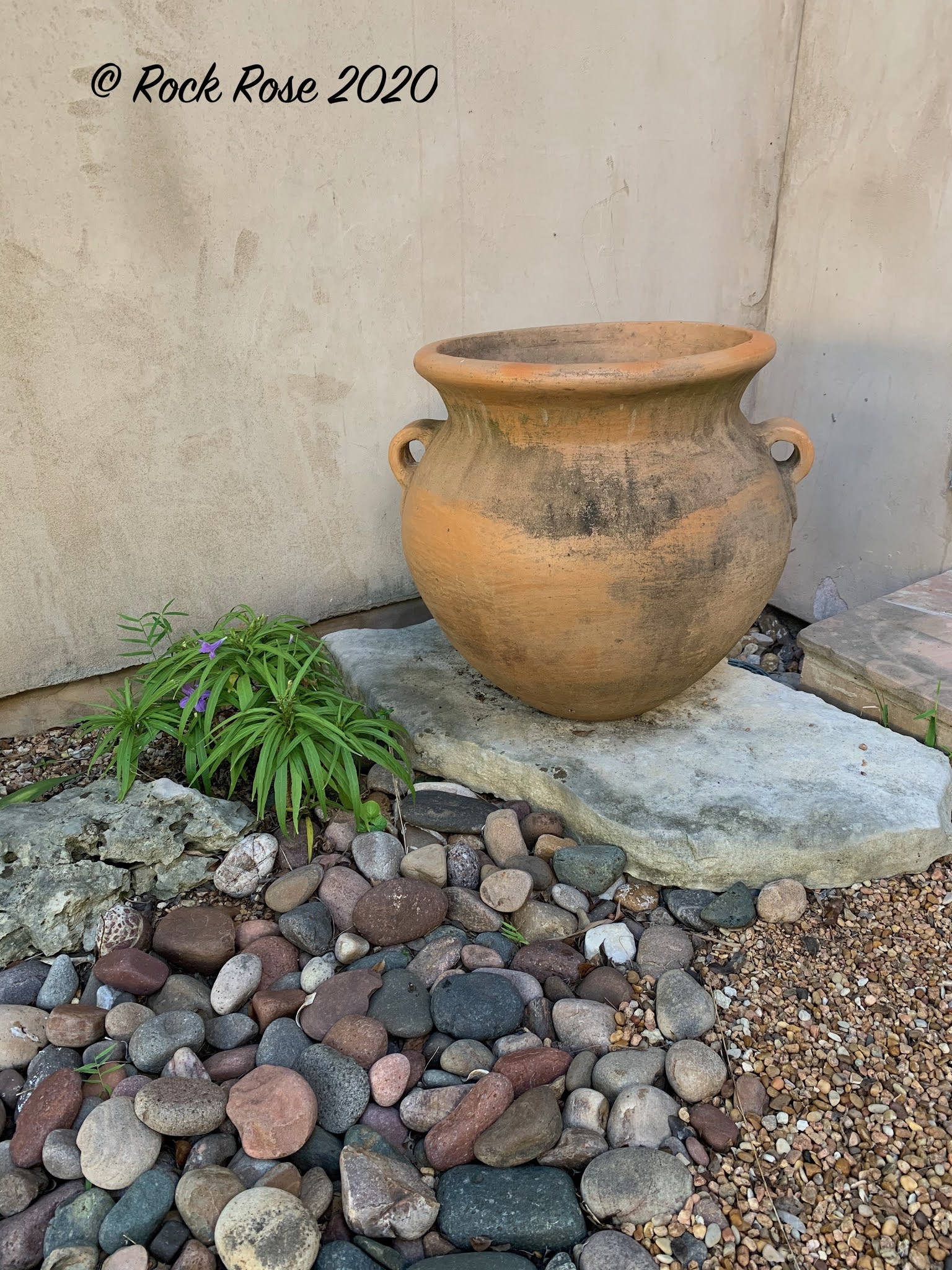
I stood back and looked at the corner realizing that it needed something in there to replace the bird bath. I started to think about what I could put in there to fill the void left by the tree. I took a wander around the garden to see what I might have. There is already a large pot in the other corner, a pot that I have never planted because it had always looked fine with nothing in it. I briefly thought of moving it over.  In retrospect I should have tried that first.


Then I remembered the pillar (half of a bird bath I had picked up somewhere) with a clay planter on the top. It was outside the gate so I lugged the two pieces in and stood back. Not right! Even if I gave it a grey wash. The problem is having two upright pieces. They fight with one another. So now I'm thinking I could put the old bird bath back and just put a plant in void. Maybe the birds will come anyway because they can fly into the yaupon for cover. Or maybe can find a suitable small bush or even a grass to plant there. One that doesn't drop leaves.

For now the planter and stand stays until I have had more of a think. And the rain came and I gave myself a pat on the back for having got the leaves cleaned out and those huge trailing liatris in the path. Those giant tubers found a new home in someone else's garden. The gravel and stones are all washed cleaned and ready for another year.

Wednesday, September 2, 2020

SOMETIMES THE NATIVES ARE TOO FRIENDLY

You know how plants can suddenly become a nuisance and just won't go away. I'm talking about a few Texas native plants that I have unwittingly allowed into my garden. First on the list is the American beautyberry, Callicarpa americana. 15 years ago I planted one outside the walls of the garden under the oak trees. Right plant right place.


Shortly thereafter one appeared in the front courtyard along the back wall. I was really excited. There it remained for several years until even pruning it back each year just didn't seem to control it enough. I got out the pick axe and took it out. It was not the end of it. 


Who doesn't love those clumps of berries that begin their life as a tiny unobtrusive flowers, morphing into tightly grouped bunches of delicious looking berries. If only we could eat them. I haven't tried but by all accounts they are quite medicinal in taste. But......delicious to many birds including the mocking bird. And therein lay my problem. Just inside the garden wall and towards the front grew, and I use the past tense, a fabulous Lady Banks rose. Its gorgeous blooms enchanted us every spring.  It was a haven for birds who found great shelter in the branches, which grow at peculiar angles making a dense tangle. And every winter as long as I can remember a mocking bird has found a home in there. It can't possibly be the same bird but somehow or other one bird will find a winter roost there. No doubt he saw great pickings in my garden because not only were there beauty berries but a yaupon ( another seeded tree) had grown up right by our living room window and providing a plentiful supply of winter berries. Last winter that bird tried our patience to the extreme. It would land on the tree and see his reflection in the window and promptly fly at the window, landing and pooping on the window ledge. We tried hanging old DVDs along the window but nothing would discourage the bird from throwing himself at the window several times a day. Not only that but when visitors were leaving at night it would suddenly begin a frightening squawking sound. 

It was a difficult thing to do but 3 weeks ago David began the painstaking job of removing the rose. The decision was made easier by the fact that since we had the terrible hailstorm 4 years ago the tree had had a difficult time recovering. There was so much dead wood underneath which had been supporting the new growth that the decision was made to remove it. It is sad that the birds would no longer find safety in the branches but I will not be unhappy if we don't get a mocking bird this winter. 

With the rose spout of the way I could get into the garden and begin clearing all the beautyberry bushes that had been seeded over the last couple of years. I didn't want to risk any of those berries falling to the ground.


Here's another good planting at the Wildflower Center. Planted under large trees is the perfect spot. 

The job isn't finished yet. I need to get the roots out and that is going to take another morning with the pick axe. At the same time I have at least 6 Texas mountain laurels to remove. Yes, there's another plant that does a little too much of its own planting.

Thursday, August 27, 2020

CAN YOU TAKE ANOTHER WEEK OF TRIPLE DIGITS?

 It’s no surprise to Texas gardeners that we are in for another week of triple digit temperatures. They will likely be around for quite a while before we start to feel that little breath of cooler air in the mornings.  This morning I asked my garden if it can hang in there for a few more weeks. I am always amazed how refreshed the plants can look in the early morning hours. At the end of the day not so much. We really have to give the plants their due as so far we have had 23 triple digit days in August with nothing less than 93ยบ and still they soldier on.

 I am slowly removing the spent blanket flowers. When the goldfinches have had their fill I will be hoping they haven’t been too tidy with their eating habits. I’d like some for next year. At the same time I am culling some of the ruby crystal grasses Melinis nerviglumis, and the Mexican mint marigold, Tagetes lucida. The latter makes a lovely small bushy plant which blooms in the fall but it is a prolific re-seeder. I cut it back to the ground in the late winter.

 One thing about the sunken garden is it mostly plants itself. Not always in the right places of course and often a little too much of some plants than I need. For instance, zexmenia, Wedelia acapulcensis var. hispida. But as long as I am around to tend to the garden then the visual effect is to my liking. However hard I try the sunken area will not accept nursery grown plants.

 I have better success with adding plants to the upper level and this year I have plans to reduce the numbers of plants growing there. More blackfoot daisies, Melampodium leucanthum, like this one. I'm usually a 4" gardener but I chanced to buy a rather healthy 1gallon plant at the grocery store this spring and it took to its surroundings quite happily.  It is shaded a little by the fragrant white mistflower, Ageratina havanensis. It is my plan to remove the mistflower in the fall as it is far too big and crowding out some more valuable plants.

Backfoot daisies seed quite well in the English garden gravel but never look quite as healthy as the one above.

I should have given these ones a light trim several weeks ago but sometimes that is a risky thing in this heat. 

Tropicals just lap up the heat like these beautiful tree-shaped potted plumerias in the English garden. I am more than happy they are white but would love some of the colored ones. They have now reached the most perfect size but I have concerns about what to do with them this winter. I don't really want to start all over but even without pot, soil and leaves they weigh a ton.

In the right foreground the Philippine violet, Barleria cristata,  waits patiently for its time to bloom. The once single plant is now three separate plants and another one has seeded by the edge. Such a wonderful plant that seems to attracts no bugs or diseases. I am happy that there are at least 3 more that have seeded themselves around the garden. This one along the edge of the patio above the sunken garden. Fortunately they die to the ground in the winter or they would be monsters.

But like the Philippine violet I wait patiently for the the temperature to drop so that I can get out and work in the garden.

Thursday, August 20, 2020

DON’T BE SO TIDY IN THE GARDEN

"Don't be too tidy in the garden" I have heard these words spoken many times before by well known gardeners and horticulturalists. It gives me an excuse to be the gardener that I am. Someone who loves the cottage garden look and can never pull a plant out until it just screams to be gone. Even when a plant no longer looks at its best it may still provide a meal for something. 

These are the spent flowers of Verbena bonariensis. They have been blooming for weeks and a few tiny flowers still remain even through the plant has gone to seed.

Those tiny seeds, and they are almost microscopic, are the reason I am leaving the plant a while longer. Every evening we enjoy the antics of the American goldfinches as they swing and do their acrobatic tricks on the stems of the plants. Many of the long stems are bent double and nearly touching the ground but the finches are so light and agile that they manage to stay balanced on the stem as they pick off the seeds. 

Easier to manage are the seeds on the blanket flowers, Gaillardia pulchella, which are more than happy to grow anywhere they can find a foothold. 

Not looking their best after days of 100° but the finches are not interested in looks. They are interested in the ripe seed heads. Many of them are just picked clean. Fortunately for me they are somewhat untidy and leave plenty off seeds scattered around which will serve for next years crop of flowers. 

That common mullein wouldn't win any prizes. 

The soft fuzzy leaves that always looked so perfect earlier in the year are crispy brown at the bottom. Every evening the stalk is nothing but a brown stick. But every morning a few new flowers open and there is always a bee having its breakfast. Seeing those flower buds on the left makes me realize that it will be quite a few days before I can pull the plant out. 


Those same solitary bees are also busy on the purple skullcap, Scutellaria wrightii and the snapdragon vine, Maurandella antirrhiniflora.


The first time I saw this vine was in Pam Penick's old garden. It was climbing up the pole of a beautiful Dovecote. It was quite large flowered which might have been due to better sil conditions or being a cultivar. Either way my native one is a small flowered scrambling, rather unattractive vine which has scrambled up to almost take over the Carolina jessamine. But the bees are on there every evening so I feel reluctant to remove it. 

Lizards scurry around in the leaf litter and the Carolina wren is often rooting around in there too. Clearly here are some tasty morsels hiding in there. There will be plenty of time in late fall for doing a big tidy.

How about you. Are you a tidy gardener. 

Friday, August 14, 2020

A MUST HAVE FOR THE SUMMER GARDEN. Dicliptera suberecta

As we enter into a spell of triple digit temperatures there is one plant that seems to thrive on these tough conditions; Dicliptera suberecta. It has both multiple Latin and common names but I have always just called it dicliptera as some of the common names can be confusing.


This one is a surprise seedling in one of my vegetable beds. I noticed it starting to grow in the spring and recognizing the leaves I was almost certain it was dicliptera. I have great plans for it this fall when I will move it into the upper level of the sunken garden. It never reaches more than 2' in height and 3' in spread.


A native of Uruguay, and sometimes known as the Uruguayan firecracker plant, it is root hardy dying back to the ground during the winter which makes it a good plant to combine with some spring flowering bulbs. It is happy in alkaline soils and very drought tolerant, flowering through some of the hottest Austin days and right through into the fall. This is what makes it so welcome in my garden. Its tubular flowers are greatly appreciated by hummingbirds as they begin their winter migration to South America. 


Bluish gray leaves are covered with fine hairs which is usually an indication of a plant that will do well in hot weather. It tolerates the humidity well and never wilts during the days when other plants wilt by noon. Its hairy leaves undoubtedly make it unattractive to insects. Flowers fade a little with age but there are always plenty to replace them.  

I am told it is not deer proof although if i get any more seedlings  I might try them outside the walls. They are better propagated by the runners they send out. Removing them means the mother plant can be kept more compact. 

I am grateful for this bonus plant which I believe will do well in my soon-to-be renovated sunken garden.

Thursday, August 6, 2020

AUGUST IN THE GARDEN

When I wrote this past week about working out in the Sunken Garden and the improvements I was about to make my enthusiasm knew no bounds. It was a wonderful feeling. On a hot afternoon I gathered up my rock garden books and leafed through page after page imagining how my new garden was going to look. I made my list. There is still much work to be done before I can ever think about heading out to the nursery for purchases.


The problem is that I have a lot of other gardens that require my immediate attention. I must cut back the remaining lantana and zexmenia as well as removing all the weeds that have sprung up with our recent rains. This is necessary because we have a long season and they will bloom again by late September early October. Then there is the vegetable garden to prepare for planting the winter vegetables. Cucumbers and Melons are finished and need removing as well as the beans and tomatoes. And it is so hot out there that only the early mornings are bearable for working outside.
And I must reserve a little time for walking around the garden, not just to see what other things need to be done but also to admire the latest blooms. This week there are new blooms on many of the cactus. A result of our recent rain which brought a brief cool-down.

From top left,

And the mystery plant growing in the gravel in the English garden has revealed its identity.


Of course!  but it is so far away from its family in the Sunken Garden! It is a chocolate daisy, Berlandiera lyrata.


In the fall I will move this to the Sunken Garden where it belongs and I may even be brave enough to remove the errant ones growing in between the pavers in the herb garden. Unfortunately they will not survive as their roots are firmly entrenched underneath the pavers.

Our recent rains have brought us a flurry of rain lilies and although I like the pink and white ones my favorite are the yellow, Zephyranthes citrina. My timely removal of the mealy blue sage that was covering them means they will be get their deserved spotlight in the post-rain garden. I plan to lift them and put them all together in one clump and mark them so I know where they are! Our native white ones seem to have a dislike for growing together in a clump. No matter how hard I try they only ever appear as singles scattered here there and everywhere. Six appeared in various spots in the herb garden this morning.


The job of removing the spent cucumbers from the vegetable garden was thwarted yesterday by finding the plants covered in aphids and ladybirds too. How could I possibly remove them now. it will have to wait a few days. I recall last year having the cardoon covered in aphids and leaving it because the mealy bug destroyers and ladybirds were hard at work. In the end the plant survived and thrived without any intervention from me. Stages of the ladybug from larva(bottom) pupa (top) adult(middle)
I'll leave them until they have finished feasting.
Overnight I decided to remove some of the Gopher plant from the Sunken Garden. I love that plant but it has become too big and untidy for even me to tolerate. There is plenty elsewhere to enjoy in the late winter and early spring but not here. I began by cutting off all the stems-they bled- and tomorrow I will get the pick axe to the root ball. Naturally more rocks are in my plans.

Saturday, August 1, 2020

THE CONSTANT EDITOR

I took advantage of a recent cloudy morning by going out in the garden with my Cobra head, my scissors, my pruners and the garbage can. Yes, pruning and removal day again. In a rock garden you should be able to appreciate the rocks and the only time you can do this in my sunken garden is in winter and early spring when most perennials are dormant. It is time for a rethink and renewal.


Early summer rains just made everything grow like weeds, and there are plenty of those. Even plants that would be great in another garden setting are no longer welcome. Plants like mealy blue sage, Salvia farinacia, and Ruellia sp. as well as fragrant mist flower, Eupatorium havanense. When this plant made its appearance a few years ago I was more than thrilled but it has pushed out the bee balm. It is now on the move again, almost covering the day lilies and somewhere behind is a yellow iris which only put out a few blooms this year. A big shout out for  something to be done. I am thinking I may just have to remove that mistflower.  I'm almost positive there are rocks under there too.
Mid-June the sunken garden was looking quite nice, although I had at this point already removed the spent annuals like Love-in-a -mist, Nigella damascena, poppies and  other spring annuals. The cone flowers, Echinacea purpurea, were in full swing but by mid July they were finished. Another task on my list unless I want them everywhere.


From one angle, on the other side of the wall in the English garden, the late July garden looks fine but I begin to see already that the Pride of Barbados, Caesalpinia pulcherrima, has already attained a size that may demand its removal before next year. Walking around the pool has become more difficult and having had that rather bad accident last year makes me very nervous about walking around there. Maybe a little chop back for now!


I have already removed all the plants in one area and have a plan to add a few more rocks before I soften the area with small plants. At the same time I will amend the soil which should help its moisture retaining ability.


And further along the wall there are Crocosmia sp. which have become  just a floppy mass. How to keep them upright I wonder. Less or more water. I remember my grandparents having these, they called them Monardia, in very sandy soil all the way along their driveway and they were very upstanding.

So I am on the hunt for hardy, small rock garden plants. Unlike English nurseries where the rock gardener would be sure of finding an area dedicated to rock garden plants, our nurseries have no such thing.Yes, they do have cactus and succulents in one area but there are plenty of other plants which could well be classified as being suitable for a rock garden. I guess there aren't enough of us with rock gardens.

The local nursery in the town where I grew up
When I visited the local nursery in the town in England where I grew up I was left drooling over all the different dianthus they had. I fear I might be a dianthus collector if I lived there. Dianthus do well here-or at least certain ones do and they are a favorite winter annual surviving sometimes for several years. But the selection is always disappointing.

So far I have been listing the plants that can take full sun and might be suitable for the 'new' rock garden.
Blackfoot daisy                                  Additions to the list from Deb Wilson
Square bud primrose                          Crag lily, Echeandia texensis
Germander                                         Hill Country penstemon
Dianthus                                             Evening primrose
Scabiosa
Achillea
Skullcaps
Alyssum
Sedums
Iceplant
Creeping phlox
Four nerve daisy
Leadwort plumbago
Thymes
Small iris species
Gulf coast penstemon

It will be a matter of balancing spring and winter bloomers. For those that are dormant at any time they must look presentable. I may be tempted to add species tulips and their seed heads are quite presentable even until the plant dies back.
Undoubtedly I will add to the list over time but I would like to try to keep the planting in this garden different from the other gardens which is not the easiest thing to do. I am open to suggestions for plants that do well in our Central Texas climate.